Chosin’s core, according to old Imperial surveys, isn’t where it’s supposed to be.
That’s the kind of sentence you find buried in a WarCom lore article and have to read three times. The sixth planet of the Armageddon System has an orbit so erratic it sometimes dips closer to the star than its inner neighbour, and the theory is that something, at some point, moved the planet’s core itself. Nobody can confirm this because Chosin has been covered pole to pole in Orks since the Second War for Armageddon. A new survey expedition would need to fight through a few million greenskins first.
I bring this up because Games Workshop just published Lore of Armageddon Part 1, and almost every hobby blog covered it as “ah, more Armageddon setup for 11th Edition.” Which it is. If you actually read the thing, though, GW quietly dropped one of the weirdest bits of pre-Imperial worldbuilding they’ve done in years, and it’s worth slowing down over.
The System Everyone Forgets About
When people say “Armageddon,” they mean Armageddon Prime. The hive world. The ash wastes. The Season of Fire when volcanoes cook the surface and everything with a pulse hides in the hives. It’s been three Armageddon Wars plus whatever the First War actually was. The Inquisition has officially disappeared that one, which is very Inquisition of them. The planet is basically a character at this point.
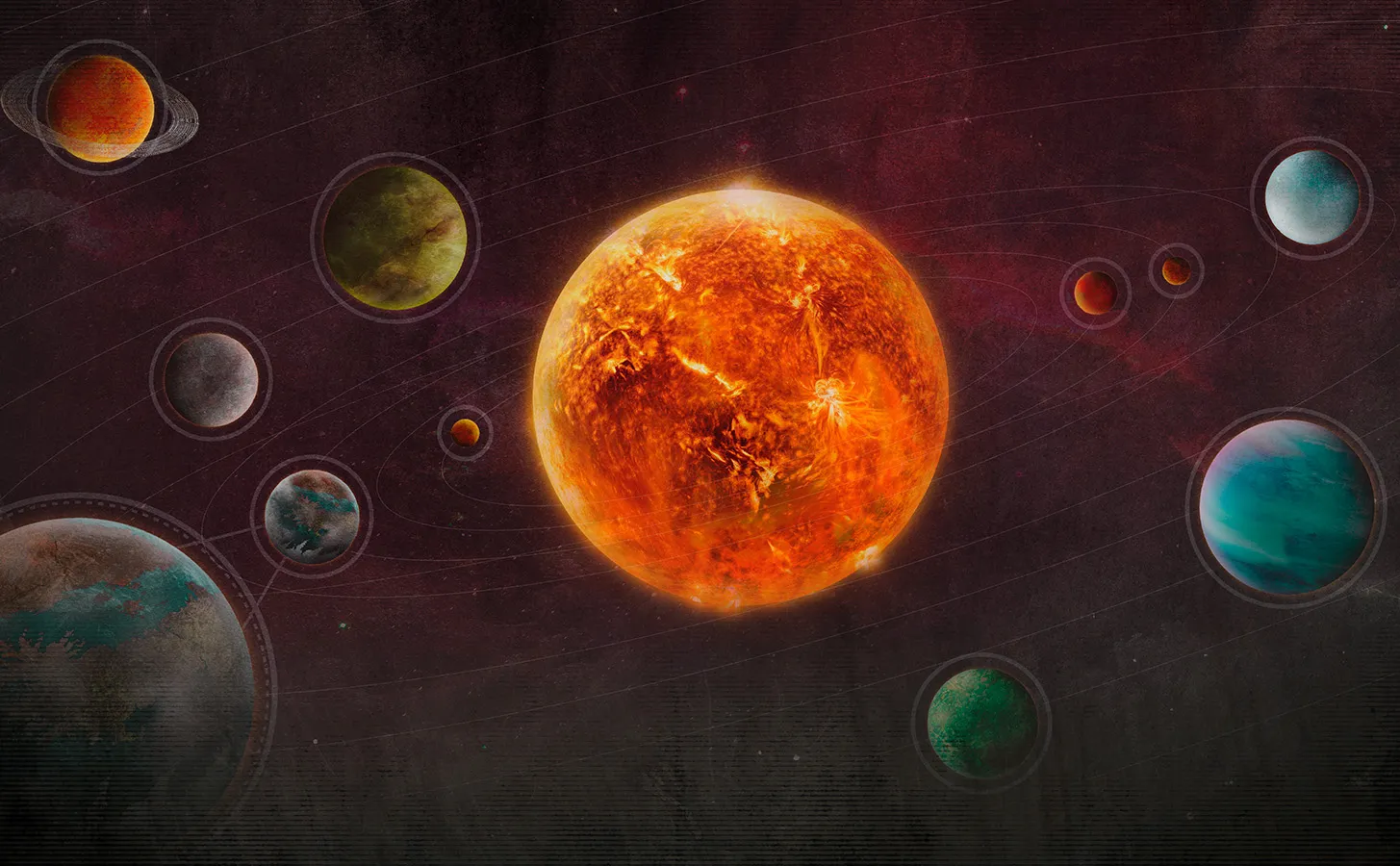
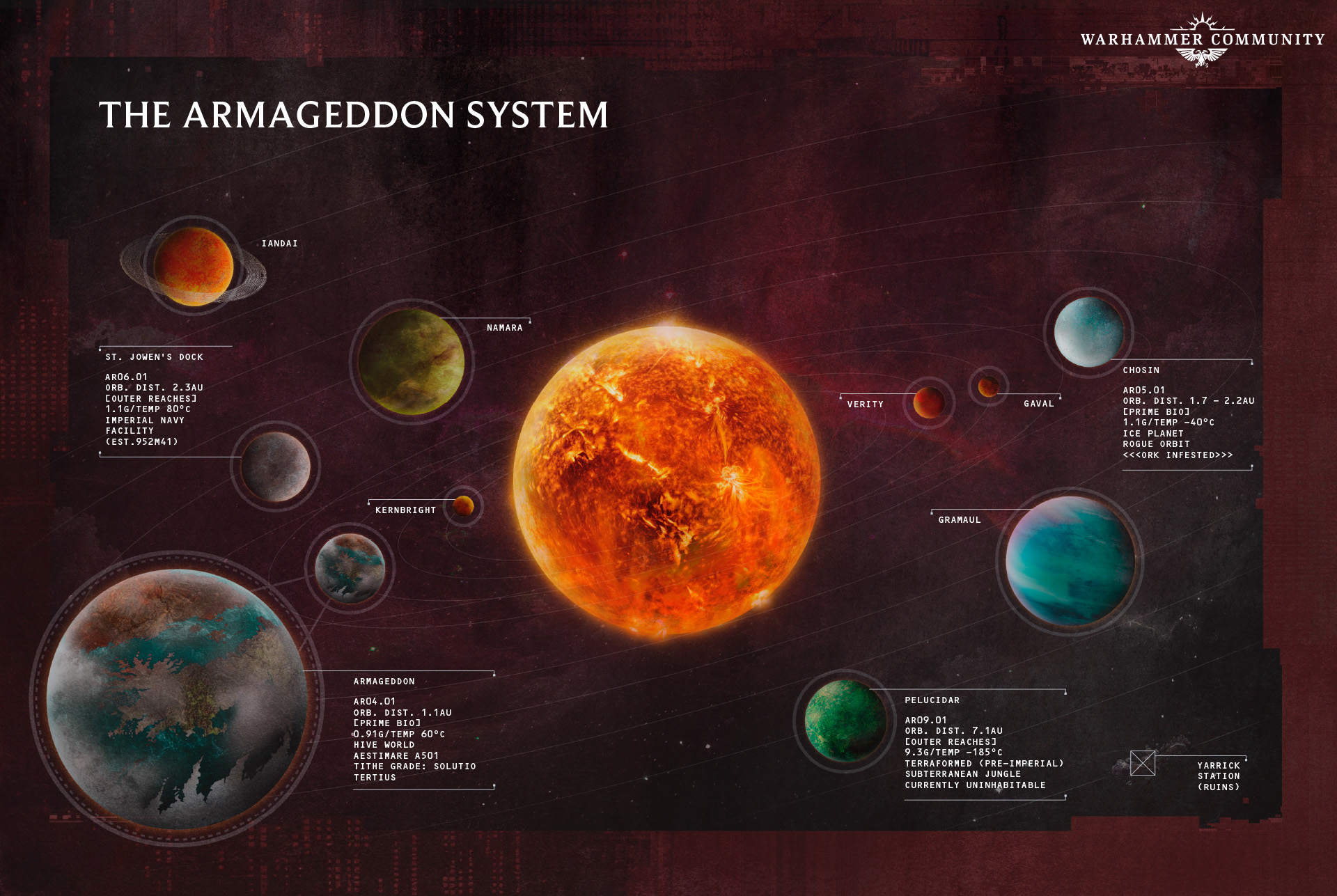
Almost nobody talks about the fact that Armageddon is one planet of ten. The Armageddon System has a star, Tisra, and nine other worlds orbiting it, and every single one of them has some kind of story nobody ever tells.
Here’s the roster, roughly sunward to outward:
- Kernbright, Verity, and Gaval: the inner worlds, cooked by Tisra.
- Armageddon itself.
- Chosin, feral-Ork-infested and possibly structurally wrong.
- St Jowen’s Dock, the naval hub.
- Two gas giants, Namara and Gramaul.
- Pelucidar, a death world with a secret.
- Iandai, a ringed gas giant whose ring is now a minefield.
Most of these have about a sentence on the wiki. GW’s article is actually the most cohesive description of the whole system I can remember reading, and I’ve been poking around Armageddon lore since the 3rd Edition codex.
The Planets That Predate the Imperium
Three of these planets have features that don’t make sense through normal Imperial worldbuilding. They make sense if you assume somebody, not human, or not recently human, was there first.
Pelucidar is the obvious one. The surface is sulphuric, volcanic, and lethal. Inside its caves, there’s a lush ecosystem of vegetation that purifies the sulphuric air. GW’s text says some Magi Biologis think this vegetation was tailor-made for the environment in pre-Imperial times. That’s a hell of a throwaway line. Somebody genetically engineered a biome to live on an uninhabitable planet, in its caves, and then left. When Ghazghkull’s Orks tried to settle there during the Third War, they died. The ecosystem eats squatters.
Gramaul, the larger gas giant, has five moons, and the smallest one is the site of archaeological digs looking for what GW calls “the remains of a precursor civilisation.” In the 40K glossary, “precursor” usually means one of a small set of things. The Old Ones. The Necrons. Maybe the Aeldari. Occasionally something we haven’t met yet. GW doesn’t say which, which is the fun part, because it could genuinely be any of them. Armageddon is in the Segmentum Solar, close to Terra, so whatever left ruins on that moon did so in a part of the galaxy the Imperium is supposed to understand.
Then there’s Chosin and the displaced-core thing. I keep coming back to this. The wiki says the planet has an anomalous elliptical orbit that crosses Armageddon’s path multiple times per rotation. The best explanation for a core that isn’t centred is that it was moved, which is the kind of engineering only a hilariously advanced civilisation does. The Necrons have tomb-world tech that can reconfigure planets. The Old Ones could apparently do anything. Could also be that the Orks did it by accident, because Orks. I don’t actually know, and I suspect GW doesn’t either, but the implication is there on the page.
Having said that, I go back and forth on whether the precursor stuff is intentional or whether a writer just wanted to spice up the geography. 40K lore accumulates by accretion. Somebody in 1998 wrote “tailor-made ecosystem” as a throwaway and forty IP notes later it’s a Necron sleeper world. Maybe. Or maybe it really is one big haunted system and the signs have been sitting there the whole time. I keep switching positions on this by paragraph, which is probably why I like the article.
Imperial Compromise as Worldbuilding
The other thing I like about this article is what it tells you about how the Imperium actually operates.
Gaval is so hot that its surface sand melts during the day and cracks at night. The orbital workers call the refinery station “The Oven.” The Imperium mines it anyway, because the resources are good. That’s all of 40K in one sentence. You don’t get shore leave, the refinery will kill you, and nobody cares because the quotas have to be met.
Namara, the smaller gas giant, has atmospheric patterns described as hypnotic and headache-inducing. You would think, GW’s article says, that would be enough to stop people mining the solid core. Nope. They mine it anyway.
Iandai, the outermost planet, doesn’t have a moon, which means it can’t resupply scouting vessels. The Imperium’s response was to turn its ring into a minefield so Orks can’t hide there. That’s both a very sensible defensive measure and the sort of thing you only do if you’ve already decided a given star system is going to be invaded, repeatedly, forever.
St Jowen’s Dock is my favourite. After Yarrick booted Ghazghkull off Armageddon in the Second War, the Imperium expanded the naval base into a full sector headquarters. Dockyards for battleships, a Naval Academy churning out officers, and command bunkers eight miles deep under Mount Ethan. The command bunkers are the tell. You don’t build bunkers eight miles down because you think the next war will go well. You build them because you already know the surface will fall.
The Monitor Stations and the 57-Year Gap
The Imperium also built three orbital monitor stations: Mannheim, Dante, and Yarrick. Named after people who defended the planet, which is fine, except Yarrick was a mid-ranking Commissar when the station was built and is still alive and complaining about his eye. Imperial institutions do not usually name infrastructure after living people. That’s a strong sign the psychological need to mark the Second War was overriding the usual paperwork caution. They wanted to memorialise what happened.
All three monitor stations were destroyed in the first stages of the Third War. This is the bit that actually haunts me, honestly. Fifty-seven years between the Second and Third Wars. Entire generations on Armageddon grew up in the rebuild. They reinforced the hives, refortified St Jowen’s Dock, seeded gravitic minefields through the system, and built these elaborate monitoring stations to get early warning. When Ghazghkull came back, the Ork armada of two thousand starships and twelve Space Hulks smashed through the whole early-warning network in the opening move. All that reconstruction, gone in solar weeks.
The Imperium’s problem is that it plans for the last war. The Orks plan for the next one.
I went down a rabbit hole on this last week, starting with the Mannheim station on Lexicanum and ending, three hours later, on an unrelated Necromunda article about gang-run orbital scrap. The 40K wiki is a gravity well. Set a timer.
Why This Matters for 11th Edition
OK, one news paragraph, because it’s why GW published this now. The new edition of 40K launches with the Armageddon boxed set, and GW is running this “Lore of Armageddon” series for the next few weeks in the lead-up. Part 1 is the system overview. Part 2 is apparently a surface map with all the hives and notable locations. Part 3 is presumably something like “and then the Orks show up.”
They’re doing it this way, I think, because GW learned a lesson from prior edition launches. You don’t just drop a boxed set and let the fandom figure out the setting. You pre-load the lore so that when the new Wazdakka Gutsmek and Commissar Yarrick models hit shelves, people already care about the place they’re fighting over. Armageddon’s been a 40K flagship since Codex Armageddon in 2000, but new players don’t know any of that. A weekly lore article series is how you catch them up without it feeling like homework.
On the actual gameplay side, the new modular detachments launching with Armageddon are going to reshape how people build armies for the campaign. If you want to dig into that, I’ve already written about it, and the system lore is honestly more fun.
What I Actually Want From Parts 2 and 3
Right so. What I want. Part 2 is the planetary map. I want the Equatorial Jungle between Armageddon Prime and Secundus, because that’s where General Kurov spent three decades doing xenocidal sweeps after the Second War and the Ork survivors kept surviving him. I want the ash wastes around the hives, which are just called “the ash wastes” like the writers ran out of names. And I want the Season of Fire properly mapped, which hemispheres catch it worst, which volcanic ranges are the most active, whether Hades Hive (where Yarrick lost his arm) is still standing or if the Third War finally took it down.
Part 3 has to cover the First War, or at least acknowledge its cover-up. The official canon is that the Inquisition suppressed the First War, a Chaos invasion, so thoroughly that most of the Imperium thinks the Second War was the first. If GW ignores this in Part 3, that’s a choice. If they acknowledge it, that’s a bigger story than Ghazghkull’s rematch. Probably they’ll pretend it didn’t happen and keep the focus on Orks. I’d bet money on that.
The Underread Bit
Look, I know this is a weirdly specific thing to care about. The reason GW’s Armageddon article is worth reading is because somebody on the lore team finally gave proper attention to the nine planets nobody models armies for. You can’t buy a Gaval refinery worker kit. You will never play a game set on Pelucidar’s precursor-engineered caves. The Gramaul moon archaeological dig is never getting its own boxed set. Those details are in the book now, though, and some Black Library author is going to pick them up eventually, and when they do we’ll have a whole new corner of the setting to argue about.
The war world gets the headlines. Read the other nine planets anyway. That’s where the weird stuff is hiding.