Imperial Armour Volume 9 has a page about the Maelstrom that I’ve reread more than any other Forge World page I own. It calls the place a point of constant interface between the real and the unreal. A warp storm near the galactic core, several hundred light years across, sitting there since before humans evolved, and stable enough that people actually live inside it. The Deathwatch reckon there are at least twenty major Ork infestations or petty pirate kingdoms in there at any given moment, all cheerfully murdering each other.
The line I stop on every time is the one about charts. Any warp chart of the Maelstrom is worthless. Locations don’t stay where you left them. Most of the savants who went in looking for a pattern went mad, and the few who came back with readable notes compared the thing to the breathing of a sleeping god.
That’s the region’s defence, and it’s been the region’s defence since long before the Imperium was a thing. Every serious attempt to bring the Maelstrom under control has foundered on the same problem, which is that a fleet can’t reliably find its way back to a system it took last year.
Black Library announced Claws of the Maelstrom this week, and the pitch is that a hive fleet is going in.
How a hive fleet actually crosses the galaxy
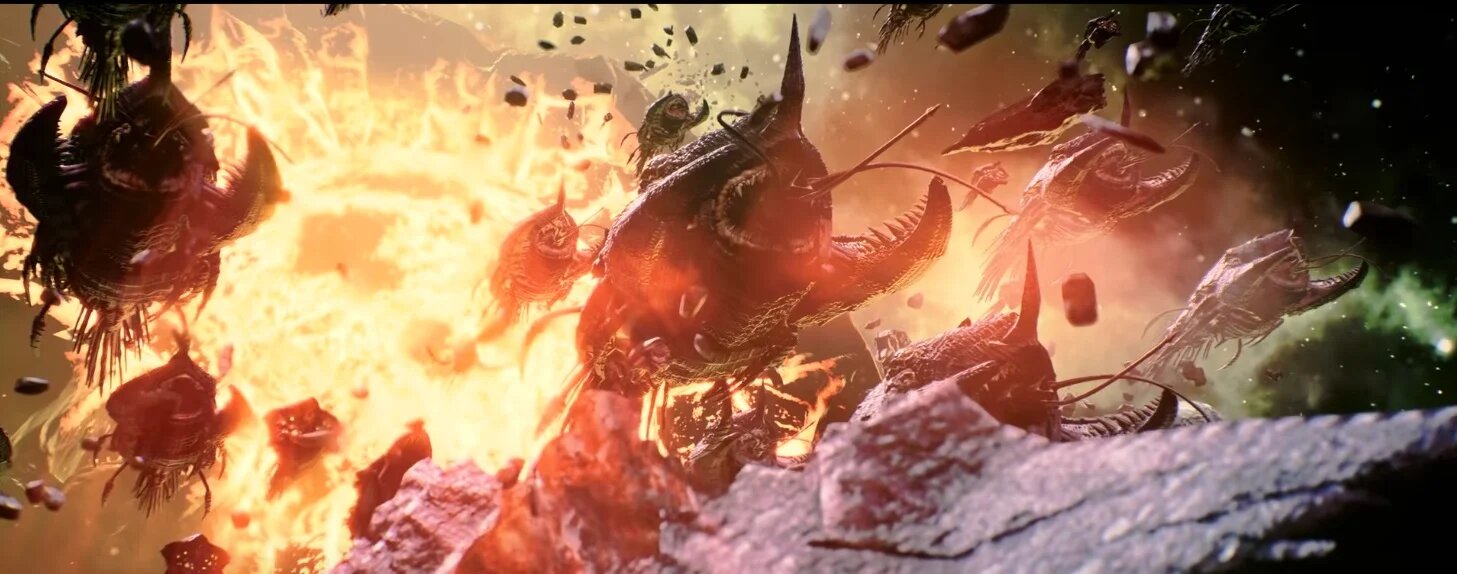
The Shadow in the Warp is such a loud piece of Tyranid lore that it colours how people picture the whole species. Their actual method of getting between stars is mechanical. Hive fleets travel using a bio-ship called a Narvhal, and Codex: Tyranids laid the mechanism out back in 5th edition: monofilament spines along the bow that read gravimetric signals across absurd distances, pick out a planetary system, then harness that system’s gravity into a corridor of compressed space the fleet travels down. The codex called it infinitely more reliable than proper warp travel and left it there.
Read that against the Maelstrom’s whole deal and you get something uncomfortable. Every defence that region has is a warp defence. Unreadable warp charts, tides that move, Navigators going blind or insane, a rift where realspace and the immaterium blur into each other. A hive fleet reads gravity instead, and the stars inside the Maelstrom have the same mass they’d have anywhere else.
There’s a nasty side effect to Narvhal travel too. Between the moment a Narvhal grabs a system’s gravity and the moment the fleet actually shows up, the planets in that system start coming apart. Earthquakes. Solar flares. Tidal waves. The defenders spend the run-up dealing with their own world turning on them, which is a lovely little detail that GW has never really needed to expand on.
What Claws of the Maelstrom is actually setting up
The book’s by Marc Collins, who wrote Helbrecht: Knight of the Throne and Krakenblood. It picks up after Master of the Maelstrom, with Huron having been shoved off the surface of Chogoris by the White Scars and still sulking about wanting a win over them. Then the shadow lands on his territory. Warhammer Community’s phrasing is that he has to “weave his tenuous web of allies into a protective net,” which is a genuinely funny way to describe what’s about to happen to him.
I’ll be honest that I can’t work out where the Chogoris raid actually happened in print. Master of the Maelstrom is Mike Brooks’s novel and it’s about Guilliman’s return and Huron’s own lieutenants circling him, no White Scars in sight. So either I’ve missed something in the Lair of the Tyrant narrative book or the Chogoris material is somewhere I haven’t read. If you know, tell me, because it’s been bugging me since Tuesday.
I bought the Tyranid half of the Leviathan box off eBay in 2023 from a bloke who had very obviously only wanted the Marines, and I painted eleven Termagants in the official Leviathan cream and purple before deciding I hated it. Stripped them in Dettol. Repainted them in a Kraken blue I’d mixed myself. Hated that too. They have now been sitting in a Really Useful Box in undercoat grey for three years, which is most of the time I’ve had the army, and every so often I take the lid off, look at my favourite awful boys, and put the lid back on.
What Huron actually has to trade
Huron’s authority over the Maelstrom is the authority of a man who takes a cut. Warhammer Community’s own description of it is intimidation, cutthroat bargains and mutual spite, which matches how the Red Corsairs have always been written. He extracts from those twenty-odd pirate kingdoms, and they stay extracted-from because the alternative is worse and because he can point them at something profitable often enough to keep the arrangement feeling voluntary.
Every party to that arrangement has an exit. An Ork warlord can go somewhere else. A renegade captain can defect, or run, or cut a side deal with whoever’s winning. All of it runs on there being a future worth negotiating over. The Great Devourer strips a world to bare rock and moves on, so there’s nothing left on the far side of the deal to bargain about.
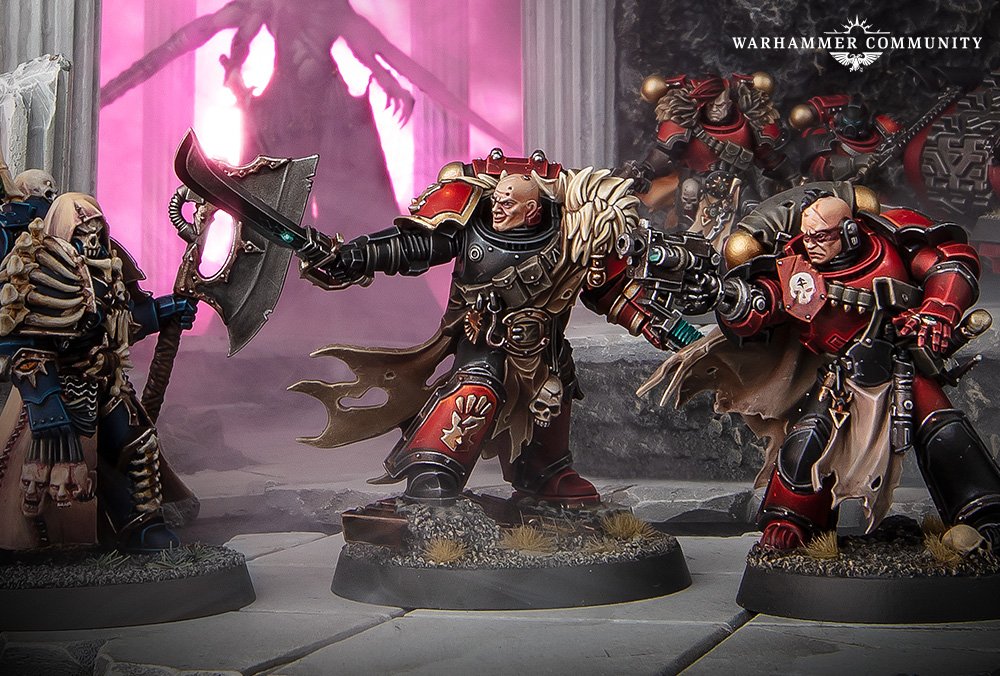
So yeah. Twenty pirate kingdoms, give or take. All in it for the cut. That’s the whole empire, that’s the thing Abaddon keeps propping up with gifts and favours, and it holds together because the cut keeps arriving on time. Bit thin when you say it out loud.
Kiran’s take, over a very long coffee on Sunday, was that this is the least interesting version of the story because Huron obviously wins, since Black Library isn’t going to eat a character they’ve just given a new model and a boxed set to. He’s probably right about the outcome. He plays Death Guard so he’s constitutionally incapable of believing any Chaos protagonist is in real danger. What he did concede is that the interesting question is what’s left of the arrangement afterwards, because holding the system and keeping the allies who watched you hold it are two different problems. He then spent ten minutes on his Death Guard list and I stopped listening.
It’s a bit like a shared house with a mouse problem. The mice get dealt with inside a fortnight. The housemates remember exactly how everyone behaved about the mice, and somebody moves out in March.
Hive fleets eat each other
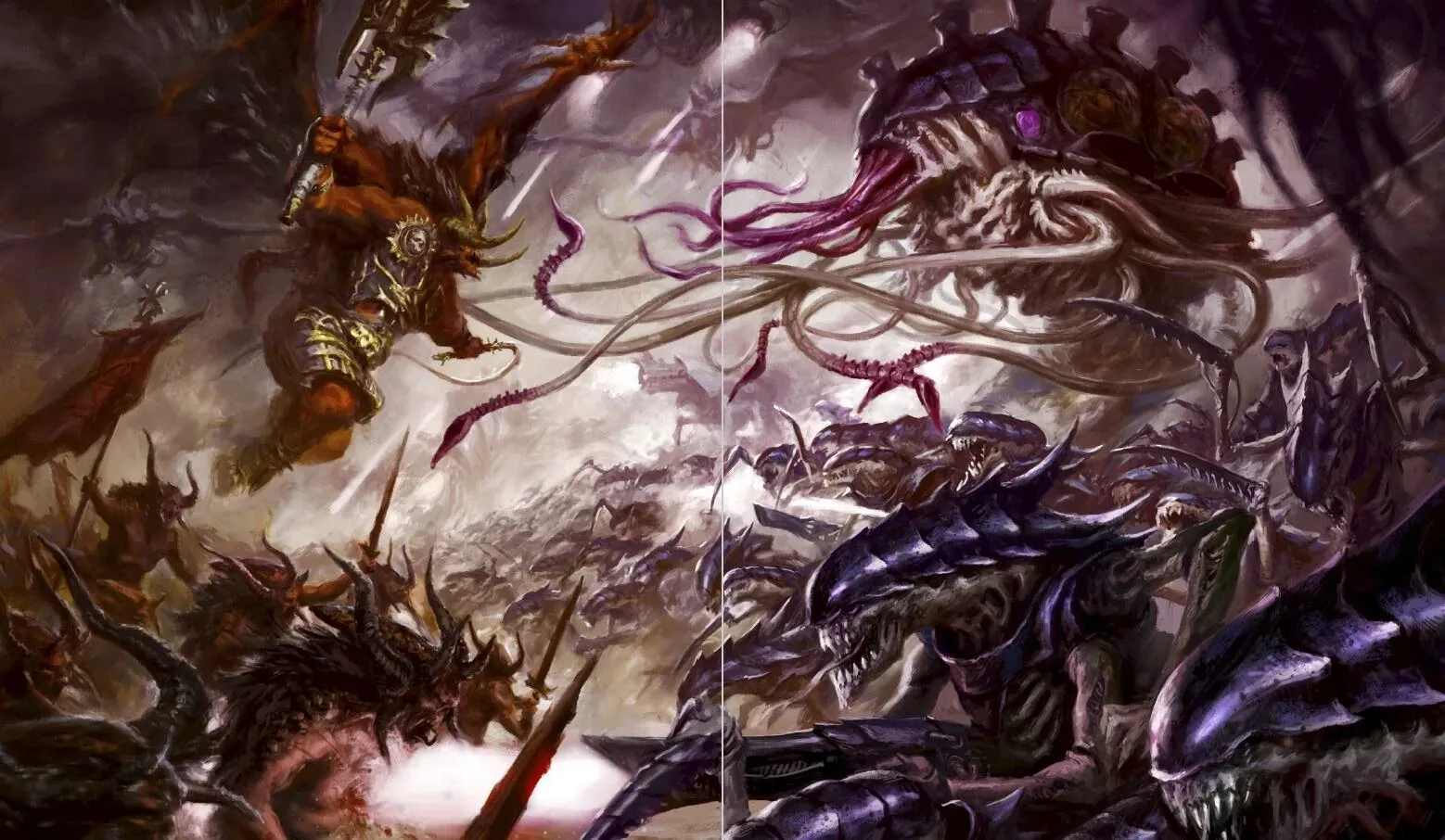
The Valedor campaign book has a sequence I think about a lot. Kraken splinter swarms come bounding across the plains toward the Leviathan swarms already feeding on the planet, with the express intent of harvesting biomass, Tyranids included. The Eldar’s entire plan for the battle is to keep the two swarms apart, because if the biomass merges in the same acidic digestion pools, the bio-ships get both hauls for free.
Then there’s Hive Fleet Typhon, which White Dwarf 507 describes as coiling its tendrils around other hive fleets and sweeping in after their invasions to eat both the dead world and the other fleet’s bioforms, spending as little of its own biomass as possible. The same entry notes Typhon seeds large numbers of Genestealers before an assault, on the basis that anyone who flees carries the infestation to the next world along.
Octarius is the other case people reach for, and the Dark Krakens have watched that war grind for long enough to know it doesn’t resolve. The Orks feed it. The Tyranids feed on it. Nothing about that region is a negotiation…
The bit I can’t resolve
I lose confidence in this argument at exactly one point. Narvhals navigate by reading gravimetric signals, and they have to drop to conventional propulsion on final approach because strong gravitational forces jam their senses. The Maelstrom is described as a place where physical law is unreliable and stellar material has been churning in a slow gyre for longer than the species has existed. That is not obviously a legible gravitational environment. It’s plausible that a Narvhal going into the Maelstrom is as blind as a Navigator, just for different reasons, and that the whole thing I’ve built here falls apart.
Except I don’t quite believe it, because gravity is a property of mass sitting in realspace, and however weird the Maelstrom gets, the stars in it still have mass. Warp turbulence doesn’t move a sun. I’ve gone round on this twice while writing and landed back where I started, which probably means I’m too attached to it. I did once spend the better part of an hour at a club night arguing that the Hive Mind can’t be considered a psyker in the codex sense, loudly, in front of people, and I was completely wrong, so my track record on this specific faction is not spotless.
The other thing I keep circling is what a Chaos empire even represents as a food source. Ten thousand years of daemonic incursion and mutation means the Maelstrom’s biomass is not ordinary biomass. Tyranids adapt to what they eat, and they’ve done it before with Ork corpses and Space Marine gene-seed. I have no idea what a hive fleet does with a population that’s been marinating in the warp for millennia and I doubt Collins is going to answer it in one novel, but somebody should.
The book doesn’t have a date yet beyond “very soon,” and the Special Edition has the black and red cover with the blood-soaked page edges, which is the format Black Library has been doing for the last couple of years and which I’ve never once managed to buy before it sells out. Last month my local store had exactly one Special Edition on the shelf, of a different novel entirely, and it was still there because it was ninety quid. So maybe I’ll get lucky this time.