If you’ve read Dan Abnett’s Saturnine (and if you haven’t, go do that), you’ve encountered the Saturnine-pattern Terminator armor. It’s one of the most interesting pieces of wargear in the lore because it wasn’t made on Mars. It came from the tech-enclaves of Saturn, secretive facilities that produced equipment rivaling (and sometimes surpassing) anything the Adeptus Mechanicus could manage.
To really appreciate what makes Saturnine armor special, you need to understand the broader family of Terminator armor patterns and how they differ from each other. Tactical Dreadnought Armour, the formal designation for all Terminator suits, has always been the heaviest infantry wargear in the Space Marine arsenal, but the various patterns each have distinct design philosophies and battlefield roles.
The Standard Patterns: Indomitus, Cataphractii, and Tartaros
The Indomitus pattern is what most people picture when they think of Terminators. It’s the one you see in the 40K game, the one with the iconic crux terminatus on the left shoulder. Indomitus armor is a compromise between protection, mobility, and manufacturability. It’s not the toughest, it’s not the fastest, but it can be produced in reasonable numbers and maintained by Chapter Techmarines without requiring lost knowledge. That reliability is why it survived ten thousand years while other patterns faded into relic status.
Cataphractii armor trades mobility for raw protection. The overlapping layered plates give it the highest defensive rating of any standard Terminator pattern, but the weight means Cataphractii Terminators move noticeably slower than their brothers in other marks. During the Heresy, Cataphractii suits were often deployed for boarding actions and siege assaults where speed mattered less than the ability to absorb punishment. The Iron Warriors and the Imperial Fists both favored them for exactly the kind of grinding, attritional warfare those Legions excelled at.
Tartaros pattern goes the other direction. It’s the sleekest of the Terminator armors, with lines that echo standard power armor more than the other Terminator marks. Tartaros wearers can actually run, which sounds unremarkable until you’ve watched a Cataphractii Terminator try to cross an open field under fire. The trade-off is less protection, but for Legions that valued speed and aggression, like the White Scars or the Raven Guard, Tartaros was the preferred option when Terminator armor was needed at all.
The Saturnine pattern sits outside this standard progression entirely. It wasn’t part of the Mechanicus production pipeline, and its capabilities exceeded all three standard patterns in ways that made the Martian priesthood distinctly uncomfortable.
Origins Cloaked in Mystery
Unlike most of the Imperium’s sacred wargear, the Saturnine pattern was not the fruit of Martian forges. Its true genesis lies with the clandestine technocratic enclaves of Saturn—enigmatic repositories of forbidden knowledge, hidden away even from the prying lenses of the Omnissiah’s disciples. Their craftsmanship produced warplate that not only rivalled Mars’ finest, but in many ways surpassed it.
First fielded in the dying days of the Unification Wars, Saturnine armour represented a quantum leap in protective battlefield technology. Yet, its complexity would also be its curse: difficult to produce, even harder to repair, and reliant on technologies barely understood even by its creators.
The Saturnine Terminator Armour: Walking Fortresses
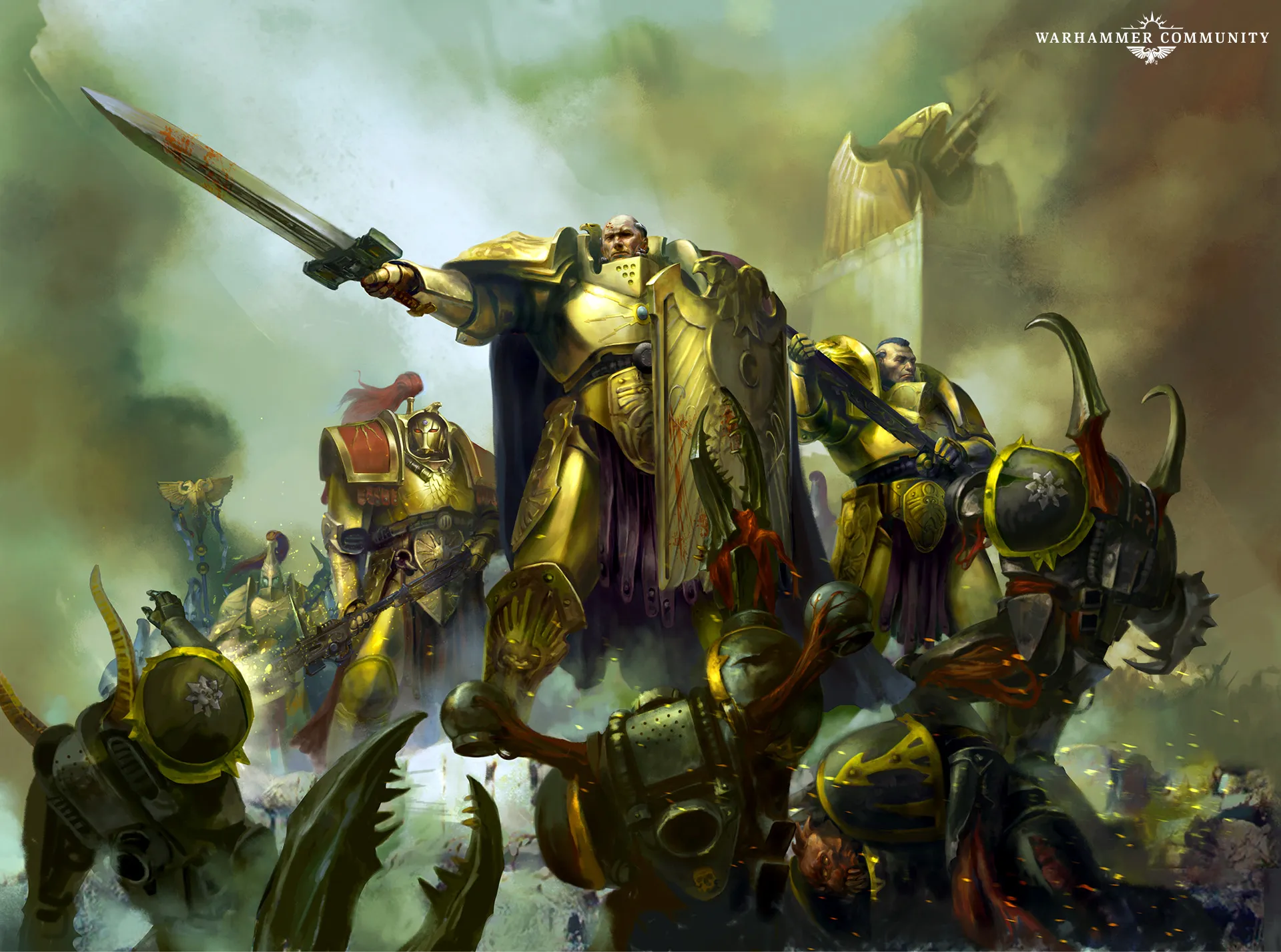
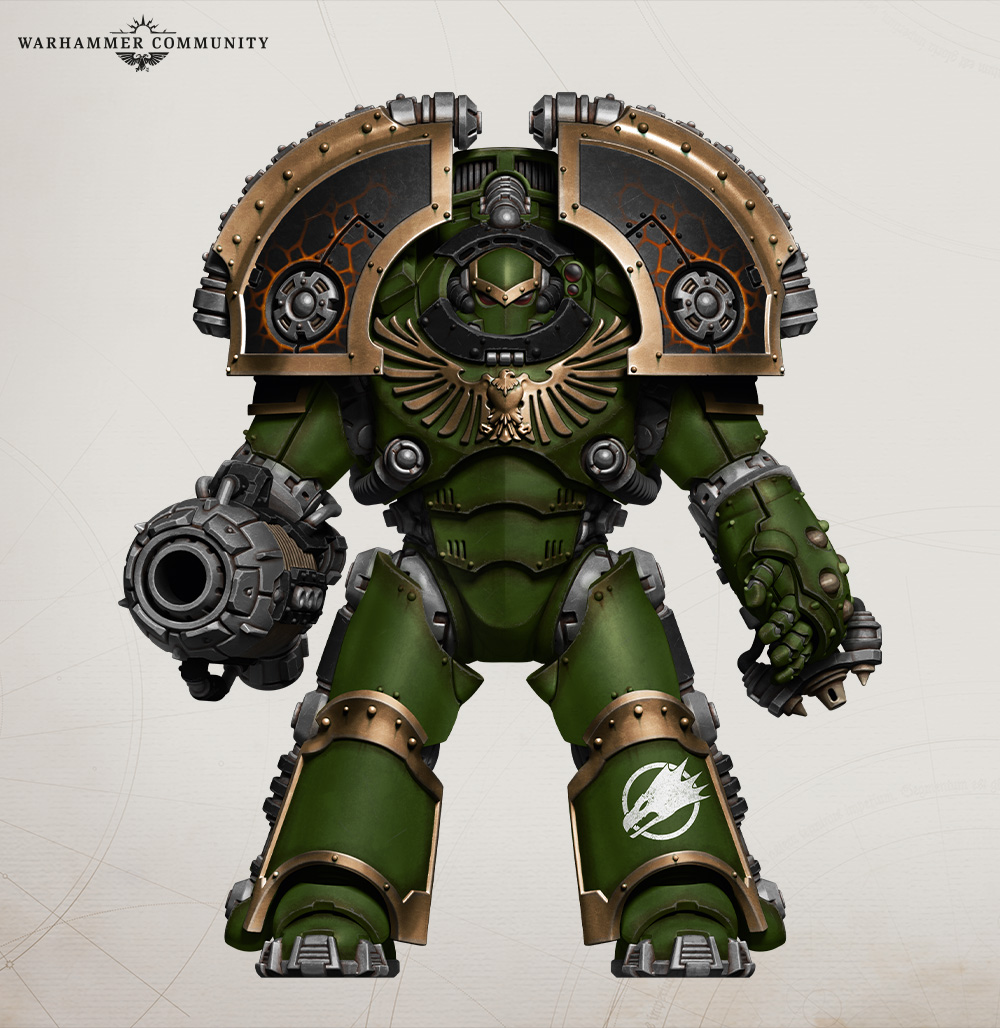
Astartes clad in Saturnine Terminator Armour are less warriors than walking fortresses. Larger than any standard Legion infantry, they tower over their brothers, encased in layered plates of ablative ceramite, reinforced adamantium, and a secondary exoskeletal frame. Sloped plating and heat-diffusing systems known as Thermal Diffraction Fields grant Saturnine armour resistance to even the most extreme battlefield conditions.
This is not armour for stealth or speed. It is slow, ponderous, and unmistakably imposing. But its bearers are near-impervious, wading into gunfire that would annihilate a lesser soldier. Teleportation synchronisers mounted in the massive pauldrons link with battlefield officers, allowing these giants to emerge from the ether in the heart of the fray, where their immense bulk and overwhelming firepower can turn the tide.
For armament, the Saturnine pattern is unmatched. From twin-linked heavy disintegrators to plasma bombards and disruption fists that can shear through bunkers and battle tanks, this warplate is designed not only to endure punishment but to return it tenfold. In some variants—particularly among the Salamanders—additional back-mounted weapons have been observed: lascannons, missile launchers, volkite culverins, even conversion beamers.
Perfection Through Vulkan’s Vision
Although Saturnine suits were seen early in the Great Crusade, their rarity limited their deployment. It was not until Vulkan, Primarch of the Salamanders, rediscovered and refined the technology that Saturnine plate saw true prominence.
A master craftsman and peerless artificer, Vulkan recognized the potential locked within the Saturnine designs. With his help, the armour was stabilized, refined, and mass-produced—if only briefly—before being shared across the Legiones Astartes. Vulkan’s generosity, however noble, would come to haunt him. When the Horus Heresy erupted, his gift meant that Traitor Legions too now possessed these near-invincible suits.
Even so, the Saturnine Aquila, emblazoned proudly across the chestplate of each suit, marked its wearer as a paragon of the Legion—a symbol of defiance, unity, and martial supremacy.
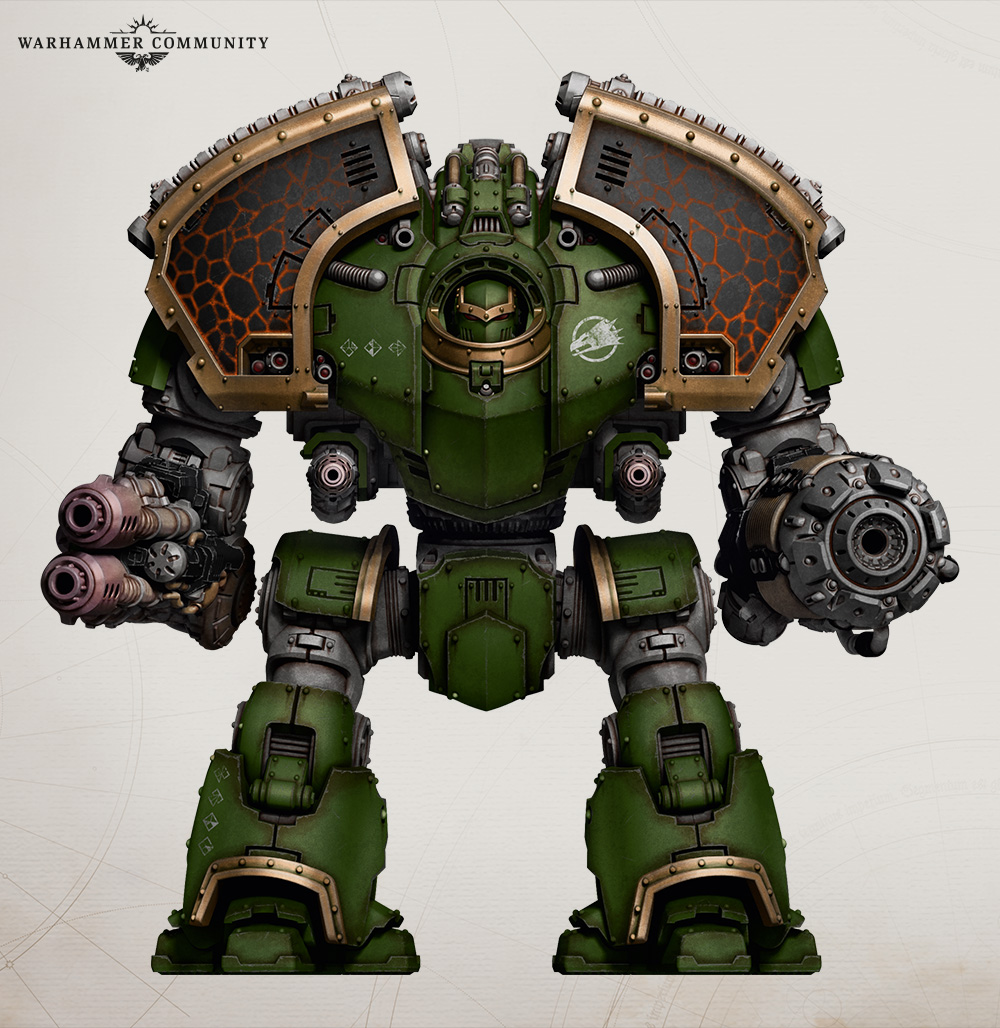
The Saturnine Dreadnought: Engine of Ruin
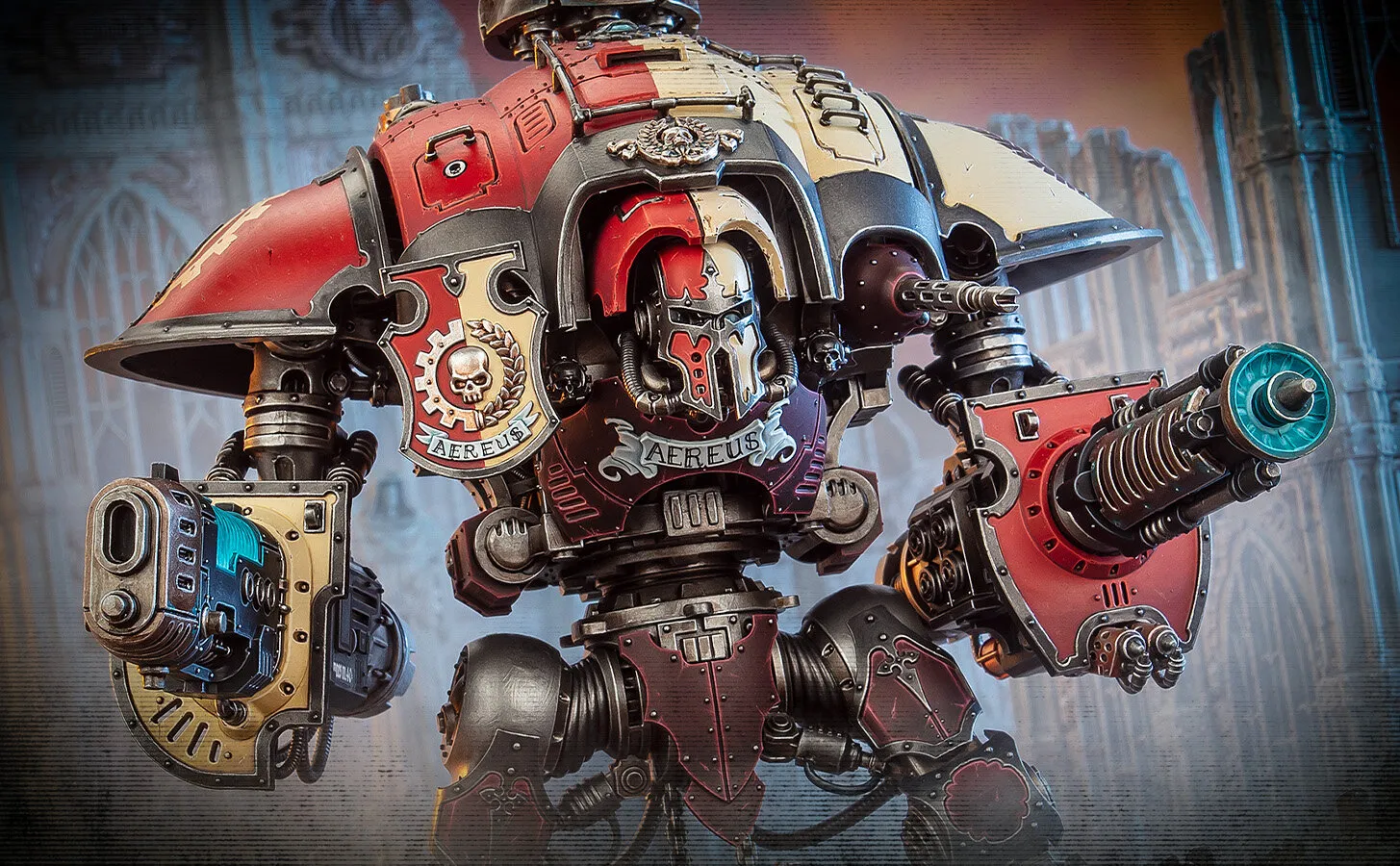
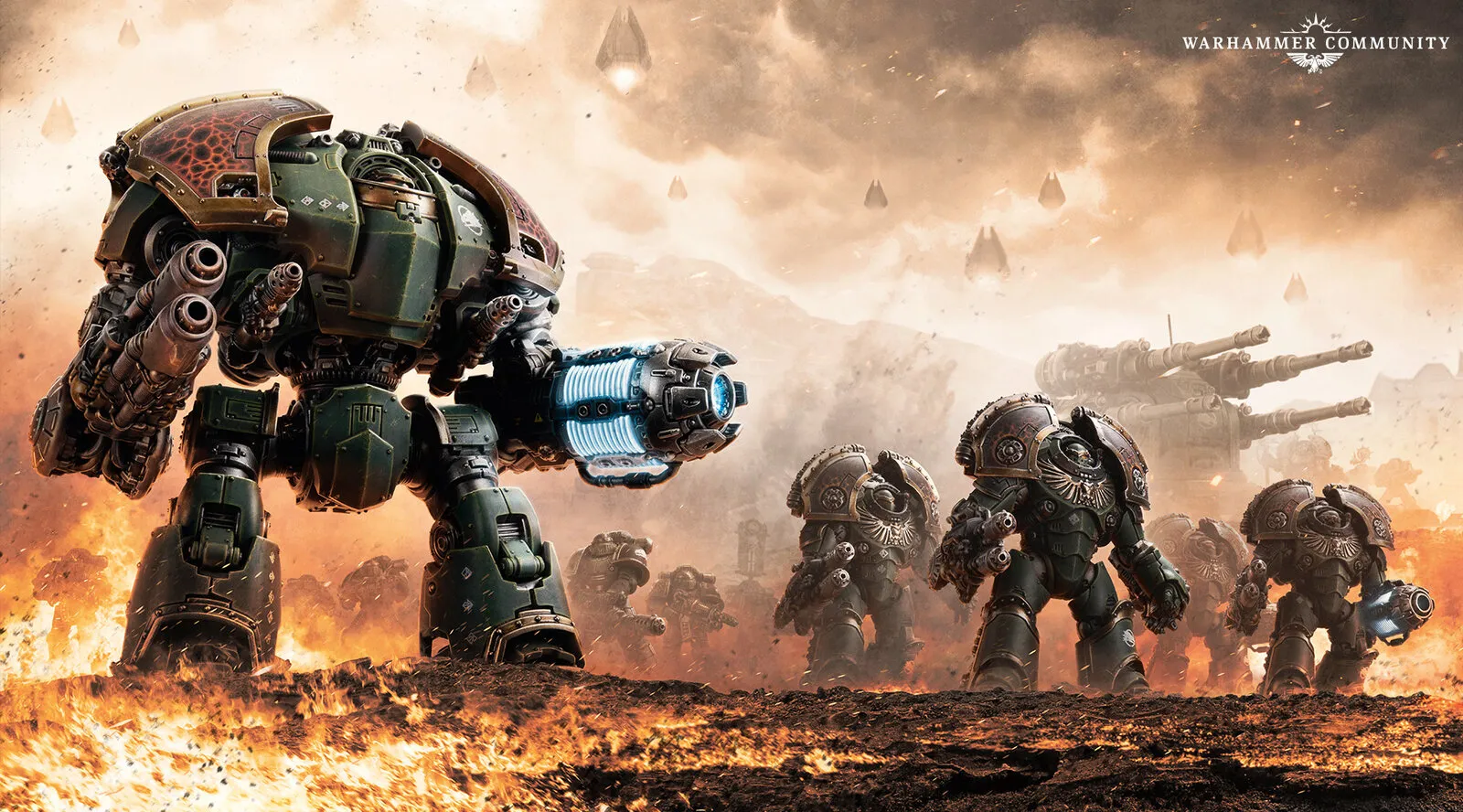
As awe-inspiring as Saturnine Terminators are, they pale in comparison to the behemoth that is the Saturnine Dreadnought. Standing taller even than the already fearsome Leviathan-pattern, this dreadnought is less a sarcophagus and more a mobile fortress, a monument to violence and engineering.
Its warframe is impossibly dense, its plating thicker than tank hulls, and its reactor core capable of supporting weapons once reserved for voidships. Among its armaments are heavy plasma bombards, photonic incinerators, and disintegration cannons capable of stripping flesh and ceramite alike down to atoms.
Its protective technologies echo those of the Terminator suits but on a grander scale. Enhanced Thermal Diffraction Fields allow it to operate in infernal conditions, while teleport synchronisers embedded in its pauldrons permit precision redeployment during battle.
But such power comes at a price. Only the most mentally fortified Legionaries—those with exceptional focus, clarity, and will—can endure the interface between mind and machine required to pilot a Saturnine Dreadnought. It is not simply a weapon, but a crucible for the soul.
What It Means to Be Entombed
This is a good point to talk about what Dreadnoughts actually are, because the concept is one of the most unsettling things in the entire setting. A Dreadnought is not a vehicle. It’s a coffin with guns. When a Space Marine is mortally wounded but too valuable to let die, the Chapter’s Apothecaries and Techmarines can inter his broken body in a Dreadnought sarcophagus, a life-support system that keeps him alive while neural interfaces connect his mind to the walker’s systems. The Marine’s body is shattered. He can’t walk, can’t fight, often can’t even see or hear without the machine’s sensors. But through the sarcophagus interface, he can pilot a war machine that hits harder than a tank.
The experience of entombment is described differently by different authors, but the consistent theme is isolation. Dreadnoughts spend centuries in dreamless sleep between deployments, woken only when the Chapter needs them. Each awakening is disorienting. The entombed Marine has to remember who he is, where he is, and what century it is. Some go mad. Others achieve a kind of grim serenity, accepting that they’re more weapon than person now. The oldest Dreadnoughts have been entombed for thousands of years, and their grip on their own identity can be tenuous at best.
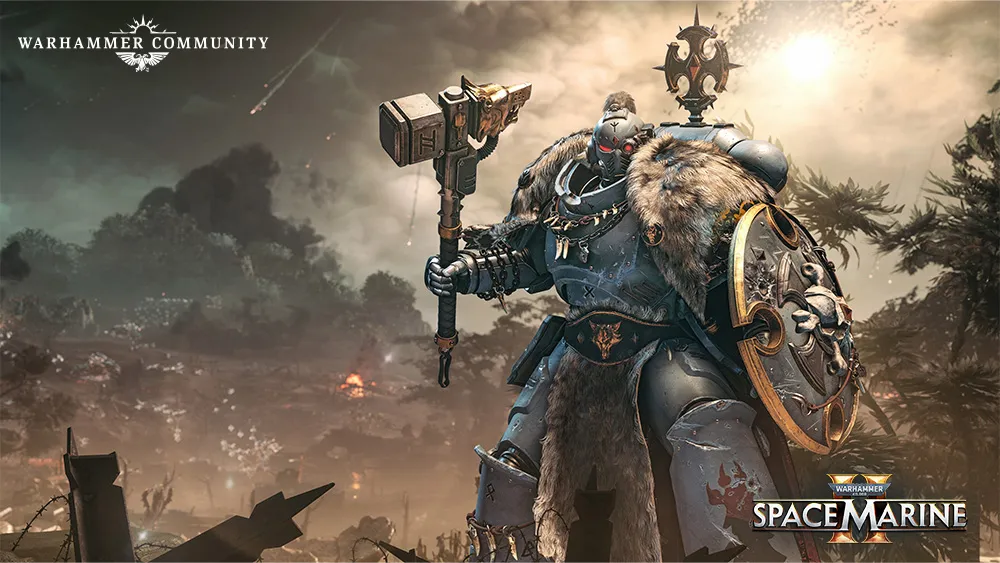
Bjorn the Fell-Handed of the Space Wolves is the most famous Dreadnought in the setting, and for good reason. He fought alongside Leman Russ during the Horus Heresy and is the oldest loyalist Space Marine still active. When Bjorn is woken, the entire Chapter gathers to hear him speak, because he remembers things that have been lost to history. He’s a living connection to an age that otherwise exists only in fragmentary records. The tragedy is that Bjorn doesn’t want to be woken. Every awakening reminds him of how much has been lost and how far the Imperium has fallen from the vision he fought for.
Then there’s Rylanor, the Ancient of Rites, an Emperor’s Children Dreadnought who refused to follow his Primarch Fulgrim into corruption. Rylanor survived on the virus-bombed surface of Isstvan III for ten thousand years, sustained by hatred alone, waiting for Fulgrim to return so he could detonate a virus bomb in the Daemon Primarch’s face. His story, told in the short story “The Ancient Awaits,” is one of the most powerful pieces of 40K fiction ever written. The community loved Rylanor so much that fans created a song in his honor that GW eventually acknowledged officially.
A Rarity Lost to Time
Despite its unmatched capabilities, Saturnine technology was doomed by its own brilliance. The complexity of its systems, the rarity of the materials needed for its construction, and the knowledge gap left by the fall of Saturn’s tech-enclaves meant that production dwindled rapidly after the Heresy.
Even at the height of the Great Crusade, the number of Saturnine suits in active use was limited. By the Heresy, they had become both prized relic and terrifying weapon, used by both Loyalist and Traitor forces in some of the bloodiest engagements the galaxy had seen.
Today, the Saturnine pattern is all but extinct. A handful of suits remain—relics stored deep in Chapter vaults, perhaps entombed with heroes of old, or awaiting the moment when mankind is desperate enough to wake its ancient terrors once more. Their presence on the battlefield is as much legend as reality, whispered of in hushed tones by those who believe such might can still be wielded.
The Saturnine pattern is one of those pieces of lore that makes the setting feel bigger. Not everything in the Imperium came from Mars. Not every piece of technology follows the Mechanicus pipeline. There were other centers of innovation, other traditions of engineering, and most of them have been lost. The Saturnine suits are a reminder of what humanity could build when different parts of the species were actually working on different problems, instead of funneling everything through one increasingly dysfunctional institution.
There’s a broader lesson in the Saturnine story about how the Imperium treats knowledge. The Mechanicus monopoly on technology isn’t just an organizational quirk; it’s a deliberate policy that has made humanity weaker. Saturn’s tech-enclaves produced innovations that Mars couldn’t replicate because they approached engineering from a completely different philosophical tradition. When those enclaves fell, their knowledge died with them, and the Mechanicus didn’t mourn the loss. If anything, the Martian priesthood was relieved to see a rival tradition disappear. The Imperium’s technological stagnation isn’t just a consequence of the Heresy or the loss of the Dark Age of Technology. It’s partly self-inflicted, the result of a culture that treats any innovation outside the approved channels as potential heresy.
The Dreadnoughts tell a similar story from the human side. The technology that keeps a shattered warrior alive and fighting is miraculous, but the cost to the individual is staggering. The Imperium treats its Dreadnoughts as weapons first and people second, waking them for war and putting them back to sleep when the fighting’s done. The fact that some of these entombed warriors have served for ten thousand years, dreaming in the dark between awakenings, is one of the most quietly horrifying details in the setting. It’s not dramatic horror. It’s institutional horror, the kind where nobody involved thinks they’re doing anything wrong.
If GW ever makes Saturnine Terminators as an actual kit (for Horus Heresy or 40K), I’ll be first in line. Painting Saturnine armor would be a project in itself, given the sheer surface area of those massive overlapping plates and the opportunity to weather them with battle damage that tells a story spanning centuries. Until then, they live in the novels and the lore, which is honestly where they’re most effective. Some things are better as legends.