There’s a line in the old Forge World aircraft book about Thunderbolt aces that I’ve never quite been able to put down. Few of them survive beyond one or two campaigns. The best pilots get handed the worst duty, the sorties where only an expert has any chance at all, and that is precisely why they don’t last. You become good enough to be worth sending somewhere lethal, so they send you there. That’s the entire career of an Imperial Navy fighter pilot, written into two sentences GW put in a book in 2007 and then mostly left alone.
So when the new Aeronautica Imperialis animation landed on Warhammer+ at the end of May, my first reaction wasn’t really excitement. It was something more like surprise that they were going to animate the bit where everyone dies in a cockpit. Three episodes, frozen world, Imperial Navy against the Aeldari of Craftworld Saim-Hann. Episode one went up on 29 May, the second is cleared for take-off on 12 June, and the whole thing is locked behind a Warhammer+ subscription, which is its own conversation.
Aeronautica Imperialis and the war 40K almost never shows
Think about how much of 40K you’ve actually seen depicted, across all the animations and games and box art, and then think about how little of it happens in the air. There’s a reason for that. The setting is built around two things the marketing loves: enormous armoured men, and tanks the size of houses grinding across a ruined city. The air war doesn’t fit either. It’s fast, it’s mortal, and the people fighting it are closer to WWII pilots than to anything you’d call a hero of the Imperium.
Aeronautica Imperialis as a tabletop thing has been around in a few forms. I’ve got the 2019 boxed game in a cupboard somewhere, the relaunched specialist game with the little plastic planes on flight stands and the cardboard altitude dials. Bought it the week it came out because the box art got me, played it maybe twice with Pete, then quietly let it become a drawer of unpunched component sprues and a rulebook I couldn’t fully remember. It’s a genuinely clever game. It’s also a game about a part of 40K that almost no fiction bothers with, which is maybe why it never grabbed a tenth of the attention that, say, Kill Team did.
That’s what makes the animation interesting to me before I’ve even judged whether it’s any good. GW chose to spend animation budget on the Imperial Navy. Not the Space Marines, who get an animation roughly every fifteen minutes. The Navy. Mortal aviators in a workhorse fighter, doing a job that the lore openly admits will probably kill them.
The workhorse
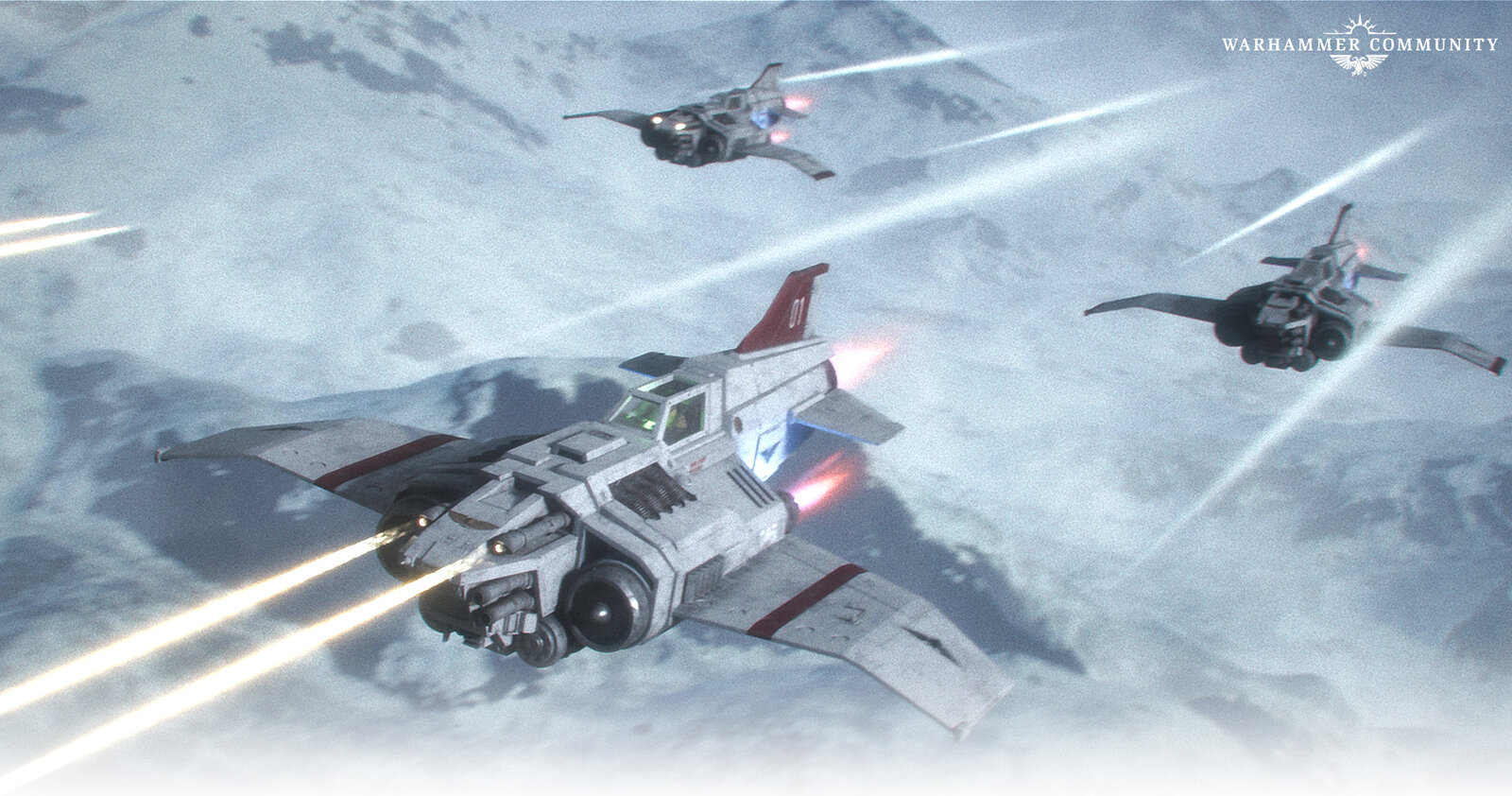
The plane at the centre of this is the Thunderbolt, and the lore on it is weirdly lovable. It’s the backbone of the Imperial Navy’s atmospheric fighter wings, a single-seater described over and over with the same words: rugged, dependable, versatile, well liked by its pilots. Quad autocannons in the nose, twin-linked lascannons for when it needs to crack a tank, hardpoints under the wings for Hellstrike or Skystrike missiles depending on what it’s hunting that day. It even carries a rocket booster that lets it punch up out of the atmosphere to dock with a mothership in low orbit, though it’s explicitly not a starfighter and isn’t meant to fight up there.
I find the small details more telling than the loadout. The pilots get issued a las pistol as a sidearm in case they’re shot down over enemy territory, and the lore notes that a lot of them don’t bother carrying it, because it’s bulky and the cockpit is cramped. Which tells you everything about the odds. If you go down, the pistol isn’t going to save you, so why give up the elbow room. The aircraft in the books all have nose art and kill markings the wing commanders pretend not to notice. One named example, Pilot Officer Ixan Muro, gets transferred into a squadron to fill combat losses, racks up enough kills to earn his own livery, and is then killed over a Tau base in the southern polar region of his planet. He’d been moved into that squadron to replace someone else’s dead in the first place.
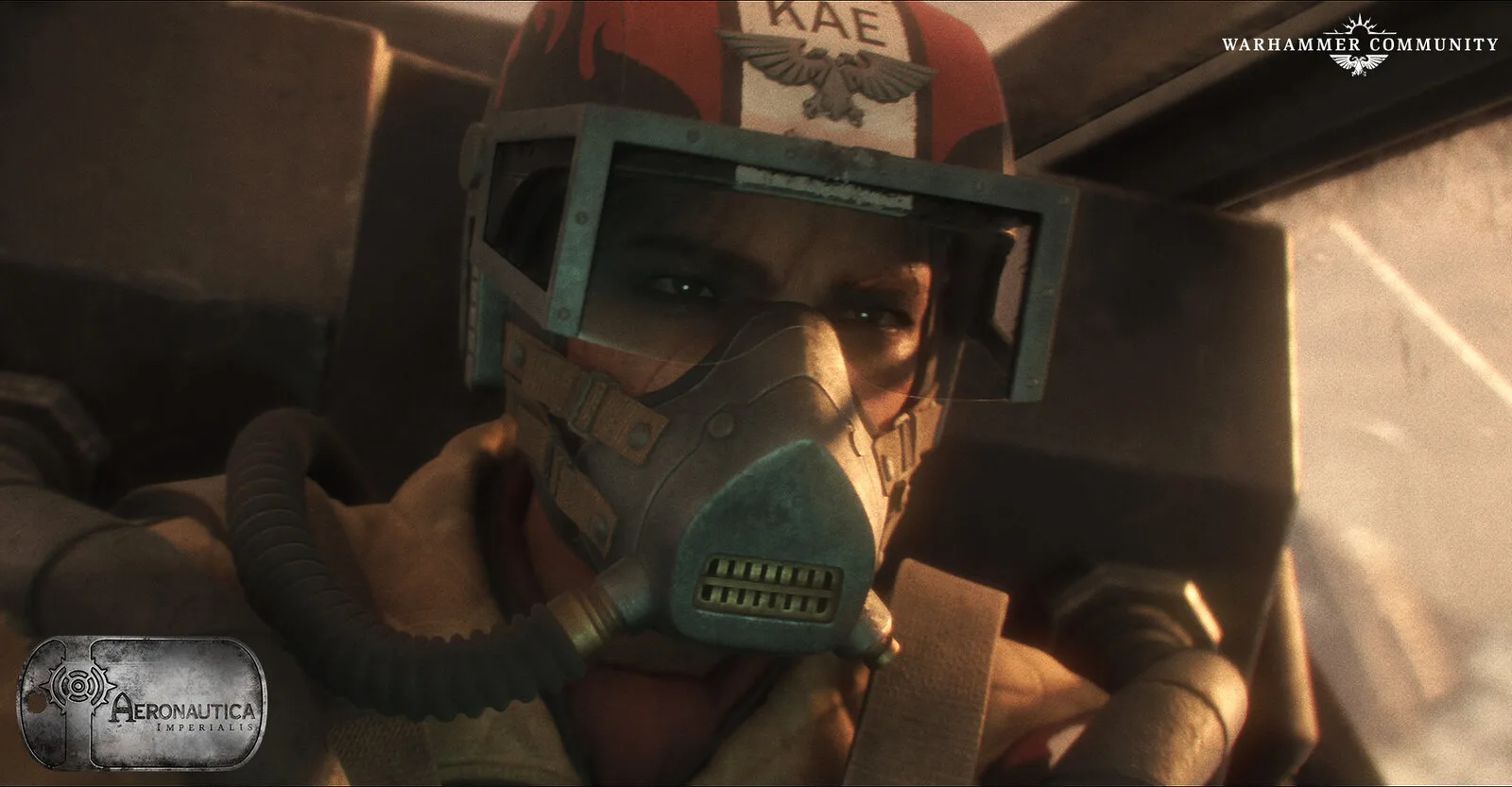
The Thunderbolt’s main role is air superiority, which in plain terms means clearing the sky of enemy fighters so the bombers and the ground forces can do their work. It can hunt Titans if it has to. It can strafe infantry. But the headline job is the dogfight, and the protagonist of the animation, an ace named Kae, is exactly the kind of pilot the old book was describing. Her Thunderbolt carries flames along the wings and a row of kill notches. GW’s own write-up of episode one is darkly funny about it: her wing has a notably high attrition rate among its crews. She’s the one who keeps coming back, which in a wing like that means most of the people she flew in with didn’t.
Saim-Hann doesn’t fight fair
Here’s where the choice of enemy starts to feel deliberate. GW could have put the Imperial Navy up against Orks, who fly held-together-by-faith contraptions that are dangerous mostly because there are so many of them. Instead they picked Craftworld Saim-Hann and the Nightwing, which is about the most lopsided matchup you could engineer.
Saim-Hann is the speed craftworld. Wild Rider Hosts, scores of jetbikes and skimmers, a culture built around riding headlong into the enemy faster than anyone can react. The Aeldari in general are a problem for the Imperium because they’re older, faster, and treat human pilots as something between an obstacle and a target. Saim-Hann turns that up. Their pilots often come up through the jetbikes before they ever touch an aircraft, so they arrive in the cockpit already fluent in the kind of velocity that breaks human reflexes.
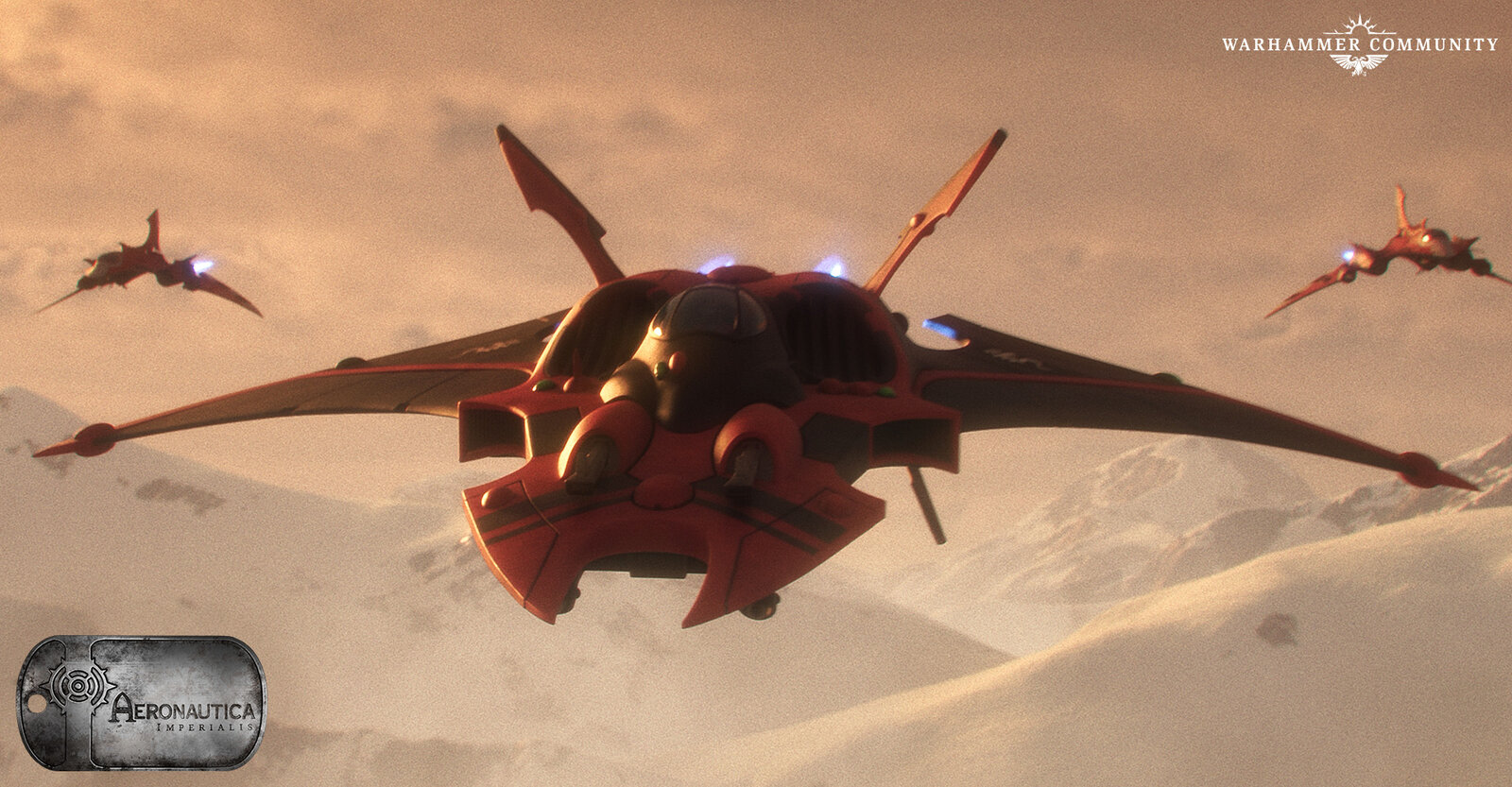
And the Nightwing is the pinnacle of what they fly. Swept-wing variable geometry, so it can fold its wings back to outrun anything the Imperium puts in the sky and then sweep them forward to pull turns and brake-manoeuvres that the lore flatly says most Imperial pilots consider impossible. No landing gear, because it sits on an anti-grav field and just hovers when it’s down. Holo-fields that throw out false images so you can’t even get a clean lock on it. Top speed somewhere around 3,600 kph. The animation names one of these Saim-Hann pilots, Idranith, and going by the trailers he spends his screen time doing things to a Thunderbolt that a Thunderbolt can’t answer.
So the Imperium loses the dogfights. That’s the part I keep coming back to. On a straight comparison of aircraft, the Thunderbolt is outclassed, and the show seems happy to admit it. What the Imperium has instead is numbers and a refusal to stop. Near-unlimited stubbornness, as the WarCom write-up puts it. You don’t win the duel against a Nightwing. You win by having more Thunderbolts than the Aeldari have patience, and by feeding pilots into the gap until the maths turns your way. Which is a grim way to run an air force, and an even grimmer thing to centre an animated drama on.
I should be honest that I don’t actually know how the series resolves any of this, because at time of writing only one episode is out and I’m not going to pretend two trailers and a press release add up to a full read on the thing. It might fumble the tone completely. Animations about doomed mortals can curdle into misery very easily.
Why the mortal pilot is the most 40K thing in 40K
But I don’t think it will, and the reason is that the mortal underdog is, weirdly, one of the things 40K does best when it bothers to try. The whole setting only has stakes because most of the people in it are ordinary. Take away the Space Marines and the god-engines for a second and what you’ve got is billions of normal humans being asked to hold a line they can’t possibly hold, against things that are bigger and faster and older than they are. A Cadian with a lasgun. A commissar who simply won’t die. A pilot in a metal box, outclassed by every alien craft in the sky, who keeps climbing back in because numbers and stubbornness are the only currency she’s got.
So yeah. The Navy. People forget it even exists half the time, because it lives between the Guard and the void fleets and gets none of the codex attention either of them get. Pilots in cramped cockpits. Sidearms they don’t carry. Kill notches on a hull that’s going to be a smear on a frozen plain by the third campaign. Old man Yarrick survives because he’s a legend. Kae survives because the wing keeps losing everyone around her and somebody has to be the one who didn’t. The setting rarely frames survival that bleakly, and I didn’t expect GW to spend money animating it.
Whether the animation earns any of this is a separate question, and one I can’t answer yet. Episode two drops on 12 June. That’s the one that has to prove the first episode wasn’t a fluke, and it’s the part of the story I actually want to watch.