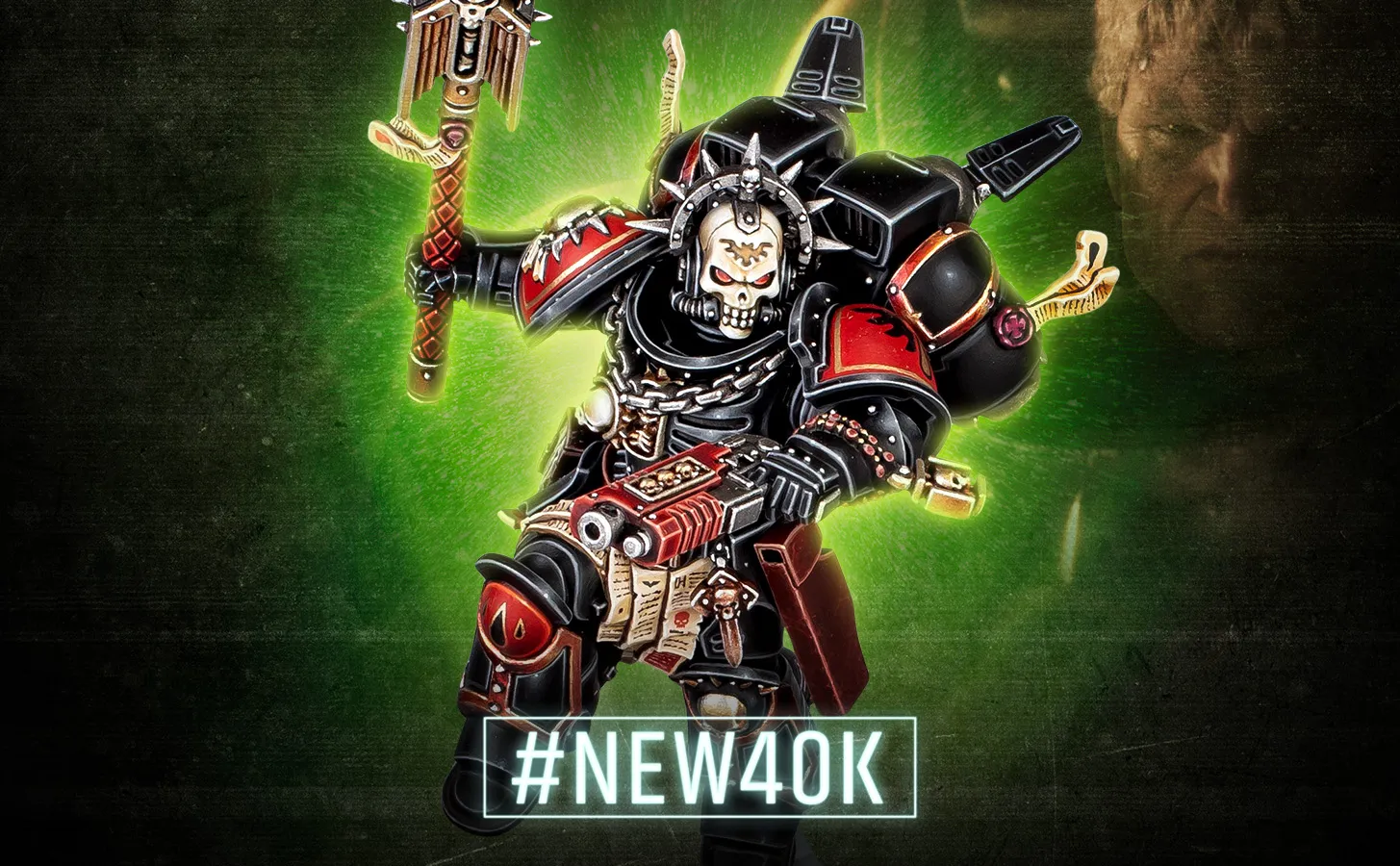
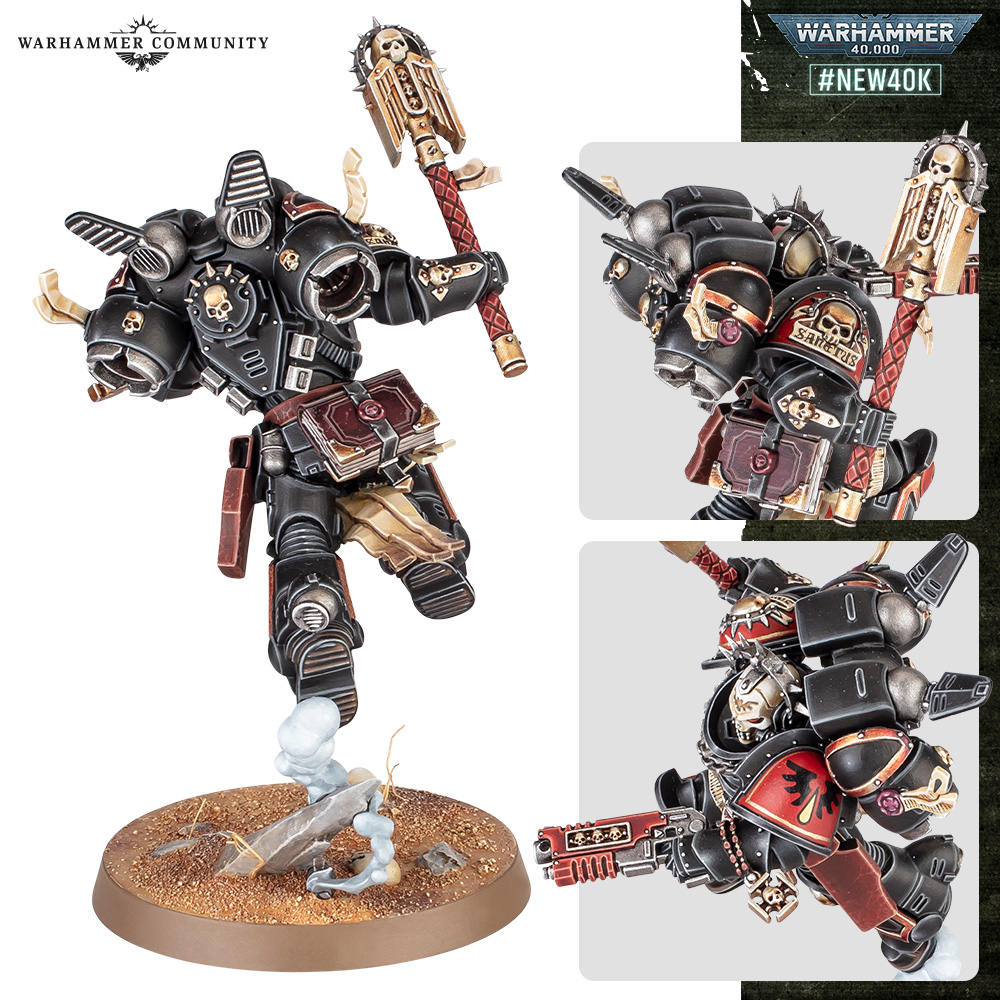
GW dropped the new Chaplain with Jump Pack on Monday and the community’s reaction has been almost uniformly positive. After the Vanguard Veteran (decent model, nothing that set the internet on fire) the Jump Chaplain landed and things seem to have clicked back into place. The smoke plume effect underneath him, the skull helm with the Iron Halo built tight into the cowl. GW confirmed he’ll have no chapter-specific markings, meaning any codex chapter can run him in their colour scheme. That matters a lot for armies that have never had a dedicated jump pack Chaplain as a kit option.
The lore origin, though, is worth understanding.
Lorgar’s Gift
The Chaplain role wasn’t the Emperor’s idea. During the Great Crusade, the Imperial Truth was the Imperium’s official doctrine: militantly atheist, hostile to religion, premised on the idea that humanity was moving past superstition as it spread across the stars. There were no priests in the Space Marine Legions at that point.
Lorgar invented Chaplains. His Word Bearers had spent decades converting newly compliant worlds to worship of the Emperor as a god (sincere, devoted worship, completely in violation of the secular Imperial Truth), and the Emperor’s response was to send Horus and the Luna Wolves to raze the city of Monarchia while the Word Bearers watched from their knees in the ash. Everything the XVII Legion had built on that world was demolished in an afternoon. Lorgar was told to stop. That moment is one of the early sparks of what became the Horus Heresy.
What happened next is that Lorgar secretly turned his Legion to the Ruinous Powers while putting on a show of compliance. But in the years before that unraveled completely, he’d already built something: a religious infrastructure within the XVII Legion. The Chaplain-Consuls wore black armour and skull-faced helms and carried a winged mace, the direct ancestor of every Crozius Arcanum carried by a Space Marine in the 41st Millennium. The skull-faced helm itself came from an older Legion tradition of heralds delivering ultimatums to unconquered worlds, so the skull as institutional symbol was already centuries old before any of this.
After the Council of Nikaea restricted psyker use across the Legions, Malcador the Sigillite, acting under the Emperor’s seal, ordered the other Primarchs to adopt Chaplains for their Legions. Morale, ideological discipline, enforcement of the psyker ban were the stated functions. Most Primarchs accepted. Dark Angels, Emperor’s Children, Death Guard, World Eaters: all of them took on Chaplains built to Lorgar’s pattern.
So every Space Marine chapter that fields a Chaplain in black armour and a skull helm is fielding an institution that traces directly back to the most corrupted Primarch in the Legions. The death mask, the black armour, the exact shape of the Crozius all come from Lorgar’s vision of how a Legion should relate to faith. Games Workshop doesn’t really foreground that lineage in the current codexes, as far as I can tell.
I keep going back and forth on whether this actually matters in the way I want it to. Maybe it’s just a lore footnote. It doesn’t change how Chaplains play on the table, and there’s an argument that reading too much theological weight into the aesthetic lineage of a fictional army is the wrong kind of nerd activity. And yet the 40K setting runs on exactly this kind of dark irony, so I keep finding myself coming back to it anyway.
After the Heresy, when the Legions broke into Chapters in the Codex Astartes reorganisation, the Chaplain role survived largely intact. The Imperium was slowly becoming a theocracy with the Emperor as god and the Ecclesiarchy governing worship, and the Chapters, nominally outside Ecclesiarchy control, developed their own internal Chapter cults. Most are unique to their Chapter, often thousands of years old, and always tended by the Chaplains.
The Skull and the Men Wearing It
Chaplains have been in the game since 2nd edition at minimum, probably earlier in some form. Black armour, skull mask, a Crozius that can stave in a tank given enough swings. What they do has never fundamentally changed: they stand near your warriors, recite things, and eventually hit something very hard with a mace.
The skull is a tool pointed at the Chaplain’s own warriors. Astartes are modified to the point where their relationship with mortality shifts in ways the fluff is honest about. The Sus-an Membrane allows suspended animation, the Ossmodula hardens bone to near-ceramite density, and three centuries of surviving things that should have killed them eventually creates a certain distance from the idea of death as a real possibility. The Chaplain’s liturgies before battle include the names of the Chapter’s fallen specifically to interrupt that distance, and reciting those names before a battle is one of the oldest rites in the Adeptus Astartes.
I fell down a genuinely absurd rabbit hole about Chaplain variants about three years ago. I was trying to figure out whether Imperial Fists Preachers have a different relationship to the Chapter’s combat doctrine compared to a standard Chaplain (they do, sort of, it’s complicated, and I never actually got a clean answer) and somewhere around 1am I had about twelve browser tabs open and was reading about whether the Black Templars’ Emperor’s Champion is functionally a Chaplain-adjacent role and what that implies about the Templars as an institution. I’d completely forgotten what I’d originally been looking for. Tried to pick it back up the next day and gave up after ten minutes.
The Blood Angels have the most elaborate funerary dimension of any chapter’s Chaplain tradition: partly Sanguinius’s aesthetic legacy, partly the practical reality of the Black Rage and the Death Company, which gives their Chaplains a specific grim function. A Blood Angels Chaplain accompanying a Death Company brother through his last engagement, whispering the details of Sanguinius’s death to keep the marine present and functional rather than wholly consumed by the rage, is a role very specific to that Chapter. At Armageddon especially, where Blood Angels kept getting drawn back across the centuries, the Chaplains had a lot of that to manage.
The Rosarius, the refractor field built into the pendant at a Chaplain’s chest, stops shots that would punch straight through standard power armour. It’s there for practical protection, and it also means the Chaplain has to be inside the fight to carry any authority with warriors who’ve been doing this for centuries. Without the refractor field, that stance would end careers extremely fast.
Putting a Chaplain in a jump pack and sending him with Vanguard Veterans into the worst position on the board is just the logical extension of that. That’s not new to 11th edition. Chaplains with jump packs have appeared in various forms across multiple editions, but a dedicated, chapter-neutral kit for it has been missing for a long time.
The Model
I’ve been running a foot Chaplain with my Imperial Fists for two editions now, mostly because he’s actually painted and I refuse to feel bad about it. He works, he fits the force, he gets the job done. I have something like eleven boxes of grey plastic waiting in my hobby room and I don’t need to be adding to them every time a new character kit drops.
The Jump Chaplain is the first model in a while that’s made me want to build a new character. The smoke plume underneath him is the detail that keeps pulling me back. It shows him decelerating for landing, mid-action in a specific and legible way. The 2016 Blood Angels jump Chaplain was a good sculpt with a frozen pose; the smoke plume on this one is what fixes the airborne problem.
Pete (Salamanders player, finishes armies faster than I can finish individual characters) had already told me he’s grabbing the Armageddon box on launch day by the time I’d finished reading the reveal article. The Chaplain isn’t going up as a separate kit, at least not yet, so the box is the only way in. He’ll have it built and painted before I’ve picked a colour scheme. I’m not even annoyed.
GW confirmed no chapter-specific markings on this kit, which is the decision that matters most for hobbyists outside the Blood Angels range. Raven Guard, Salamanders, Iron Hands, any successor chapter with an assault focus that has never had a proper jump Chaplain option, all of them have one now. The reveal photos show him in Blood Angels red, and the visual debt to 2016 is obvious, but the intent is clearly broader than that.
He grants +1 to wound for his unit through the Litany of Hate, carried forward from 10th edition, which makes him a reliable combat buff for Vanguard Veterans in the Armageddon box. Specific litanies, additional special rules, point cost: none of that’s confirmed yet. GW is still drip-feeding information ahead of the June launch, as the whole Armageddon reveal cycle has been weekly drops rather than one big info dump.
Whether the broader Chaplain range gets attention alongside the 11th edition codexes, I genuinely don’t know. The foot Chaplain is showing its age, and the Bike Chaplain hasn’t been touched in years.