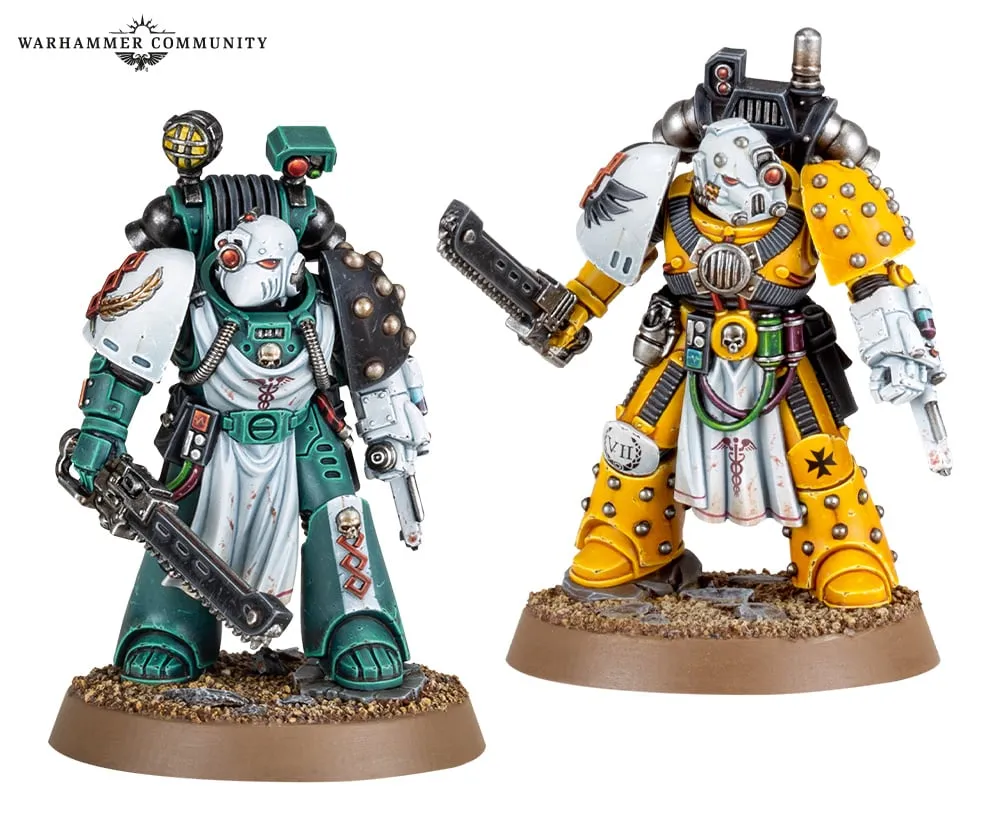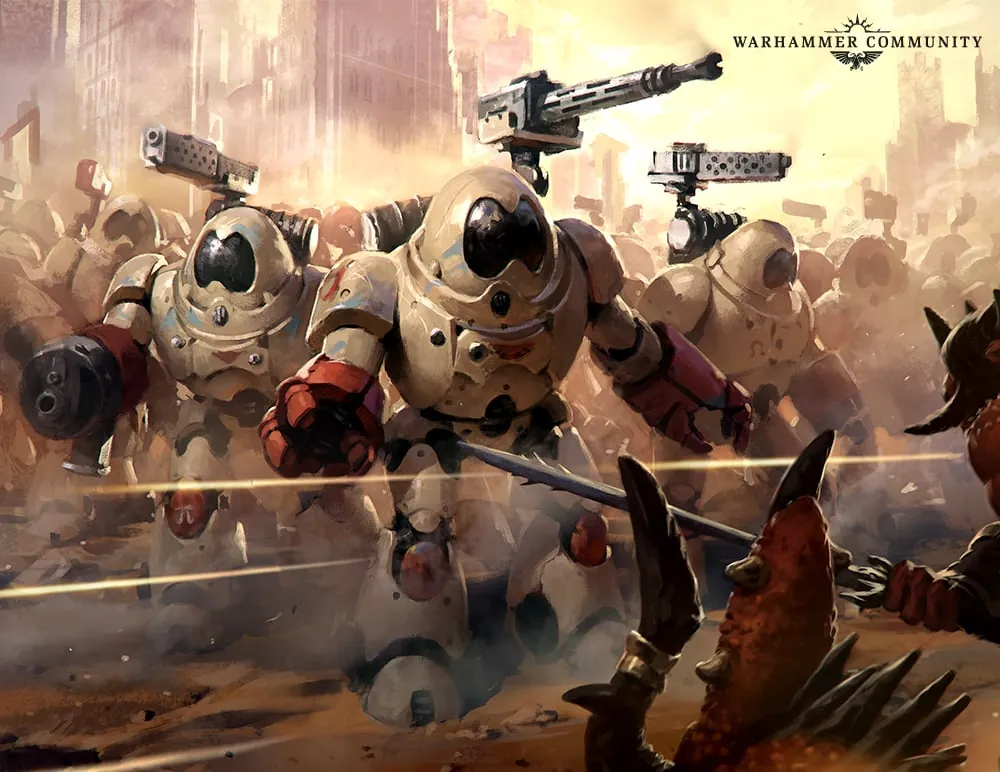
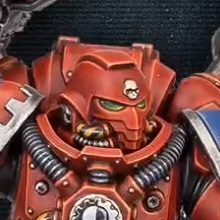
A Cybernetica Datasmith has to get a card into a slot behind a Kastelan Robot’s chestplate to change its instructions. I keep trying to picture that happening under fire. The Legio Cybernetica sends an armoured walking furnace into battle, then sends a much smaller priest after it with the next set of orders. There’s a drill on the priest’s model. Looking at the size of those fists, I’d want somebody to hold the robot still while I worked.
Goonhammer updated its Cohort Cybernetica article on 5 October, bringing the detachment back into the conversation around 11th-edition Mechanicus armies. Its assessment is favourable, particularly for a force built around robots and vehicles. The feature that caught me was the concentration of stratagems in the Command phase: you decide what your machines will need before the rest of the turn happens. That feels appropriate for a Datasmith with a chestful of prewritten routines to supervise.
The Kastelan’s programming is a practical expression of the Mechanicus fear of letting a machine think for itself. Then you read about the itinerants, ancient robots that appear at battles and depart afterwards, and the amount of control the priesthood actually has becomes harder to pin down. I touched on them in the machine-spirit article, but the detail deserves more space. It also needs a correction in emphasis: that wandering behaviour belongs to the itinerant accounts, and shouldn’t be applied casually to every Kastelan in a forge world’s inventory.
The Legio Cybernetica carries the orders in its pockets
The Lexicanum account of the Legio Cybernetica, drawing on Codex: Cult Mechanicus, describes the post-Heresy control system as sanctified doctrina wafers. They’re pieces of wetware about the size of cards from the Emperor’s Tarot. A Datasmith inserts one behind the robot’s chestplate, and its protocol determines the machine’s behaviour. The religious vocabulary is familiar, but the physical card is wonderfully specific. You can mislay it. You can put the wrong one in.
According to Lexicanum’s Datasmith entry, which cites Imperium Maledictum: Adeptus Mechanicus Player’s Guide, apprentices acquire plenty of examples of badly expressed orders causing trouble. I’m fond of that being part of the job. There’s a whole profession inside the Imperium whose formative experience is phrasing a command badly and watching a very expensive object obey it. I’d like to see the training grounds, particularly whatever survives around their perimeter.
The standard Kastelan description carries this obedience to its horrible endpoint. It’ll keep following an instruction even when doing so gets it destroyed. Lexicanum’s summary gives the example of a robot walking into a chasm unless its Datasmith updates its orders. That account traces the general description to the old Games Workshop product page. An instruction remains active until somebody supplies the next one, however much the terrain has deteriorated since it was written.
I originally thought the physical wafers were mostly a visual joke about old computers. They fit the robot’s curved armour and blank faceplate, that lovely slightly rubbish future where your enormous killing machine needs a cartridge. Reading the chasm example made me take the priest’s workload more seriously. He has to anticipate the situation, specify an adequate response, then physically intervene as the situation changes. I manage to send office emails with the attachment missing, usually remembering it just after somebody replies.
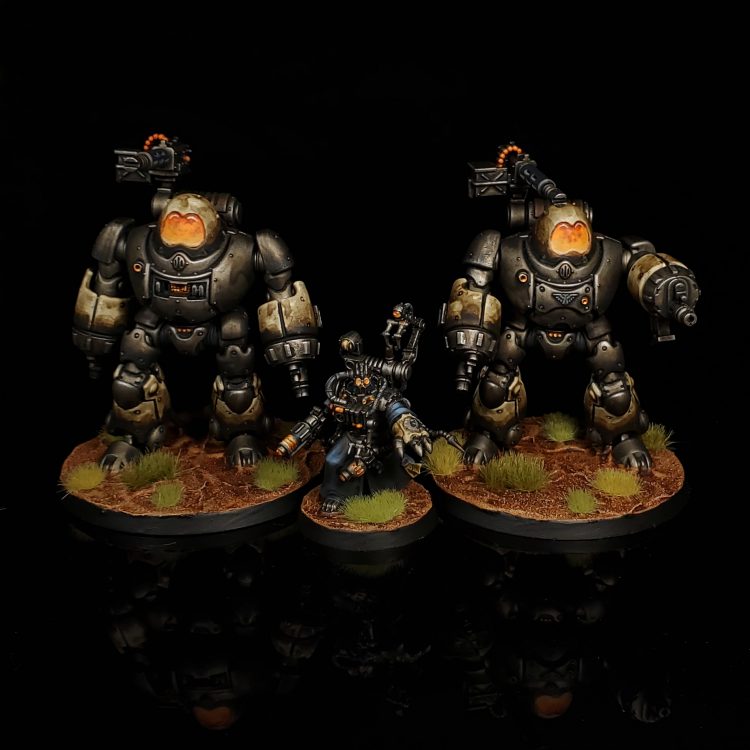 Kastelan Robots and Datasmith painted by Rockfish, photographed for Goonhammer.
There’s an emergency option. The ninth-edition codex’s Binaric Override, as summarised by Lexicanum, allows a superior priest’s static chant to force a change of orders while burning out the doctrina wafers. I like how inconvenient that is. You can get the machine to change course urgently, and you’ll have repairs to do afterwards. It suggests a system designed around a degree of restraint even its own operators sometimes find intolerable, with consequences for breaking through it in a hurry.
Some of this depends on which era of Cybernetica lore you’re reading. The older robot material describes a cortex made from synthetic proteins and enzymes, overlaid with combat wetware before battle. The seventh-edition Cult Mechanicus account emphasises the wafers used since the Heresy. Those descriptions come from different publications and address different parts of the system. I can’t give you a reliable cutaway showing how every generation of robot brain fits together, and I’d be suspicious of a neat diagram that claimed to settle it all.
The doctrine behind the machinery has a name: the Crimson Accords of Mars. Lexicanum traces these restrictions to the Mechanicum’s Age of Strife foundations, with The Horus Heresy Book Two: Massacre among its sources. The Accords prohibit the Silica Animus, the forbidden soulless intelligences, while permitting certain lesser forms of synthetic life. Battle-automata occupy an authorised place inside that distinction. There’s already a category for them; a Datasmith doesn’t have to invent a theological defence every time he deploys his maniple.
The Men of Iron are the historical terror hanging over those restrictions. It’s easy to read the Cult’s rules and roll your eyes at another institution obstructing itself. I do. Then I remember that an armed machine continuing a literal order has already produced enough problems to justify a specialist standing beside it. Giving that machine wider freedom would deserve some careful thought, even from a civilisation with less incense involved.
The programming used to be your problem too
In 1988, White Dwarf 104’s Imperial Robots feature gave players programming rules. Lexicanum describes the process as preparing paper-and-tape flowcharts before a game, laying out the instructions your robots would follow. I’ve only read the retrospective account, so I can’t tell you how comfortable it was to use for a whole battle. It sounds like the sort of thing I’d enthusiastically agree to try and regret once I’d spent an evening cutting out the pieces.
That predates my fifth-edition start by a long way. The games I learnt gave you plenty to remember without asking for a little flowchart as well. Still, there’s something appealing about the player sharing a Datasmith’s problem: your machine is going to do what you told it, and you have to live with how you expressed the instruction. I’d happily lose a small scenario to that, although I’d want somebody who’d used the rules before to help me write the first program.
So, yes. Big lovely robot. Put the orders in. Off he goes. Hang on, that door’s shut now. Somebody needs to go over there. The little priest? He’s behind the other robot. Ah. Can he get round the side of it?
I don’t want a matched-play army to demand literal programming homework. Goonhammer’s current description gives the player a manageable version of advance planning through Command-phase stratagems. The exact bonuses will move around with balance updates, and its write-up even contains some leftover points references, so I’m leaving list advice to the people keeping up with the documents. The part I enjoy is having to commit to what a robot will need before it starts moving across the board.
I spent an evening during eighth edition trying to paint tiny black lettering on a parchment strip for one of my Imperial Fists. The strip was attached to a shoulder pad. About forty minutes into it, Pete pointed out that I’d painted the lettering with the pad upside down. I turned the strip into a row of dots and told myself it was a machine-readable devotional pattern. It’s still on the model, on the left shoulder of a Tactical Marine with a bolter.
The Kastelans that arrive without a delivery manifest
The eighth-edition Codex: Adeptus Mechanicus introduced a particularly awkward complication, preserved in Lexicanum’s itinerant Kastelan summary. Some robots are older than the Imperium and belong to no single forge world. They turn up at battles, join Mechanicus forces, and accept direction from the local priests. When the battle is won they disappear again, sometimes for centuries. The Cult treats their appearance as a sign of the Omnissiah’s favour.
That’s a generous reading of an unexpected asset arriving with nobody available to explain its service history. I’d certainly be glad of the extra phosphor blasters if something was trying to overrun my position. I’d also want to ask where the robots had come from, how they’d found us, and whether the same priest could order them to stay afterwards. The account gives us their behaviour and the Cult’s interpretation of it, with centuries sometimes passing between appearances.
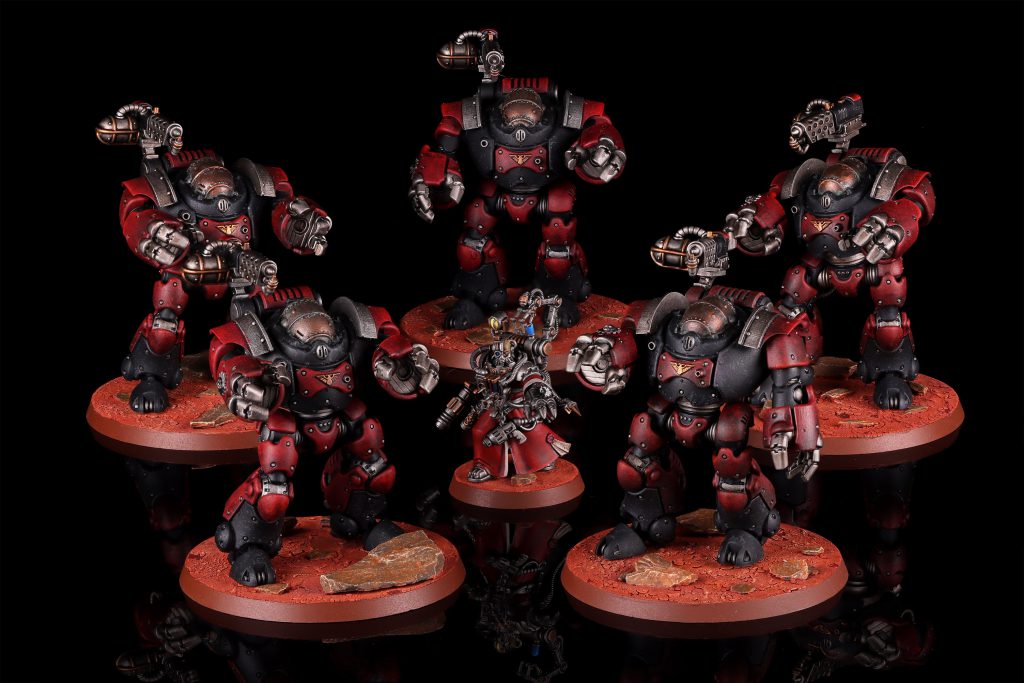 A Kastelan maniple painted and photographed by Pendulin for Goonhammer.
The codex material even allows these ancient itinerants unusual colours, outside the strict schemes of the forge worlds. I love that permission. You could put a battered blue robot beside a red Martian force and give it a history nobody in the current army knows. The named examples include the Automongrel of the Graian Stellar Drawbridge and an Iron Ghost of Farewell Secundus. Those names are catalogued in Lexicanum from the eighth-edition book; some entries have only a scrap of information attached.
I’d be tempted to invent a long account of the Automongrel’s travels. Then I’d paint him cream because I like the battered appliance look and never finish the account. A maniple assembled from several wandering machines offers enough excuses for mismatched armour that I’d probably spend longer choosing the individual colours than building them. My Imperial Fists already give me enough yellow surfaces to repair.
The obvious question is whether those departures prove sentience. I don’t think the description gets us that far. A sufficiently elaborate old routine might include finding a war zone, temporarily accepting local command, and departing when particular conditions are met. That’s my possible explanation, and the story leaves room for others. We haven’t been given the contents of an itinerant’s original instructions, or a transcript of what happens when somebody tries to countermand its departure.
But I can hear myself making excuses for the priesthood there. If an ancient robot arrived to help me, stayed for precisely as long as it considered useful, and left, I’d probably describe that as a decision. Especially if I was the person left holding the instruction cards. I keep wavering over how much the word “decision” tells us about the thing making it, particularly with a program that may have been running for thousands of years.
Wandering automata also appear in official Heresy material. In WarCom’s introduction to Journal Tactica: The Battle of Tallarn, studio writer James describes Cohorts Vagus as groups whose connection to their Tech-Priest masters has been severed and who are drawn to war. Those are Heresy-era automata, so I wouldn’t simply equate them with every itinerant Kastelan. They’re another published instance of machines continuing to find battles after the person who directed them is gone.
The Mechanicus has plenty of methods for imposing obedience on its forces. White Dwarf 468’s Adeptus Mechanicus Kill Teams describes neurosync implants in Skitarii that let priests upload combat programs and even take over their soldiers. Reading that beside the wandering-robot accounts makes me wonder how a priest feels when something valuable leaves his control. I’d like a story told from the Datasmith’s side of that departure, with the inventory report still to write.
Give me an itinerant turning up halfway through a small narrative game. Let the Datasmith get close enough to change its protocol. Let it help hold a crossing for a couple of turns, then start walking towards the far table edge with whatever orders it brought from its previous battle still somewhere inside it. Does the priest follow, carrying the spare wafers? I’d probably send him after it and leave the objective unattended.