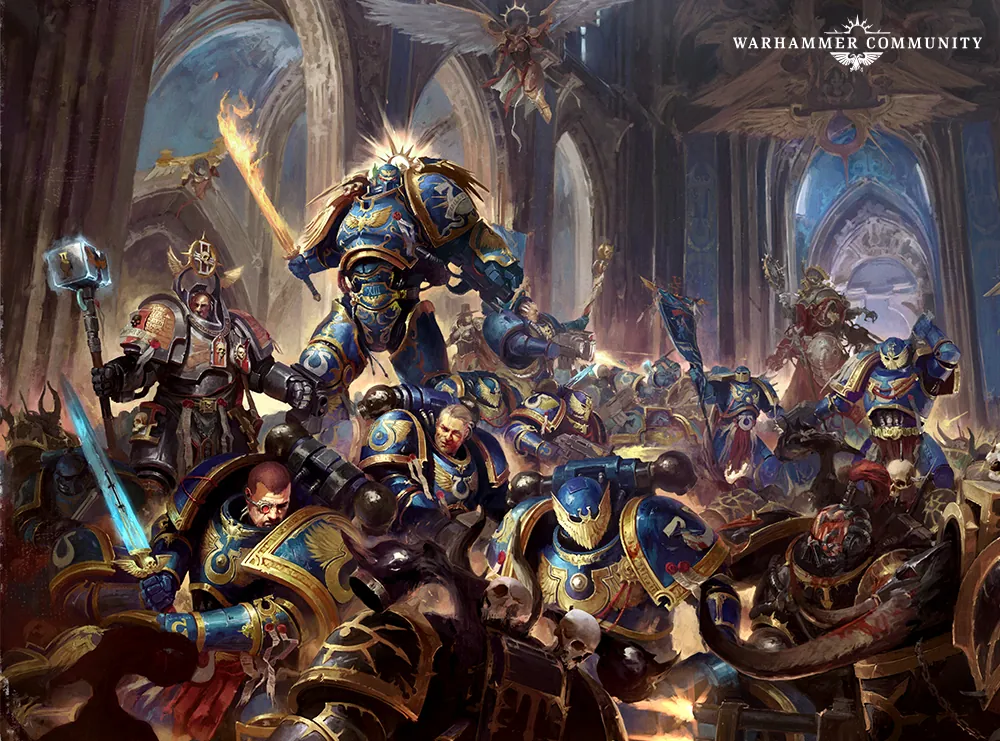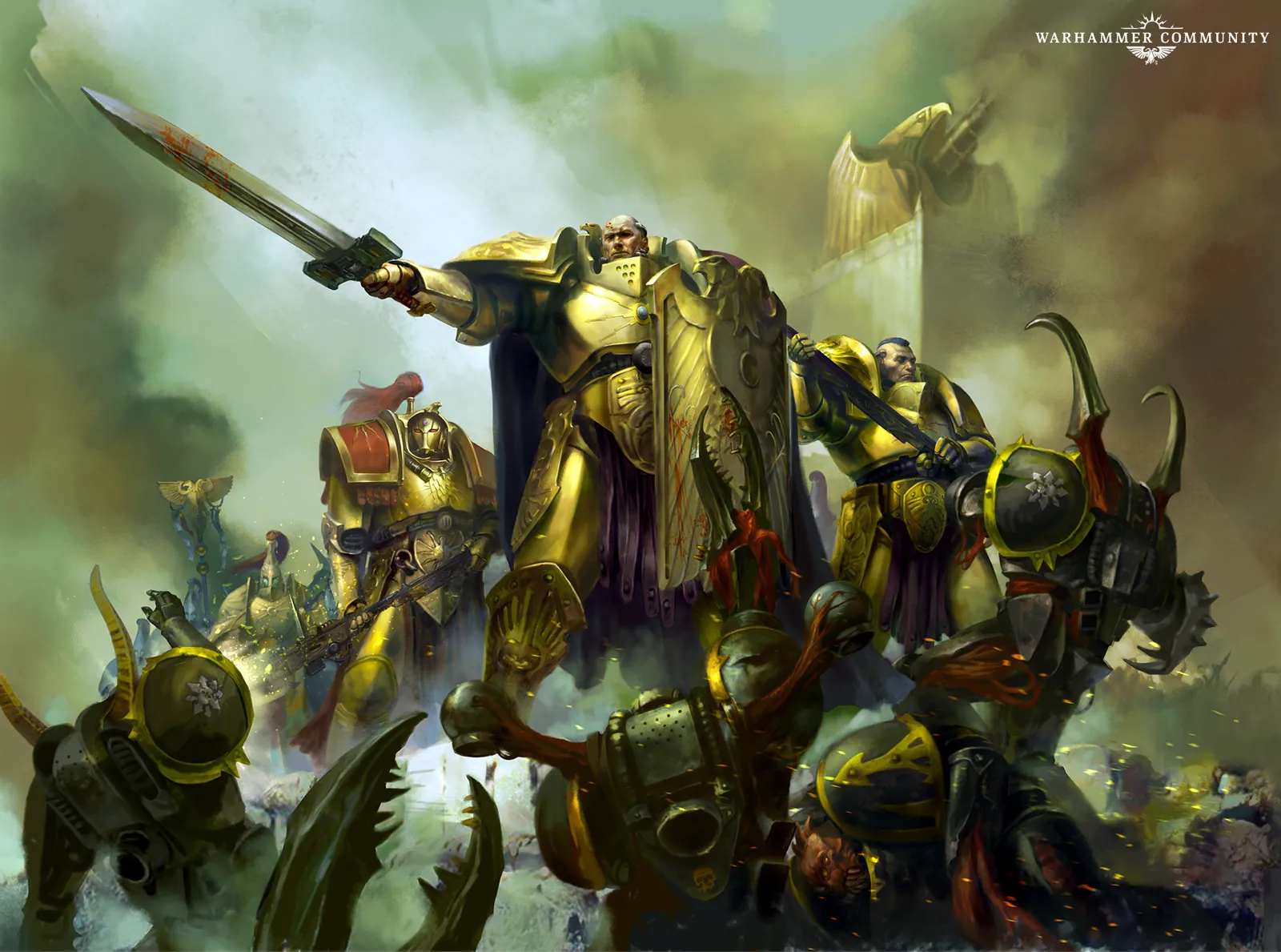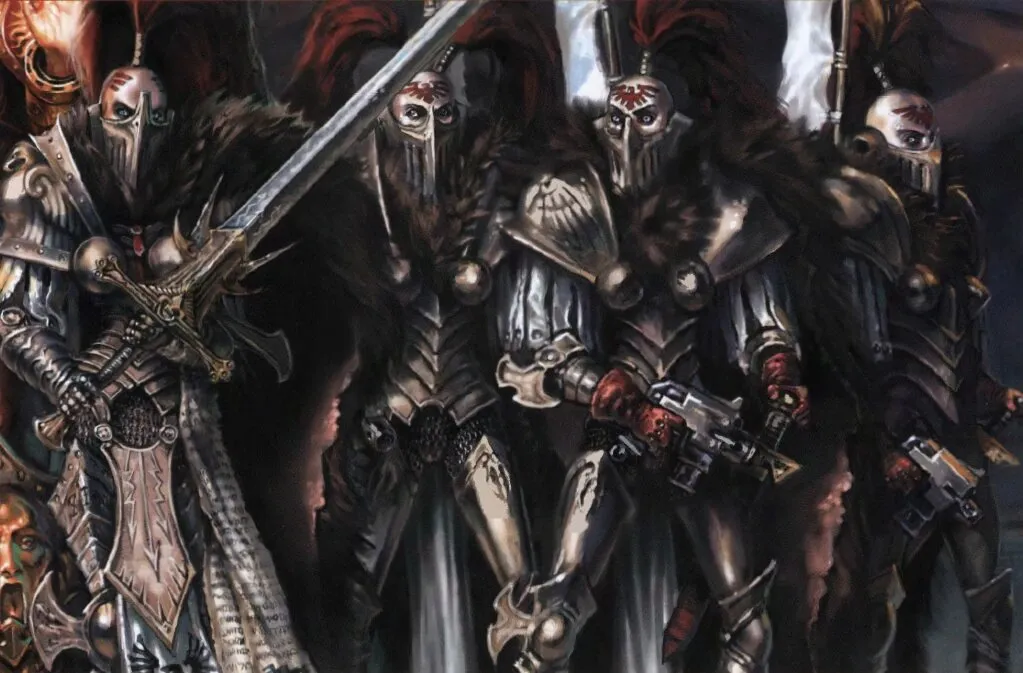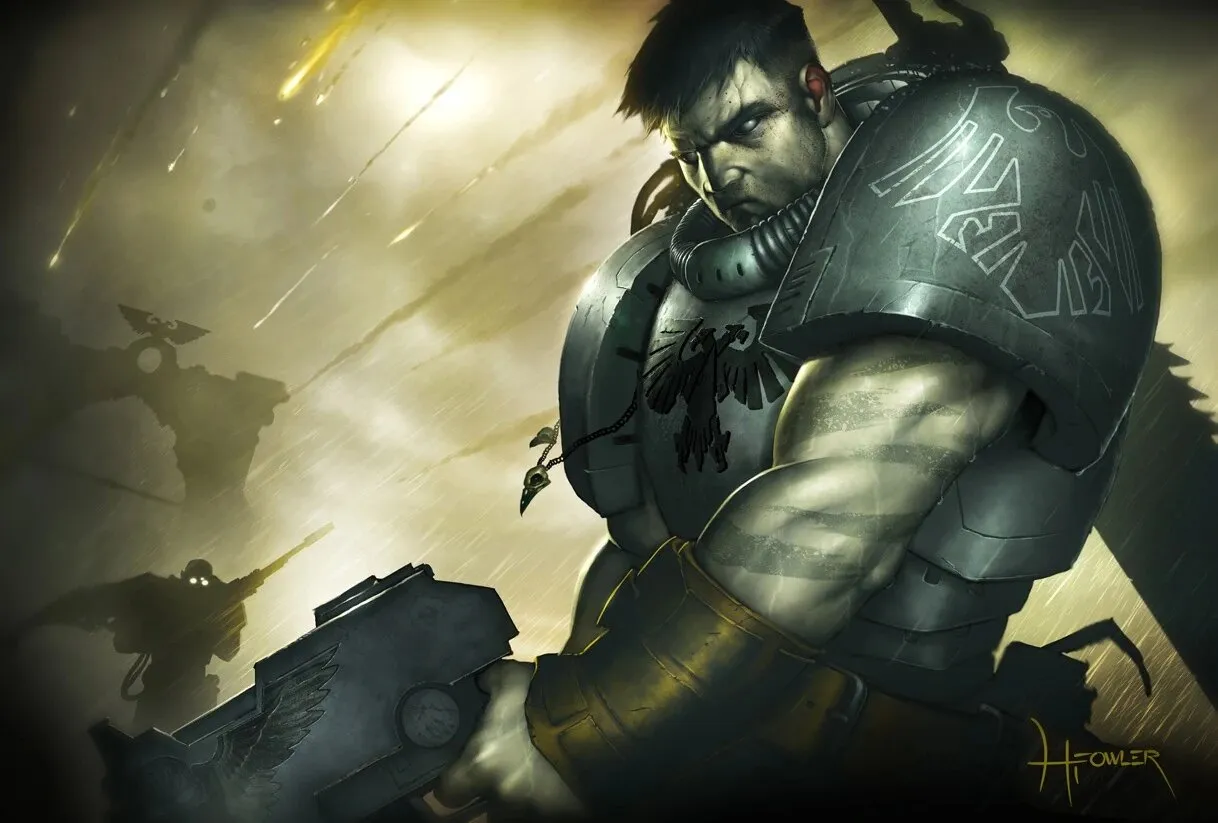
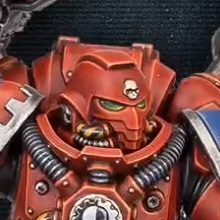
A Space Marine Scout wears his squad number on his right shoulder plate, painted in white. That’s the whole insignia. No company badge, no company colour, no number identifying the company he belongs to. And the 10th Company itself doesn’t have a battle standard, or a company banner. Every other company in a Codex-compliant Chapter gets one.
Games Workshop gave away a Space Marine Scout as September’s Miniature of the Month, free in stores from the 5th while they lasted, and the product blurb described him as one of the “neophytes who have advanced in their training far enough that they can take part in combat operations, before the installation of the Black Carapace allows them to interface with power armour.” That’s a subordinate clause doing an enormous amount of work, and I’ve been chewing on it for about a week.
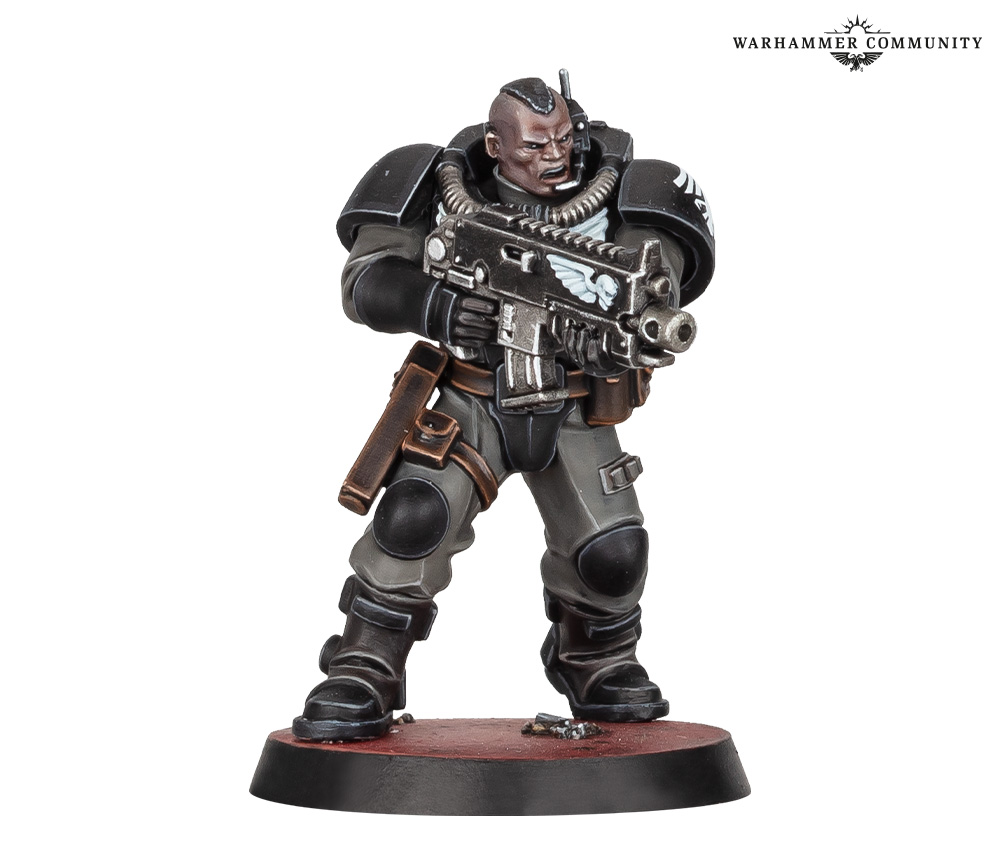
The Space Marine Scout and Phase 19
Nineteen implants. That’s the full list, and White Dwarf #421 printed the whole table back in 2017 with ideal implantation ages against each one. Secondary heart at ten to fourteen. Ossmodula and Biscopea, which grow the skeleton and the muscle, at ten to twelve. Betcher’s Gland goes into the lower lip or the hard palate at sixteen. The progenoids, the ones the Apothecary cuts out of your corpse to keep the Chapter alive, at sixteen to eighteen.
Phase 19 is listed as Carapace, ideal age sixteen to eighteen, and the notes column says two words: Final Implant.
The description of what it actually is has barely changed since the Index Astartes material. Black carapace grows as a film in a tank, looking like black plastic. It gets lifted out of the culture solution, cut into sheets, and implanted directly under the skin of the recruit’s torso. Within hours the tissue expands and hardens on the outside, and sends invasive neural bundles inward. Then several months of maturation, after which an Apothecary cuts neural sensors and transfusion points into the hardened shell, which are the plugs the armour connects to.
Imperial Armour Volume 3 goes further on what the plugs do. The suit’s actuators and fibre bundles replicate muscular commands through a neurone interface that plugs into the wearer’s spinal column, via the black carapace, straight into his motor nervous system. The armour stops being a thing he’s wearing. Same book notes that when a Marine drives a Rhino or a Predator, a spinal interface runs through the carapace into the vehicle, and the crewman gets called the Custodian of that tank.
So the Scout has eighteen of the nineteen. Two hearts, the acid spit, the memory-eating gut, the organ that clots his blood before he bleeds out. The one he’s still waiting on is the interface, which is why he’s in a flak vest with a sniper rifle instead of a suit of Mark VII.
Sisters of Battle wear power armour too
I have to walk part of that back, because power armour doesn’t actually require a black carapace to function. Sisters of Battle wear it. Inquisitors wear it. Rogue Traders with enough thrones wear it. None of them have a single Astartes implant and they all move around in the stuff perfectly well.
The grace is the part the implant buys you. Without the direct nervous-system link to the suit’s machine spirit, the movement is described as cumbersome, and the armour is much worse at the bio-monitoring and auto-treatment side, the bit where it reads your heart rate and doses you when you’re bleeding. So GW’s blurb saying the carapace “allows them to interface with power armour” is loose. It allows them to interface with it properly. A Scout could physically be bolted into a suit of Mark VII tomorrow and he’d clank about in it like a Sister with worse training.
I sat with that for a bit and I still think the Chapters are right to wait. If the suit is going to be part of your nervous system for the next four centuries, you probably want the sockets in first.
The origin of the thing is a genuine rabbit hole I fell into and I’m not sure I understand it. The prototype template gets attributed to a Terran geneticist called Amar Astarte, who ran the Imperial Biotechnical Division, and her design was flawed enough that it had to be fixed by a man named Ezekiel Sedayne, who’d been alive through the Age of Strife and who eventually took her job. Sedayne’s mind later got folded into Belisarius Cawl through Cawl’s soul-merging business, which is apparently why Cawl half-remembers working alongside the Emperor on the gene-seed organs. How much of that was always true and how much of it is Guy Haley tidying up after the fact, I honestly couldn’t tell you…
Ceramite without the power
Scout armour is made of the same ceramite plates as a full suit. It just isn’t powered, so the Scout can’t carry the weight of a complete set and wears partial plate over fatigues woven from a carbon and titanium composite that’ll turn most small arms fire. It’s close to Astra Militarum carapace armour without being identical, and it’s near-silent, which is the actual point of it for a squad whose job is to be somewhere before anyone knows they’re coming.
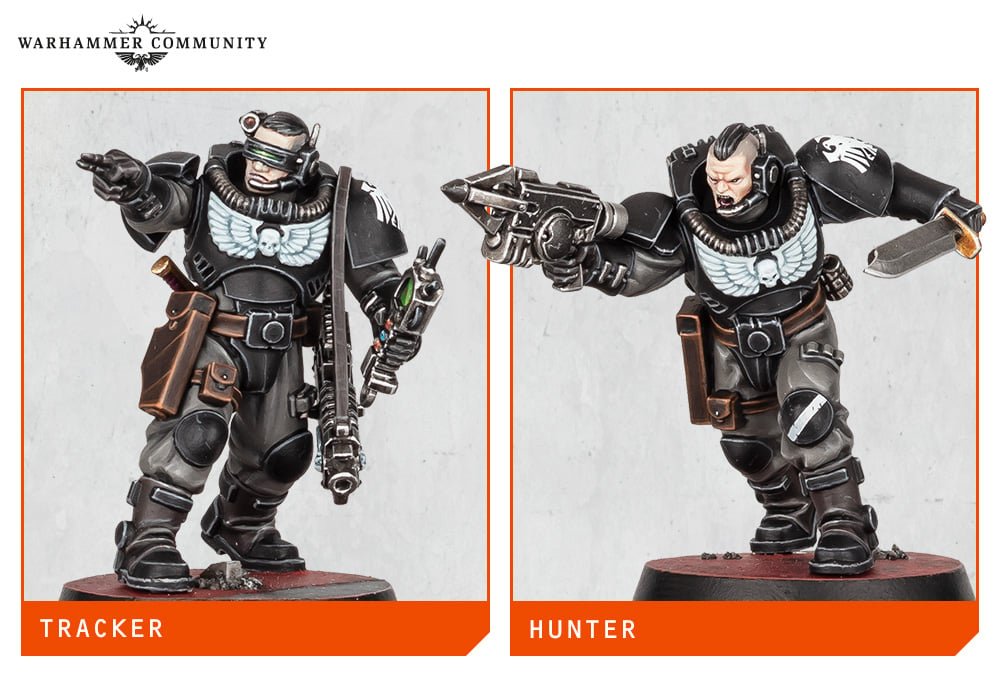
White Dwarf #312 ran a page of approved camo patterns for it, and the specificity is lovely. Sub-arctic mountainous, used by Subjugators Scouts during the Tranquillity Campaign. Sub-tropical forested, White Scars, 422 patrol, the Canak death world incident. Cobalt and ammonium desert for the Novamarines at Galen V. Iron oxide desert for Ultramarines at the relief of Fort Wrath. An urban pattern approved in M38 and issued to Scouts heading for Medusa V. The page reckons there are five hundred-plus variations in use across all Chapters.
So yeah, Scouts. On the table they’ve always been a bit rubbish, haven’t they. Toughness that doesn’t hold up, a save that folds to anything with an AP value, and the sniper rifles were never as good as you wanted them to be. Everyone I know bought them for the Infiltrate rule and then quietly stopped bringing them. Mine went in a drawer somewhere around sixth.
I did buy a Land Speeder Storm in 5th, though. The open-topped Scout transport. I bought it because there was a stretch where every Marine list I liked the look of had one, and I convinced myself I was going to run a proper 10th Company force with Telion in it. That was, what, fifteen years ago now, longer than I’ve had the job I currently have. It is still on the sprue. Pete has painted three full armies in the time that box has sat in my loft, which he mentions roughly once a year.
The 10th has no banner
The company that runs all this is stranger than it gets credit for. The officers and sergeants of the 10th are often among the most experienced brothers in the Chapter, veterans who came up through the 1st Company and then turned down promotion to higher office in order to train recruits instead. That’s the career move. Serve in the Chapter’s elite Terminator company, get offered a captaincy, say no, go and teach teenagers how to use a bolt pistol.
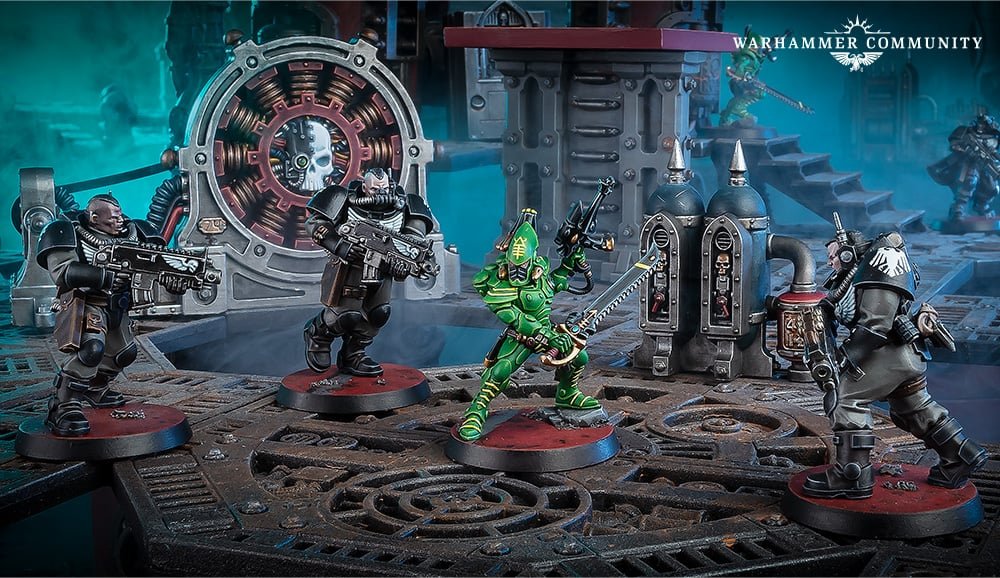
Torias Telion is the one everybody knows, and his line to his recruits is that once they’ve mastered their duties he’ll have nothing left to teach them and they’ll truly be Space Marines. The 10th is rarely fielded as a single unit. Its squads get detached out to the battle and reserve companies and fight attached to them. The Codex Astartes sets no cap on how many Scout squads a Chapter can have, though in practice it’s almost never more than ten and usually a lot fewer, depending on how many aspirants are worth keeping and how badly the Chapter has been mauled lately.
Not everyone does it this way. The Black Templars don’t run a training company at all, they apprentice each neophyte to an individual Initiate who drags him around the crusade until he’s ready. The Space Wolves put their graduates straight into Blood Claws packs, and their Wolf Scouts are grizzled loners who’ve been fighting for centuries.
In the Indomitus era the captain of the 10th usually holds the title Master of Recruits, and increasingly that’s paired with Master of Reconnaissance, because the Primaris Vanguard and Phobos units got filed into the 10th as well. Which means the company now holds the trainees who can’t plug into their armour alongside the Vanguard specialists who wear the sneakiest armour the Chapter owns.
Where the washouts go
The training kills a fair number of them, and injury isn’t the only way out. A Scout can be found spiritually wanting during one of the Chapter cult rituals, or break one of the articles of Chapter law, and that’s the end of it.
Most of the ones who fail get mind-scrubbed and spend the rest of their lives as Chapter serfs, cleaning and cooking and carrying things for the brothers they trained beside. The unluckier ones are turned into servitors and handed to the Techmarines to operate machinery. A very small number end up somewhere reasonably senior in the Chapter’s support network, and even those are nameless to a battle-brother.
The free September mini, then, is a lad with eighteen implants, a shoulder pad with a number on it, and a decent chance of ending up mopping a corridor in the fortress-monastery he was recruited into. My Imperial Fists 10th Company consists of four Scouts I painted in 2013 and a Land Speeder Storm in a box. If you want to read the general version of how the implants work, the overview of what a Space Marine actually is covers the rest of the nineteen, and the new codex apparently gives them 232 pages of background to sit in.