Ciaphas Cain is the best thing to happen to Warhammer 40K fiction, and I will die on this hill. In a setting defined by grim self-seriousness, Sandy Mitchell created a protagonist who’s a self-admitted coward, a liar, a fraud (by his own account), and also somehow the most decorated Commissar in Imperial history. The entire Ciaphas Cain series is built on a single joke that never gets old: Cain tries to run from danger, and his attempts to save his own skin keep accidentally putting him in position to save everyone else.
If you haven’t read the books, fix that. Start with For the Emperor. You’ll burn through the whole series.
The Concept
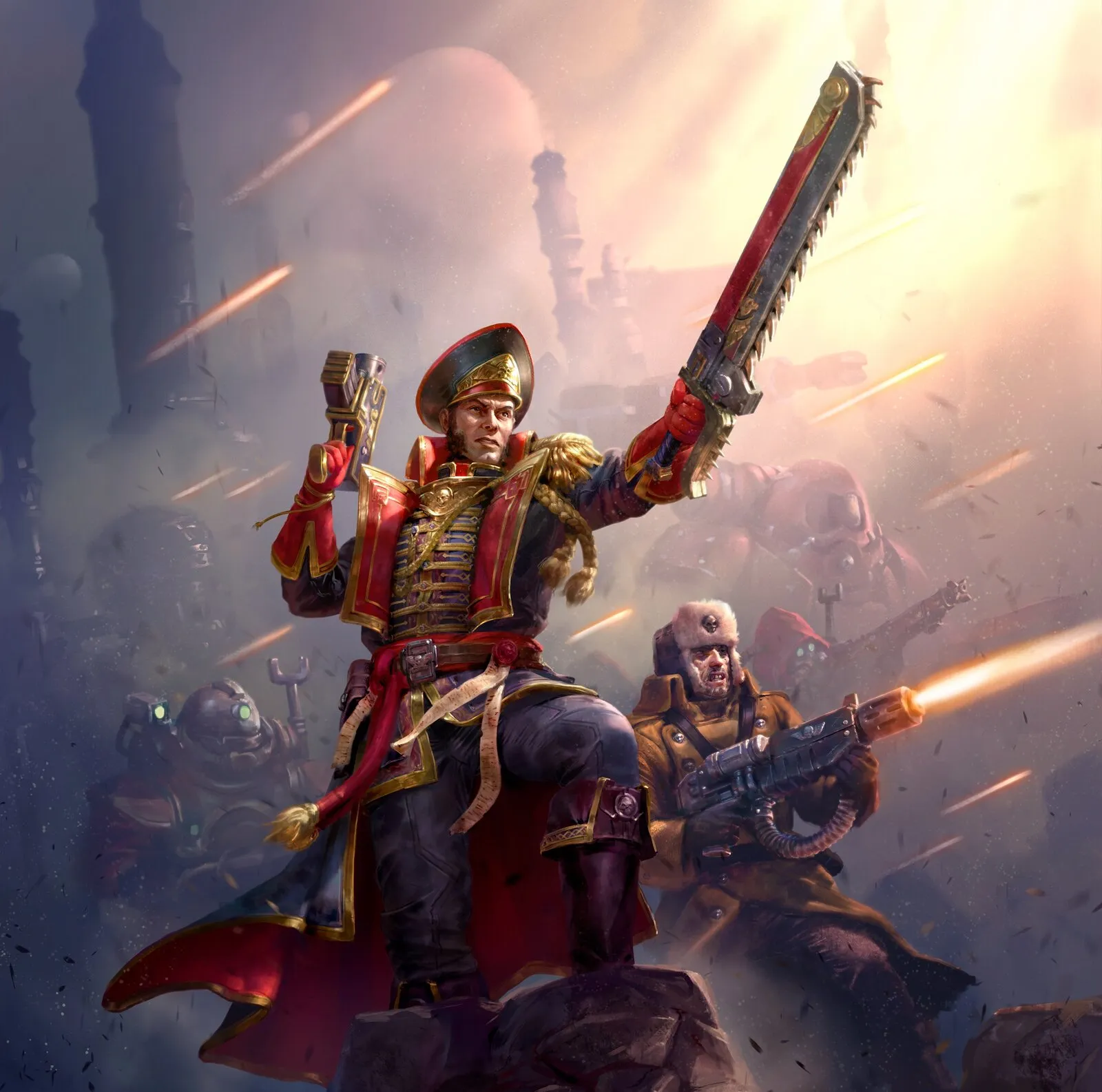
Cain is a Commissar, one of those political officers whose job is to maintain morale in the Imperial Guard by shooting anyone who runs. The standard Commissar in 40K lore is a grim-faced zealot who inspires through fear. Cain is the opposite. He inspires through charm, humor, and a carefully cultivated reputation as a frontline hero.
The twist is that Cain insists (in his private memoirs, which form the novels) that he’s none of those things. He claims every heroic act was actually motivated by cowardice. He didn’t charge the enemy position out of bravery. He charged because the position behind him was about to be overrun and forward was the only way to survive. He didn’t single-handedly hold the bridge against the Ork horde because he’s courageous. He held it because if he ran, his own troops would lose respect for him, and a Commissar without respect is a dead Commissar.
The genius of the series is that the reader can never be sure if Cain is being honest about his motivations or if he’s a genuinely brave man with imposter syndrome. Inquisitor Amberley Vail, who edits and annotates his memoirs (and who is also his on-again-off-again love interest, which is its own delightful subplot), clearly believes Cain is selling himself short. The truth is probably somewhere in the middle.
The Key Adventures
Cain’s career spans decades and touches almost every major enemy faction in 40K. That’s part of the fun. Each book drops Cain into a different type of conflict, and his attempts to avoid danger are consistently and hilariously thwarted.
His first posting was supposed to be cushy: the Valhallan 12th Field Artillery, well behind the front lines. Instead, he ended up in the middle of an Ork invasion that escalated into a Tyranid incursion. His attempts to find a safe position kept putting him at the exact crisis point of the battle. By the time it was over, he’d killed an Ork warboss in single combat (by accident, more or less) and earned a reputation as a fearless hero.
This pattern repeats for his entire career. Assignment to a training world? Genestealer cult uprising. Diplomatic mission? Chaos invasion. Quiet garrison duty? Necron tomb world waking up beneath his feet. Cain’s luck is spectacularly bad at keeping him out of trouble and spectacularly good at keeping him alive through it.
The Valhallan 597th, the regiment he served with for most of his career, is one of the most enjoyable units in 40K fiction. Formed from the merger of two feuding regiments (one all-male, one all-female), the 597th starts the series on the verge of civil war. The men and women hate each other. Officers are sabotaging each other’s squads. And Cain, who just wants a quiet posting, has to fix it because a regiment that kills itself is a regiment that can’t protect him.
His solution is vintage Cain: he identifies the best soldiers from each side, puts them in mixed squads, and lets mutual competence build mutual respect. It works. The 597th becomes one of the best regiments in the sector, and Cain gets the credit for building a model unit, when all he was really doing was trying to stop people from shooting each other long enough for him to survive the posting.
Over the course of the series, the 597th develops into a genuine family. Individual soldiers get names, personalities, and arcs. Sergeant Lustig, Corporal Magot, Colonel Kasteen, Major Broklaw. You care about them because Cain cares about them, even though he’d never admit it. When the series kills someone from the 597th, it hurts in a way that most 40K fiction never manages, because these aren’t faceless Guardsmen. They’re people Cain has been protecting (accidentally, he’d insist) for years.
Amberley Vail
The other character who makes the series work is Inquisitor Amberley Vail of the Ordo Xenos. She’s technically the framing device: the novels are presented as Cain’s private memoirs, edited and annotated by Vail for the Inquisition’s records. Her footnotes are some of the funniest parts of the books. She corrects Cain’s self-deprecation, provides historical context he conveniently leaves out, and occasionally drops dry observations that make it clear she knows him far better than he’s comfortable with.
She’s also his love interest, which is played with more subtlety than you’d expect from a 40K novel. They’re not a couple in any conventional sense. They meet, they work together, they clearly care about each other, and then one of them disappears for years on a mission. It’s an on-again-off-again relationship conducted across decades and star systems, and Mitchell handles it with a light touch that avoids the melodrama. Vail is never a damsel. She’s an Inquisitor with her own retinue, her own agenda, and the authority to requisition entire armies. She doesn’t need Cain. She likes him, which is somehow more compelling.
The footnote format also lets Mitchell do something clever with reliability. Cain’s memoirs are the primary text, but Vail’s annotations sometimes contradict him or fill in gaps he deliberately left. You get two perspectives on the same events, and the tension between what Cain says happened and what Vail knows actually happened is a running source of both comedy and character depth.
Jurgen
I can’t talk about Cain without talking about his aide, Gunner Ferik Jurgen. Jurgen is personally repulsive (his hygiene is legendary even by Guard standards), socially invisible, and an absolute combat savant with a melta gun. He’s also a Blank, a psychic null, which makes him immune to Warp influence and lethal to daemons and psykers.
Jurgen doesn’t know he’s a Blank. Nobody’s told him. He just thinks everyone avoids him because of his smell (which is also true). This obliviousness is played for comedy throughout the series, but Jurgen’s null field has saved Cain’s life more times than either of them realize. Their partnership is the emotional core of the books: a charismatic fraud and a smelly, loyal friend who’d follow him into hell. And has, literally, on several occasions.
Cain Among the Angels of Death
The Emperor’s Finest deserves its own mention because it puts Cain somewhere he absolutely does not want to be: aboard a Space Marine vessel, embedded with the Reclaimers Chapter. Cain’s narration of Space Marine life from a normal human’s perspective is some of the funniest material in the series. He’s technically a guest and a senior Commissar, but he’s also a baseline human walking through corridors designed for eight-foot-tall transhuman warriors, eating food that tastes like it was designed for someone with a completely different biology, and trying to make polite conversation with beings who view him as something between a respected ally and a curious pet. There’s a moment where Cain attempts to use a Space Marine training facility and realizes that the lightest weight setting is heavier than anything he could lift with both arms, and his deadpan description of the experience is one of the best passages Mitchell ever wrote.
What makes the Space Marine sections work is that Cain is genuinely intimidated by them but too proud (and too committed to his reputation) to show it. He navigates Astartes politics with the same charisma he uses on Guardsmen, and to his own surprise, it works. The Reclaimers respect him because he’s a decorated Commissar with a legendary record, and Cain has to keep performing the role of fearless hero in front of beings who could literally pull his arms off. The tension between his internal panic and his external composure reaches its peak in this book, and Mitchell milks every drop of comedy from it.
Some of the series’ best individual moments come from Cain’s talent for accidentally saying the right thing at the right time. In one book, he makes an offhand remark about a tactical situation that his commanding officers interpret as brilliant insight. In another, he stumbles into an enemy command post while looking for a bathroom. His first encounter with a Necron involves him backing into a tomb chamber while retreating from something else entirely, and his reaction (immediate, abject terror followed by the realization that running would get him killed faster than fighting) is the Cain formula at its purest. Mitchell has a gift for slapstick that never undermines the genuine danger of the situations, and that balance is why the comedy works across an entire series.
Why He Works
Cain works because he’s a mirror held up to the 40K setting. The Imperium runs on propaganda, hero worship, and the myth that faith and courage alone can overcome any threat. Cain’s private memoirs reveal what’s behind the curtain: the heroes are as scared as everyone else, the victories are messier than the official reports suggest, and survival often has more to do with luck and quick thinking than noble sacrifice.
But the books aren’t cynical. That’s the other trick. Cain might claim he’s only in it for himself, but he consistently makes choices that protect his troops, his friends, and the civilians around him. He could have let the 597th tear itself apart in the early days. He didn’t. He could have abandoned Jurgen a dozen times. He didn’t. He could have stayed retired and lived out his days in comfort. He came back.
The Ciaphas Cain series is 40K’s version of Blackadder Goes Forth: comedy set against horror, with a protagonist who’s smarter and more decent than he wants anyone (including himself) to believe.
What sets Cain apart from other 40K protagonists is that he’s self-aware. Eisenhorn knows he’s compromised but rationalizes it. Gaunt knows he’s in danger but pushes through on duty. Cain knows exactly what he is (or thinks he does), narrates his own hypocrisy in real time, and still can’t stop doing the right thing. He’s the most honest narrator in 40K precisely because he’s trying so hard to be dishonest about his own character. Every time he insists “I only did it to save my own skin,” you can feel Amberley’s footnote hovering, ready to point out that the safest option was actually the one he didn’t take.
The Books
If you’re starting:
- For the Emperor introduces Cain, the 597th, and the Tau (the only 40K fiction where the T’au are played for comedy, which works surprisingly well)
- Caves of Ice is Orks plus Necrons plus a frozen wasteland. Classic Cain.
- The Traitor’s Hand involves Chaos and is probably the most action-packed
- Cain’s Last Stand is Cain as an old man defending a Schola Progenium against a Chaos warband. It’s unexpectedly moving, and the moment where his students realize their doddering old professor is THAT Ciaphas Cain is one of the best reveals in the series
- The Emperor’s Finest sends Cain aboard a Space Marine vessel, and watching him navigate the politics of the Adeptus Astartes while trying not to get killed is a highlight
The omnibus editions (Hero of the Imperium, Defender of the Imperium, Saviour of the Imperium) collect the novels and short stories in order. They’re the best value and the best way to read the series.
If you’re a 40K fan who’s only read the serious stuff (Heresy novels, Eisenhorn, etc.), the Cain books will feel like a breath of fresh air. They prove that the 40K setting is versatile enough to support genuine comedy without undermining the grimness. Cain doesn’t make the galaxy less dark. He just shows you that even in the darkest setting, people are still funny, still human, and still trying to get through the day without dying.
Mostly by running away. But still.