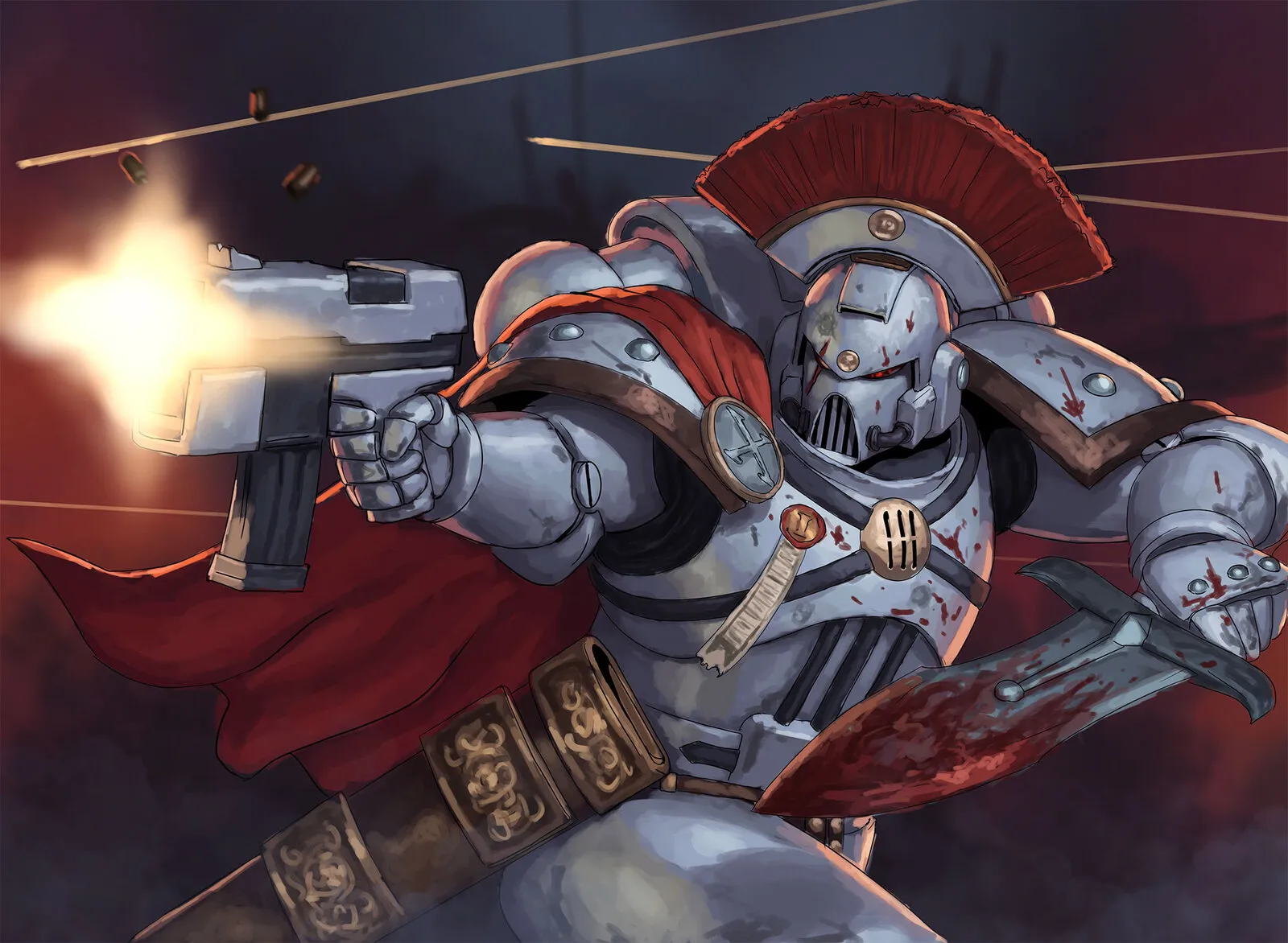
If you’ve read Horus Rising, you already know Garviel Loken. He’s the POV character who walks you into the Horus Heresy, and Dan Abnett uses him perfectly: a loyal, decent man surrounded by the brewing catastrophe that will destroy everything he believes in. Loken doesn’t just witness the Heresy. He’s ground up by it, spat out, and somehow keeps going.
I think Loken is one of the best-written characters in all of Warhammer fiction, and his arc across the Heresy novels is the emotional backbone of the series.
The Luna Wolf Who Asked Questions
Loken was a Captain of the XVI Legion, the Luna Wolves (later renamed Sons of Horus). Born on Cthonia, a gang-ruled hive world, he was everything a Space Marine captain should be: brave, skilled, and honest to a fault. That last trait is what set him apart. In a Legion that was increasingly falling under the sway of warrior lodges and secret rituals, Loken was the guy who kept saying “something doesn’t feel right.”
Horus himself elevated Loken to the Mournival, his inner circle of four trusted captains. The Mournival was supposed to represent four temperaments that balanced each other: the warrior, the pragmatist, the philosopher, and the moderator. Abaddon was the warrior, aggressive and direct, the First Captain who solved problems with overwhelming force. “Little Horus” Aximand was the pragmatist who could see all sides of a tactical situation. Tarik Torgaddon was the wit, the one who kept the group human with his humor and refusal to take anything too seriously. And Loken was the voice of conscience, the newest member who brought fresh perspective and an uncomfortable habit of asking questions no one wanted to answer.
The dynamic between these four is some of the best character writing in the Heresy. Abnett lets you see how they complement each other, how their debates sharpen Horus’s decision-making, and how the bonds between them are genuine. Which makes the eventual fracture devastating. When the lodges and Erebus’s influence began corrupting the Legion, the Mournival didn’t break cleanly. Abaddon was already leaning toward the darkness. Aximand was torn, wanting to stay loyal to Horus personally even as Horus became something unrecognizable. Torgaddon sided with Loken. The Mournival’s collapse is a microcosm of the Heresy itself: people who loved each other choosing different sides and destroying each other because of it.
It was meant as an honor. For Loken, it became a front-row seat to his Primarch’s corruption.
In Horus Rising, Abnett uses Loken as the reader’s eyes. He’s the one asking the questions the reader is thinking. Why are the warrior lodges secret? Why is Erebus always lurking around? Why is Horus changing? Loken notices what others dismiss or ignore, and it costs him everything.
The warrior lodges deserve special attention here because they’re the mechanism through which Chaos infiltrated the Luna Wolves. On the surface, they were just social clubs where marines from different companies could meet as equals, without the hierarchy of rank. But Loken sensed something wrong about them from the start. The secrecy bothered him. Why would a fraternal organization need secret meetings and oaths of silence? What was being discussed that couldn’t be said openly? His refusal to join the lodge marked him as an outsider, and that isolation is what eventually saved his life. The marines in the lodge were the ones who turned first, because the lodge structure gave Erebus and the Word Bearers a ready-made network for spreading Chaos influence. Loken’s instinct that something was off turned out to be exactly right, and the price of being right was watching his Legion eat itself from within.
Another relationship that grounds Loken’s character is his friendship with Mersadie Oliton, one of the human remembrancers assigned to document the Great Crusade. Their bond is unusual because Space Marines aren’t supposed to form close attachments to baseline humans, but Loken genuinely valued Mersadie’s perspective. She saw him not as a weapon or a demigod but as a person, and her questions about the Crusade’s purpose forced Loken to articulate doubts he might otherwise have buried. When things fell apart, his inability to protect her was one more wound among many. The Loken-Mersadie dynamic humanizes the Heresy in a way that Space Marine-to-Space Marine interactions can’t, because it reminds you that this galaxy-spanning civil war destroyed ordinary people’s lives too.
Isstvan III and the Betrayal
When Horus turned traitor, Loken was one of the Loyalists targeted for purging on Isstvan III. Horus virus-bombed the planet with his own loyal marines on it. Loken survived (thanks to a warning from Saul Tarvitz of the Emperor’s Children) and fought a desperate last stand in the ruins.
The Isstvan III sequence in Galaxy in Flames is brutal. Loken is fighting his own brothers, the people he trained with, served with, trusted. His best friend Tarik Torgaddon is killed. The commander he idolized has tried to murder him. Everything that defined Loken’s identity is torn away in a matter of hours.
He was buried in the rubble of Isstvan III and left for dead. For years, the lore left it ambiguous whether he survived.
The Knight Errant
He survived. Barely. Nathaniel Garro (another fantastic Heresy character) pulled him out and recruited him into the Knight Errants, a secret group assembled by Malcador the Sigillite to counter Chaos infiltration. Loken, broken and traumatized, slowly rebuilt himself.
The relationship between Loken and Garro is one of the underappreciated dynamics of the Heresy. Garro was a Death Guard captain who had his own betrayal story, having fled Isstvan III on the frigate Eisenstein to warn Terra. Both men had watched their Legions turn traitor. Both had lost brothers they loved. But where Garro channeled his trauma into a fierce, almost religious devotion to the Emperor’s cause, Loken was more fractured. Garro became the recruiter and handler for the Knights Errant, the one who held the group together through sheer force of will and faith. Loken respected Garro but I think he also envied him. Garro had found something to believe in after the betrayal. Loken was still searching.
What I like about this phase of Loken’s story is that it doesn’t pretend he’s fine. He’s not. He’s haunted by what happened on Isstvan. He hallucinates Horus’s voice. He struggles with survivor’s guilt. The man who was defined by certainty and loyalty has lost the thing he was loyal to, and the novels let him sit in that pain rather than rushing past it.
The Knight Errant missions were exactly the kind of dirty, deniable work you’d expect from Malcador’s personal operatives. Hunting down Chaos-compromised individuals within the Loyalist ranks. Recovering dangerous artifacts before they could be weaponized. Assassinating targets that couldn’t be dealt with through conventional military channels. These weren’t glorious battlefield engagements. They were shadow operations carried out by broken men who had already lost everything and could therefore be trusted with missions where failure meant death and success meant silence. Nobody was going to write remembrancer accounts of what the Knights Errant did. That was the point.
For Loken specifically, the missions were a double-edged sword. They gave him purpose, which he desperately needed, but they also forced him into constant proximity with the Chaos corruption that had destroyed his Legion. Every mission reminded him of what Horus had become. Every traitor he hunted wore a face that could have been one of his old brothers. The PTSD from Isstvan didn’t fade during this period. It deepened. Loken was functional, capable of carrying out complex operations and fighting at a Space Marine’s expected level, but there was a crack running through him that everyone around him could see. He would freeze at unexpected moments. He would hear Horus’s voice in quiet rooms. He carried the weight of Isstvan III like a physical thing, and the Knight Errant operations kept picking at the wound even as they gave him reasons to keep moving forward.
There’s something deeply human about the way the novels handle Loken’s mental state during this period, which is remarkable given that he’s a posthuman super-soldier who isn’t supposed to be vulnerable to psychological trauma in the way a normal person would be. The Heresy authors made the smart choice to acknowledge that even a Space Marine’s mental conditioning has limits, and watching your father figure murder your best friend and try to kill you is past those limits.
By the time of the Siege of Terra, Loken is one of Malcador’s agents operating behind enemy lines. He fights in the tunnels beneath the Saturnine Gate, and this sequence deserves more attention because it’s one of the best action set pieces in the entire Heresy. The Saturnine gambit involves a massive feint and counter-feint, with both sides trying to outmaneuver each other for control of a critical entry point to the Imperial Palace. Loken ends up in close-quarters combat in tunnels that are collapsing around him, fighting Sons of Horus marines who were once his brothers. The claustrophobia of the tunnels, the desperation of the fighting, and the emotional weight of Loken killing members of his own former Legion make the Saturnine chapters in Dan Abnett’s novel hit harder than almost anything else in the series. There’s a moment where Loken faces someone he knew, someone he trained alongside, and the recognition between them doesn’t stop the violence. It just makes it worse.
He’s present at the end of the Siege, too. Not on the Vengeful Spirit for the final duel between the Emperor and Horus, but on Terra, still fighting. Still doing his job. That’s Loken in a sentence: he doesn’t get the dramatic final confrontation, he just keeps fighting because that’s what he does.
Why He Matters
What happened to Loken after the Siege is left deliberately open-ended, which I think is the right call. The implication in the later novels is that he survived, but the lore doesn’t give him a dramatic sendoff or a definitive fate. He just… keeps going. Somewhere in the Imperium, a former Luna Wolf captain is still fighting, carrying ten thousand years of memory and grief. Whether he’s alive in the current 41st millennium timeline or whether he died quietly on some forgotten battlefield, the lore doesn’t say. And honestly, I prefer it that way. Some characters work best when you don’t know how their story ends.
Loken matters because he’s the human perspective in a story about demigods. The Primarchs are larger than life. The Emperor is basically a god. But Loken is a regular Space Marine (well, “regular”) who happens to be in the wrong place at the wrong time with the wrong Primarch. His tragedy is relatable in a way that Horus’s or the Emperor’s isn’t. He didn’t choose to be at the center of a galactic civil war. He was just a good soldier who believed in the cause, and the cause betrayed him.
His survival and continued service also carry a message that I think is central to the Heresy’s themes: you can lose everything and still choose to keep fighting. Not because victory is guaranteed, but because the fight matters. Loken doesn’t know if the Emperor’s Imperium is worth saving. He’s seen too much to be naive about it. But he fights anyway, because the alternative is giving up, and Loken doesn’t give up.
If you’re starting the Heresy and want a character to anchor your reading, Loken is your guy. Start with Horus Rising, follow him through False Gods and Galaxy in Flames, and then pick him up again in Garro and the Siege of Terra novels. His arc is one of the few that spans the entire series, and it’s consistently excellent.
Abnett created something special with this character. In a universe full of gods and monsters, Garviel Loken is the most human thing in the room. And that’s exactly why he works.