“Well of course it’s not the Emperor.”
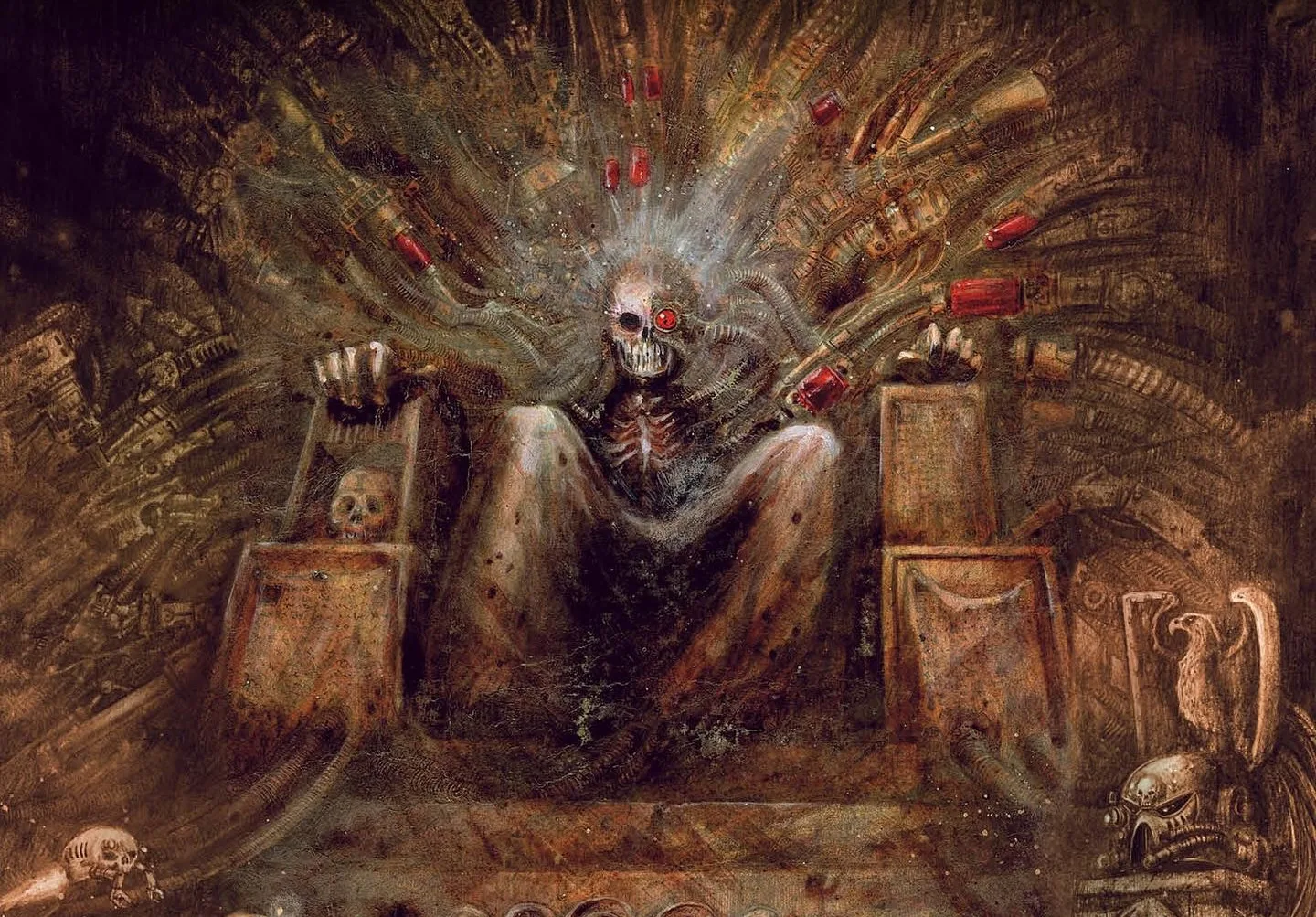
John Blanche says this in an interview about his most famous painting. The image of a withered figure on the Golden Throne, eyes shut, surrounded by cables and incense and crackling power, the one that has been the canonical face of the Emperor of Mankind since 1988. Blanche painted it. And in the interview, he talks about it the way you’d talk about a waxwork in a cathedral. That isn’t the Emperor in the picture. It’s a figurehead on the front of the throne. A physical representation pilgrims spend decades queuing to lay offerings before. The actual Emperor, he says, is deep inside the throne, kept alive in bits by Mechanicus machinery.
The interview surfaced a couple of years ago and the discussion has come back on r/40kLore this week, with the megathread titled “We were Bamboozled.” Most of the comments are some version of: wait, what?
I had the same reaction. Then I went back through the lore. The lore doesn’t actually contradict him.
The Artist Said It Was a Statue
If a codex writer tells you the Emperor sits on the Golden Throne, that’s canon. If the artist who painted the Emperor on the Golden Throne tells you the figure on the front is a statue and the real one is in jars somewhere inside, that’s also a kind of canon. It’s the visual canon. The 1988 painting is the only image of the Master of Mankind most fans can call up from memory without prompting, and the man who put paint on the canvas thinks we’ve been looking at the wrong figure. The interview is on YouTube. Watch it back; his tone doesn’t change when he says the line about the throne.
What he describes in the interview is a ship’s figurehead. A wooden saint on the prow. Something pilgrims can stand in front of and weep over because the actual thing they’re worshipping is too horrifying or too obscure to show. The pilgrims in the painting are gathered because that’s where you go when you want to be near him. Mecca, Jerusalem, Compostela. Every religion does the same thing.
Whether Blanche meant it metaphorically or literally is up for grabs. The matter-of-fact delivery in the interview suggests literally. “Well of course it’s not the Emperor” is the sentence of a man who finds it obvious. He’s been around the lore longer than most of us have been alive. Black Library writers cite him by name when they describe Imperial aesthetics. He gets to weigh in on what the picture is supposed to mean.
What Canon Actually Says About the Emperor’s Body
This is the part that surprised me on the reread. The canonical lore has never been clear about what the figure on the throne physically is. The first edition Rogue Trader rulebook described the Emperor as “less than a corpse.” The 1990 Realm of Chaos books described a withered body, eyes closed, kept alive at the cellular level by the throne. Visions of Heresy gave us the most detailed pre-Heresy scene, with Malcador and Dorn standing before “a huge chair, bulky and machine-like, a mass of twisted cables, wires and conduits linking it to the enormous portal over which it hung.” The Emperor in that scene is still walking and talking. The body in the chair came after.
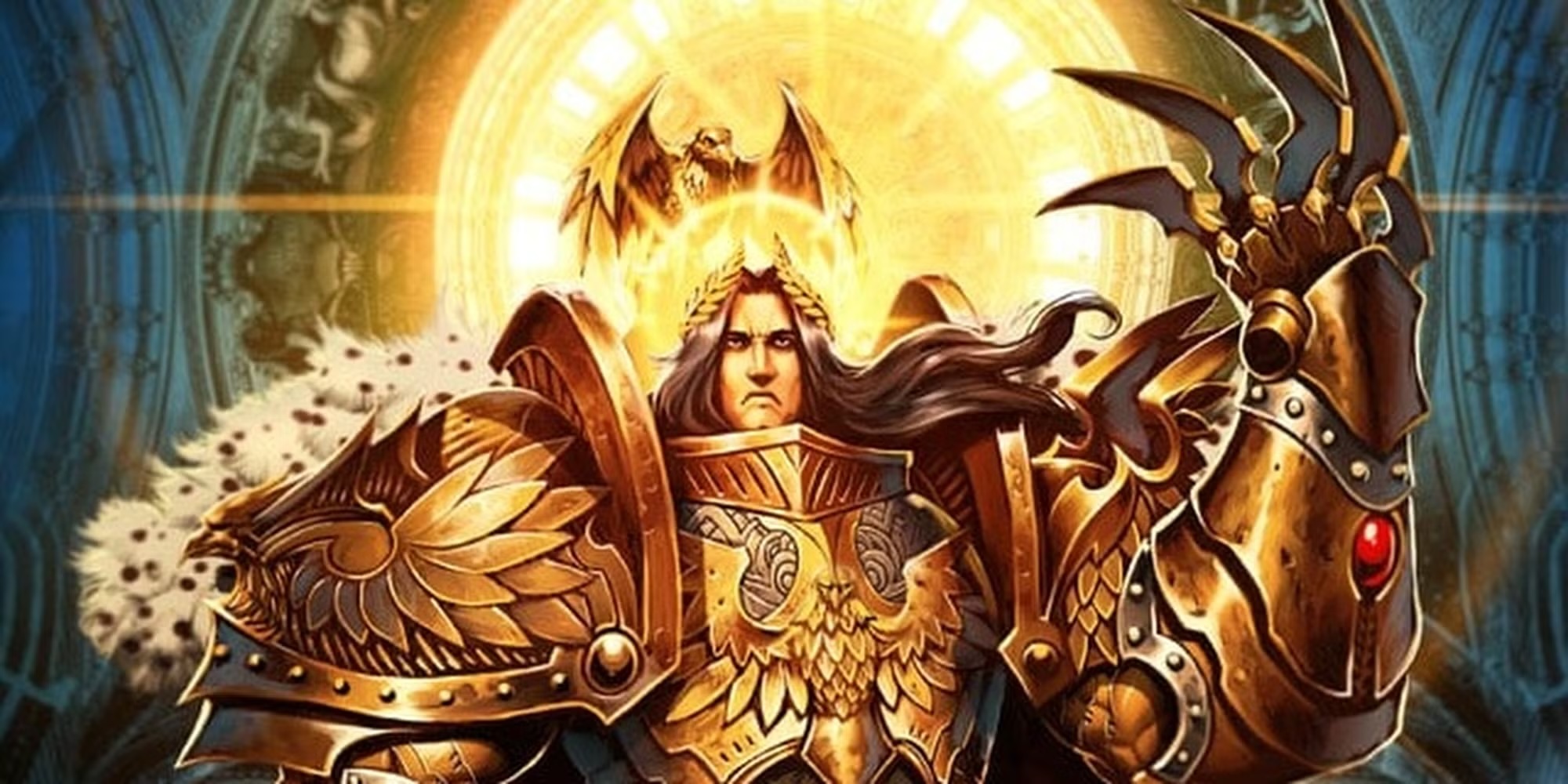
After Horus split the Emperor open on the Vengeful Spirit, the surviving bits were carried back to Terra. What Dorn put on the Throne afterwards is described differently in every source. Aaron Dembski-Bowden’s Master of Mankind shows a being still partly recognisable. Dan Abnett’s End and the Death describes something less easily diagrammed. The 2018 White Dwarf reissue just calls Him “mortally wounded by the arch-traitor Horus 10,000 years ago,” sitting “immobile on the Golden Throne.” That’s the only physical description on the page.
In ten thousand years of 40K writing, nobody has committed to a literal description of what the body actually looks like now. Every artist who’s painted the Emperor has had to make it up. Blanche’s version, the withered eyes-closed gold-armoured corpse, became the consensus because it was the first and the best. The body in the painting is Blanche’s choice. The source text doesn’t describe one. If he says the choice was always meant to be a reliquary front rather than a man, that reading is consistent with the writing. Nothing in the source text rules it out.
The Wikipedia Hole
I lost half a Sunday evening to this last winter. I’d opened the wiki to check a Custodes detail for an Imperial Fists list. I keep thinking I’ll add a few golden boys to my Fists, and I keep not actually buying any. Three hours later I was four tabs deep in 1988 White Dwarf scans, a fan reconstruction of the original throne sketches, and a 2007 forum thread arguing about whether the Emperor in the painting was supposed to be wearing the gold armour from the throne sculpture or a separate set, which is the kind of question that doesn’t have an answer but you have to know the answer is missing before you can put it down… The Tactical squad I was supposed to be priming never got primed. My wife came down to ask if I was coming to bed and I tried to explain why the throne in the painting might not have a body in it at all and she just looked at me. I went to bed.
Pete reckons I’m overthinking it. He paints Salamanders. Has done since the 5th edition starter. His position on the lore is, you take the picture in the codex, that’s the picture. Emperor on throne. Throne on dais. Dais in palace. Palace on Terra. If GW wanted us to see something else, they’d have painted something else. He’s probably right. He’s usually right. He also finished his army about four years before I finished mine.
The Imperium Was Always Doing This
The Imperium is built on intermediaries. Pilgrims don’t pray to the Emperor directly. They pray to the Ecclesiarchy, who pray to the saints, who pray to the Emperor on their behalf. The Custodes guard the throne. The Mechanicus maintain the throne. The High Lords speak for the throne. The Astronomican is the throne’s voice. Cardinals sell forgiveness in the throne’s name. Every system around the body in the chair is a buffer, a person standing in for the person standing in for the person. The whole administrative diagram of the Imperium is built that way on purpose.
The throne doing the same thing inside its own structure fits the Imperium’s whole posture toward its god. Every interaction with the Master of Mankind is mediated. The image on the front of the throne is what a pilgrim can pray to because the actual thing is too dangerous or too disordered to look at directly. This is how Catholicism treats relics. This is how Orthodox Christianity treats icons. The 40K setting borrowed liberally from both and combined them. The Imperium uses both as templates.
There’s a Sunday morning before lockdown I keep coming back to. I was killing time at my local store waiting for a game and the owner had this big print of the Blanche painting pinned behind the till next to a Macragge banner. I’d looked at it for years without thinking about it once. After watching the interview, that print is the first thing I thought of. It’s still pinned up there. I checked on Saturday.
You could counter that an artist’s offhand comment shouldn’t carry the same weight as a published codex line, and I’d grant that under normal circumstances. The trouble with Blanche specifically is the weight he carries inside the canon. He established what the Emperor looked like in the first place. The 1988 painting was the description itself. Everything that came after copied it. The painting has had 38 years to become the consensus version of the Emperor, longer than I’ve been alive by a couple of years. If the original source says it’s a figurehead, 38 years of follow-up art have been painting figureheads too. None of them have come out and said so.
The End and the Death Was Already Pointing Here
The recent Siege of Terra finale, Abnett’s End and the Death trilogy, spends a strange amount of time being coy about what the Emperor actually is. Sanguinius gets killed on the Vengeful Spirit and his soul shows up later in the throne. The Emperor talks to characters who aren’t physically present. Big chunks of the third volume happen in a space that might be the warp, might be the throne, might be the Emperor’s mind. By the end of it, the line between what the Emperor’s body is and what the Emperor’s idea-of-himself is has gone soft. Whichever bits Sanguinius’s soul is in now, they’re not in the pilgrims’ line of sight. The trilogy doesn’t say exactly where they are.
The Dawn of Fire books and the post-Indomitus material keep pointing the same way. The Emperor speaks. The Emperor sends warnings. The Emperor maintains the Astronomican. Whatever does the speaking and warning and maintaining is using a body in a chair as the input cable. Whether you call that a figurehead or a soul-anchor or a psychic battery, the picture on the cover of your codex is the visible front of a machine, and the entity using the machine is elsewhere.
Tomorrow It Won’t Be Canon
GW probably won’t acknowledge any of this in a rulebook. Blanche is retired, the interview wasn’t billed as a canon update, and the corpse-Emperor painting has been the brand’s visual centre of gravity for 38 years. Throwing it out would cost them more than it would buy them. The corpse-Emperor is on T-shirts.
Fans can choose which version of the throne they keep at the table though, and the figurehead reading has the advantage of being unambiguously what the man who painted it says it is. The figurehead reading is also weirder. A god-shaped door, with the actual remnants of the god being kept functional by the priests of Mars somewhere behind it, is more interesting to think about. The setting can absorb both readings. I keep using the second one when I’m trying to explain 40K to people who haven’t read the books.
The thing that keeps sticking with me is the matter-of-factness of the line. “Well of course it’s not the Emperor.” Like we were the ones being slow.