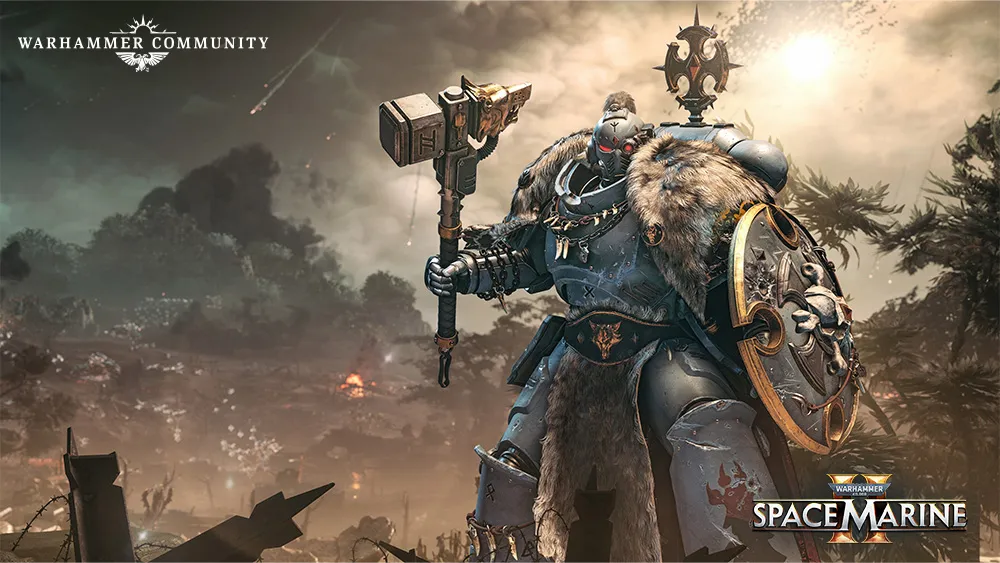
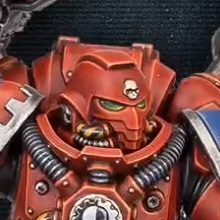
The round shield on Space Marine 2’s Wolf Guard Champion is the bit I keep looking at. There’s a wolf skull in the middle, curved metalwork around it, and enough raised trim to ruin an evening with a detail brush. The tabletop Battle Leader has the same basic shield, right down to the little decorative shapes around the rim. I’ve spent too long comparing the two pictures, considering I don’t collect Space Wolves.
Warhammer Community’s 1 October anniversary update explicitly identifies the Wolf Guard Battle Leader as the inspiration for the new Space Wolves Champion. The armour belongs to the Bulwark class, with a Fenrisian storm shield and modified MkX Tacticus plate covered in fur and fangs. The pack is sold separately and included in Season Pass 3. The one-handed thunder hammer arrived in the same update as a free weapon addition.
I’ve already gone down the rabbit holes for the Lamenters’ penance armour and the Exorcists. This fellow had been waiting while I argued with myself about gene-seed. Looking up his tabletop equivalent brought me back to something I tend to flatten whenever I talk about veteran Marines: a Wolf Guard’s position depends on a particular lord choosing to trust him. That personal appointment affects who gets admitted, who commands when the lord’s away, and whose company you’re looking at across the battlefield.
How a Space Wolf becomes Wolf Guard
Champions of Fenris, in its Grimnar’s Kingsguard section, says each Wolf Lord maintains an elite cadre drawn from the finest warriors under his command. It specifically allows selection through courage, skill and loyalty rather than requiring the longest service or an existing veteran title. A lord notices what a warrior does, judges him worthy, and brings him into his own guard. There’s room in that description for someone to advance very quickly.
The general Space Wolves organisation leaves each Great Company with its own lord and character. Putting a chosen elite inside each of those companies distributes the Chapter’s celebrated fighters across its existing commands. A Wolf Lord has his own people close at hand, warriors he’s seen under pressure and whom he can send to take charge elsewhere. I find that easier to picture than another chart of company numbers, although my Imperial Fists would probably insist I learn the chart anyway.
The honour comes with useful equipment. Lexicanum’s Wolf Guard entry, drawing on the Space Wolves codices, describes access to a Great Company’s best wargear and the option of power armour or Terminator plate. It also describes Wolf Guard leading packs and passing their experience to younger brothers. Membership therefore gives a warrior several possible jobs, including protecting his lord, fighting alongside his peers, and trying to keep a pack alive long enough for its members to learn something.
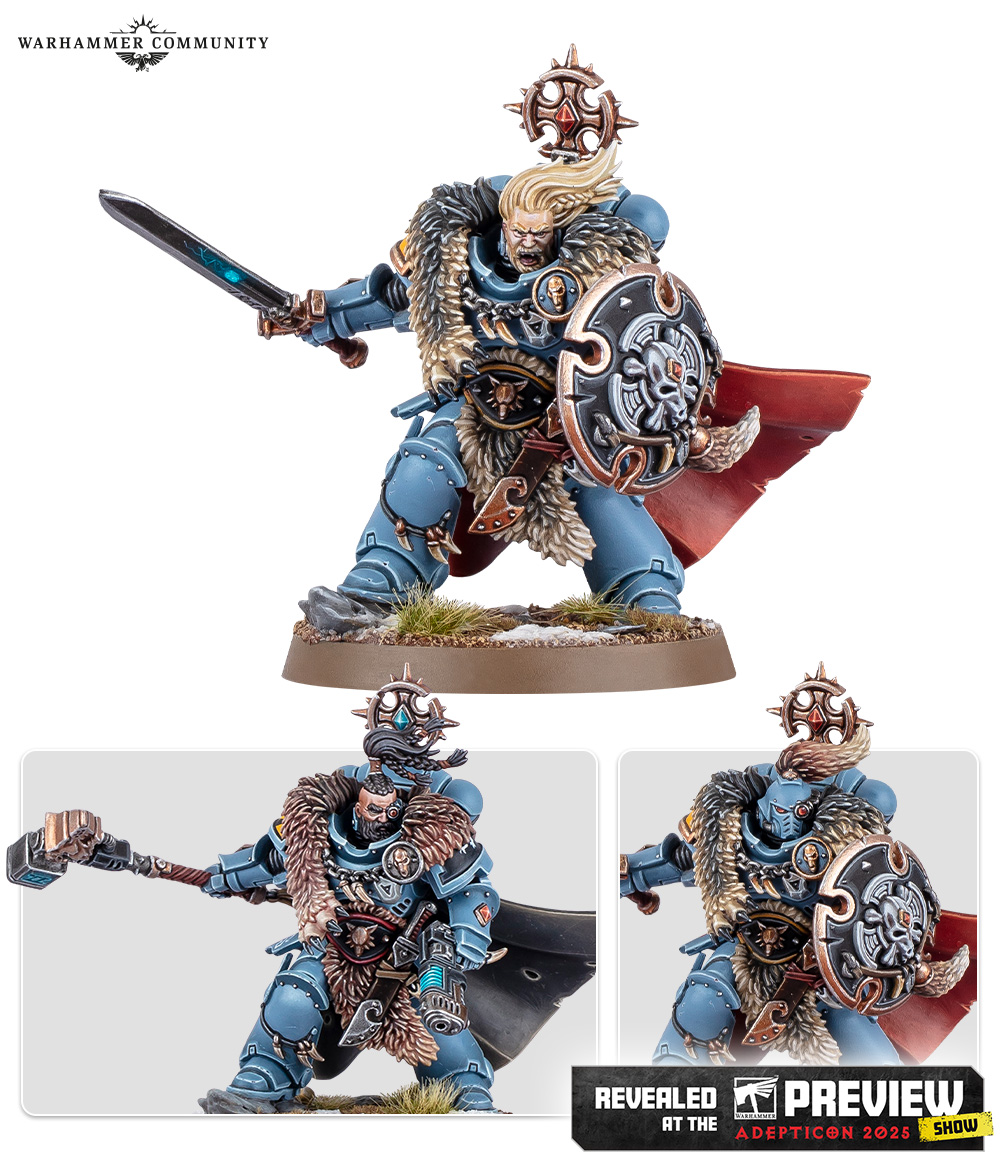
A Battle Leader adds command responsibility. GW’s Space Wolves release preview describes these officers as trusted sub-commanders responsible for several hunting packs, broadly equivalent to lieutenants elsewhere. The miniature offers a sword or thunder hammer, a choice of pistols or shield, and several heads. A Bulwark Champion is a workable visual home for the shield-bearing version, even though a video game class can’t reproduce every duty attached to the rank.
The age point needs a little care. Wolf Guard certainly include old and enormously experienced warriors. The source gives the Wolf Lord latitude in choosing them; it doesn’t turn every promising Blood Claw into an officer overnight. I don’t know how often a young warrior gets admitted compared with a Grey Hunter who’s spent decades earning the lord’s confidence. Champions of Fenris gives us the principle and a very enthusiastic account of Logan’s household, without a recruitment ledger to count through.
Logan’s Kingsguard are an especially large example. That same section describes a body of Wolf Guard big enough to split into several smaller packs. They accompany the Great Wolf into battle and command his forces when other demands take him away. Being trusted to stand beside Logan comes with the possibility of being trusted to act in his absence, which is a considerably more awkward assignment if the campaign then goes badly.
I initially found the whole arrangement appealing because it sounds so immediate. Do something extraordinary where the boss can see you and your career changes. Then I thought about every office I’ve worked in where being visible to the boss affected who got opportunities, and I cooled on it a bit. A Wolf Lord can make mistakes about people too. The supplement is celebrating Logan’s judgement, so we’re mostly being shown the men for whom the system worked. I’d still like a story about the capable Grey Hunter who watched a much younger brother get the invitation.
The guard takes after its lord
Ragnar provides a useful smaller view. Sanctus Reach: The Hour of the Wolf, in Ragnar’s Blood Claws, describes the force he brings to Strike Force Stormclaw. His personal Wolf Guard march beside him, supported by experienced Grey Hunters and Long Fangs, while Blood Claws, Swiftclaws and Skyclaws make up much of the force. The account connects that abundance of eager young warriors with Ragnar’s own comparative youth and temperament. You get a company with a recognisable preference in the way it fights and the brothers it attracts.
Warzone Fenris: Curse of the Wulfen gives Harald Deathwolf a different emphasis in The Deathwolves. It describes the cool-headed veterans around him, men with the patience to stalk prey, and picks out his favoured Wolf Guard Thunderwolf Cavalry, the Riders of Morkai. Those riders have personalised pack markings, sometimes augmented with their own honour badges. The book even names Gunnar Felsmite as a member of the pack. I like entries that bother to name one of the ordinary painted examples alongside the famous commander.
There’s plenty of patience in a Chapter I keep lazily describing as a crowd of shouting men running at things. Harald’s entry also explains a belief behind the animal remains they wear: the creature’s spirit stays attached to its pelt or other remains and lends its qualities to the wearer. That’s the Deathwolves’ belief as the book presents it. A cloak can carry an association with a particular hunt and a hoped-for virtue, as well as being something the painter gets to drybrush.
During 7th edition I spent an entire evening painting the inside of an Imperial Fists sergeant’s cloak. Mephiston Red, increasingly tiny highlights, a bit of grime along the bottom. Then I attached his backpack and discovered that most of the work was hidden. Pete turned the model upside down to see what I’d been complaining about and got a thumbprint in the basing paste. I still pick him up by the backpack, so the only person regularly looking at that cloak lining is me when I drop him.
I have a weakness for that sort of unnecessary surface. Looking at these Wolves makes me want to paint individual marks inside shields, where they’ll be awkward to photograph and largely invisible during a game. My yellow boys already take long enough, and I’ve got a Cadian squad waiting for faces. Adding heraldry to the backs of shields would be an extremely predictable way for me to avoid those faces for another week.
So, the little marks. Yeah. You give a man a name, then a pack, then you start wondering who he fought with before he got that shield. And now you’re choosing a colour for a knee rune. You were meant to be finishing five Marines. I’ve done this with the same sergeant for three evenings running.
Somebody else wore that Terminator suit
GW’s Wolf Guard Terminator reveal says their ancient armour carries runic carvings and Fenrisian totems, often left by previous wearers. That’s a particularly good complication for an army full of personal trophies. The current warrior has his own honours, and the suit may already have things on it that belonged to a brother who died before he inherited it. The pictured models have enough surfaces for a painter to decide which details came with the armour.
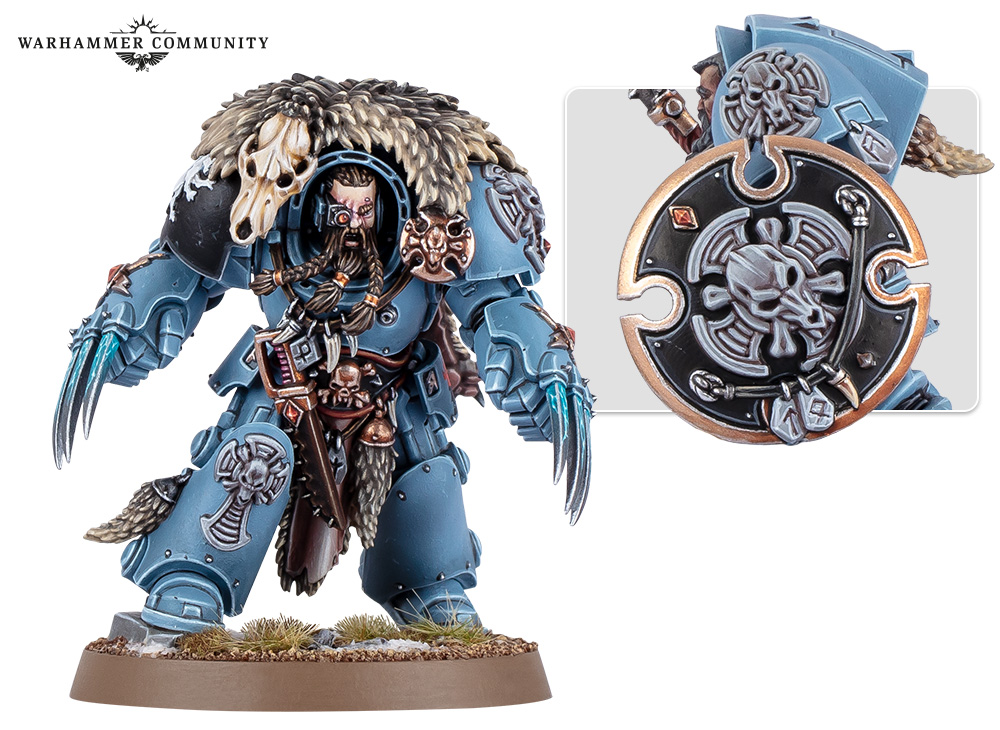
In Curse of the Wulfen’s The Champions of Fenris, individual Kingsguard markings receive names and explanations. Hagrik Wyrdfang belongs to Daggerfist’s Voidclaws, with black wolves signifying death. Groka Helmsmiter appears as a Terminator of Wulftongue’s Shieldbrothers. The entry gives each of Logan’s Wolf Guard individual pack heraldry associated with his prowess. These details let you describe a particular member of a particular pack without needing to invent an entire Great Company around him.
The same section records Logan’s changing insignia. His earlier device was the Night Runner; after becoming Great Wolf, he and many of his warriors adopted the Wolf That Stalks Between Stars, on the Great Wolf’s black field. An appointment changes the visual identity of the men around him. If I were painting a Kingsguard force, I’d be tempted to keep an older device somewhere on a veteran’s equipment, and I’d label that as my modelling choice when showing the squad.
There’s an earlier version of the personal guard in White Dwarf #427’s Space Wolves Praetor and Varagyr Wolf Guard. It describes Leman Russ personally choosing the Varagyr from his own Great Company to serve as his honour guard. They wear rune-marked Cataphractii plate and Fenrisian furs. The Heresy models bring that vocabulary into a different armour silhouette, with weapons mounted at the wrists and fur hanging over those enormous shoulders. I’ve resisted buying them because I know exactly how slowly I’d paint all the little teeth.
The Space Marine 2 Champion uses current Tacticus armour, a round shield and a heavy fur mantle. The tabletop Battle Leader next to him makes the adaptation easy to follow: the raised backpack ornament, the fur around the shoulders, the belt decoration, the shield. I can’t identify a canonical owner for every rune or trophy on the game model, and the announcement doesn’t supply a personal saga. There’s enough there for me to read him as a decorated officer without pretending I’ve decoded his whole service record.
I’d quite like to carry one of those details back to the tabletop. A Wolf Guard with a slightly mismatched shield, an inherited rune left on a greave, a pack marking chosen after figuring out which lord he follows. I’ve already spent enough time on Bjorn and the long memory of the Space Wolves to enjoy the idea of equipment hanging around across several owners. For a single Battle Leader, I’d start by writing down the name of his pack and painting the shield before attaching the arm. The inside, too, if I could still reach it.