There’s a paragraph in the designer’s notes for the new Horus Heresy Journal Tactica that I’ve now read about six times, and it isn’t a rule. It’s a disclaimer. GW is adding a full Daemons of Tzeentch army list to the Age of Darkness, and somebody in the studio clearly knew that the second they did, a large number of people would open the comments to point out that Heresy-era daemons aren’t supposed to have names yet.
So the note gets ahead of it. The heading is “Daemonforms of the Horus Heresy,” and it concedes that previous writing on daemonic activity in this period “explicitly mentioned that Daemons of this era were not fully formed and usually indistinct.” Then it says the title Daemons of Tzeentch “was only one retroactively applied by the keepers of the most dangerous knowledge in the Imperium, and at the time of the Heresy itself, the Daemonforms that beset the Imperium were not fully understood as their patrons ascended to power.”
Nobody in the Heresy said Tzeentch. That’s a word from the filing that got done afterwards, by people who had the reports in front of them and a century of hindsight to read them with.
Eight Ætheric dominions in the Horus Heresy list
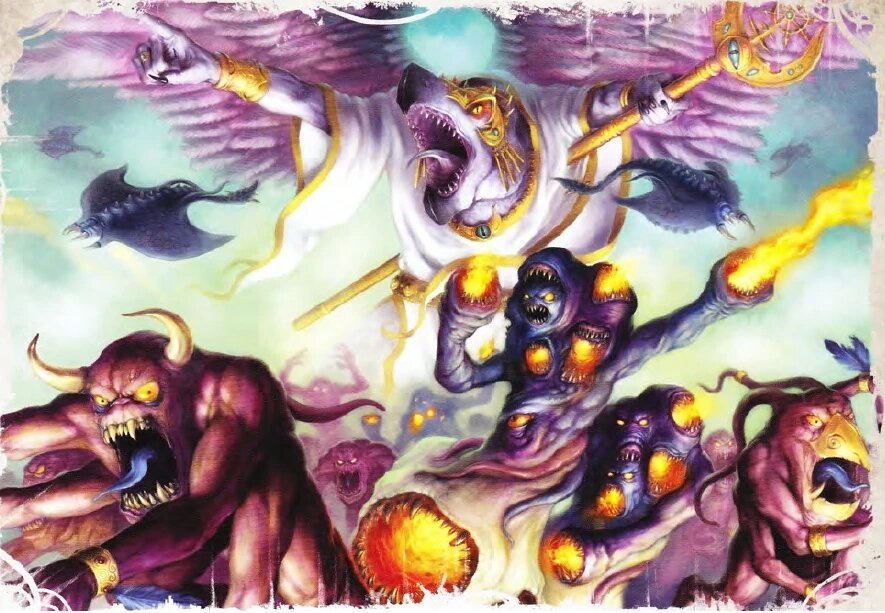
The list this is bolting onto is Daemons of the Ruinstorm, which turned up in Forge World’s Book VIII: Malevolence in 2019. Seven years, which is most of the time I’ve had a Thousand Sons army. The whole design of that list is an act of withholding. Every unit in it is a generic noun with “Ruinstorm” in front of it. Daemon Sovereign. Daemon Harbinger. Daemon Hierarch. Brutes, Swarms, Beasts, Behemoth, Harriers, Riders, Lesser Daemons. No Bloodletters, no Plaguebearers, no Horrors, nothing that maps to a god you could name.
What the units do have is an Ætheric Dominion trait, and there are eight of them: Encroaching Ruin, Heedless Slaughter, Putrid Corruption, Rapturous Sensation, Formless Distortion, Infernal Tempest, Ravenous Dissolution, Malevolent Artifice. You can read the god off most of those in about a second, which is the joke. When GW put the free army list PDF up, the designer’s notes described the dominions as “the uncoalesced, ascendant forms of the Chaos Gods before they truly rise to their full power,” and said that the resemblances being blurry was “wholly intentional and is a reflection of the unformed, unfocused nature of the Ruinstorm daemons of the early Heresy.”
Both sets of notes are credited to a Ben in the Warhammer Studio. I’m assuming it’s the same Ben, in which case he’s now written the designer’s notes on both sides of this question.
Where Tzeentch sits on the compatibility chart
The new rule is called Alignment of Ruinous Powers, and it says Tzeentch daemons can be fielded alongside daemons with four specific dominions without penalty: Infernal Tempest, Formless Distortion, Encroaching Ruin, and Malevolent Artifice. Mix in any of the other four and every daemon in your army takes minus two to Leadership, Cool, Willpower and Intelligence, because the infighting gets bad enough to show up on a stat line.
That’s a compatibility graph. GW has never told us which dominion belongs to which god, and now it’s published a table that tells you which ones a Tzeentch army gets on with. If the Star of Chaos were doing the work here you’d expect one exclusion, since Tzeentch’s opposite number on that diagram is Nurgle and nobody else. Instead half the dominions are off the menu. Which either means the mapping isn’t clean, or it means Heedless Slaughter and Rapturous Sensation are exactly what they look like and Tzeentch is just harder to get along with than the diagram suggests. I’ve gone round on this twice and I don’t have an answer I’d defend.
There’s also Samus, sitting in the Ruinstorm list as one of three named Lords of War alongside Cor’bax Utterblight and Ka’bandha. Ka’bandha is a Bloodthirster, which means GW has been putting a Khorne greater daemon on the Heresy table under a proper name for years without ever writing the word Khorne next to him. And Samus, from the opening act of Horus Rising, arrives with his name already in his mouth. He announces himself, in the first Horus Heresy novel GW published, years before anyone thought to write a dominion trait.
I had an argument about this with Kiran that ran the length of an entire evening and most of the drive home. He’d started a Ruinstorm allied detachment to go with his Death Guard, all Putrid Corruption, and he kept calling them his Nurgle daemons. I kept telling him they were Putrid Corruption daemons and that Nurgle didn’t come into it, because the distinction was the entire point of how Forge World wrote the list. He asked me what I thought Putrid Corruption was supposed to be. I said that wasn’t the question. He said it was very much the question. This went on. At one point I actually got the PDF up on my phone in a pub to read the dominion text aloud, which is not a thing I’d like broadcast. And the thing is he was right, or right enough. I was defending a distinction the rules never asked me to make, and I was doing it in the tone of someone who thinks he’s the only person in the room who’s read the book…
GW has run this move before
The retroactive label is old. It’s how the Thousand Sons’ whole origin has been written for at least a decade.
White Dwarf #413’s Magnus and His Brothers covers the bargain that saved the Legion from the flesh-change, and the sentence it uses is this: “Though it’s unlikely that Magnus knew at the time, the benefactor that saved his Legion was the Chaos god Tzeentch, the everscheming Changer of Ways.” The mutations went into remission, the psychic gifts stayed, and the price was Magnus’s right eye. He didn’t know who he’d paid, and the White Dwarf text hands you the name anyway, from ten thousand years further down the line.
That’s the same move as the new designer’s note, run ten years earlier on a single primarch. The Heresy gets narrated by people who already know how the story ends, and they can’t stop themselves annotating it with vocabulary the participants didn’t have. It’s the family photo album where somebody has gone through in biro decades later, writing names on the back of every picture, and some of those names are guesses made by a person who wasn’t in the room.
The Imperial Truth makes this worse in a way I find genuinely funny. The official Imperial position during the Great Crusade was that daemons don’t exist. So the people best placed to build a taxonomy of daemons were forbidden from admitting there was anything to classify. Whatever records survived that period survived as heresy, in caches, kept by exactly the sort of people who’d later be executed for having them. Any Heresy-era account of a Lord of Change is somebody’s illegal notebook. The Order Elucidatum existed to find those notebooks and the people holding them.
The Legion that didn’t know what it was buying
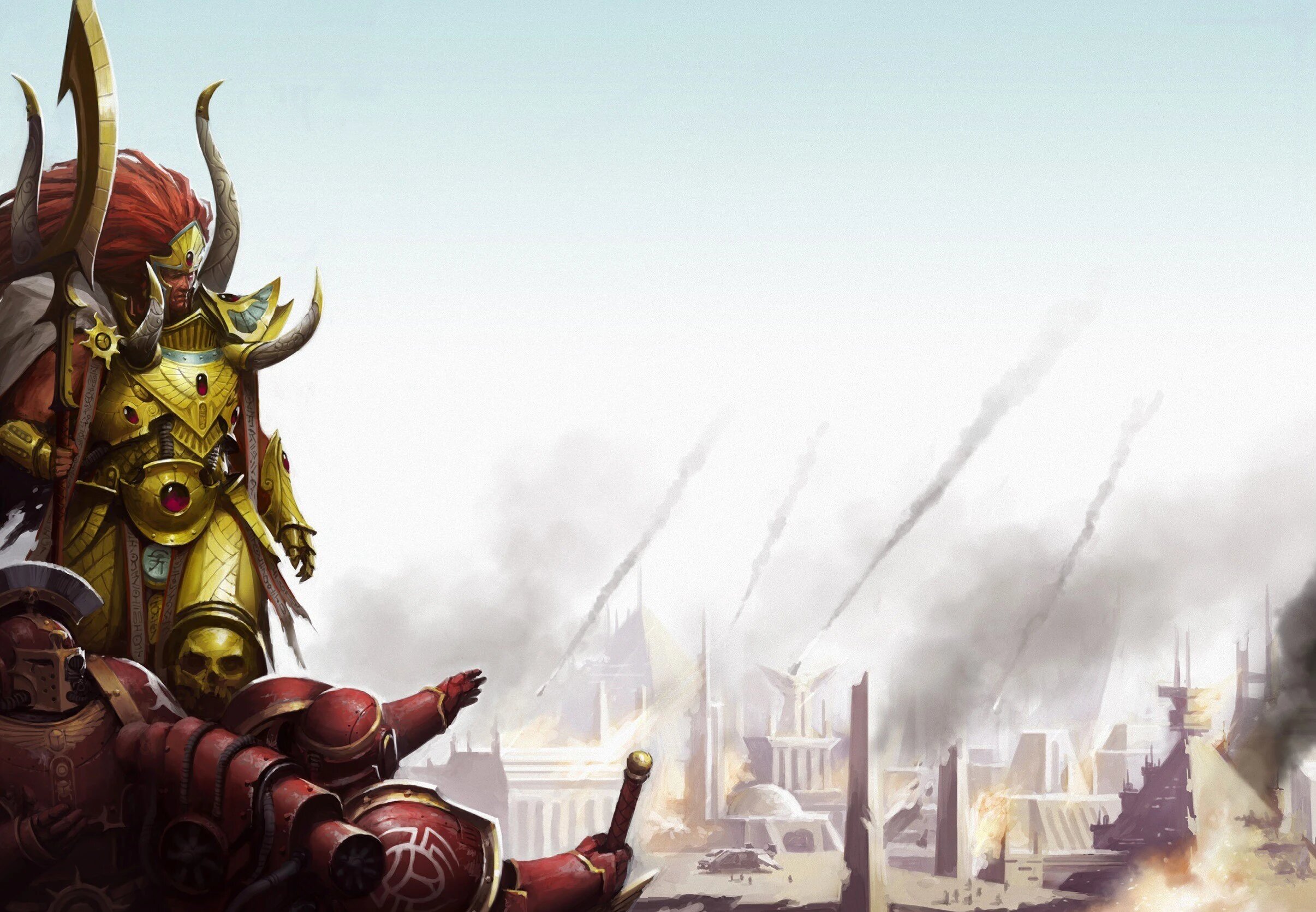
Prospero, then. Of all the places GW could have hung a Tzeentch army list, they picked the one where the Thousand Sons lived.
They’re the Legion built on knowing things. Every recruit who makes it through is a psyker or nothing, the whole culture is libraries and cults of learning and Tizca’s silver towers full of books, and Magnus spent his life insisting that knowledge itself was neutral and the Emperor was a coward for saying otherwise. And the single most important transaction in their history is one where they didn’t know the name of the counterparty. White Dwarf says so in those words.
Then Russ turns up, the libraries burn, and Magnus makes the second deal, the one where he does know. And after that comes Ahriman and the Rubric, which is the Thousand Sons trying to solve a problem with a spell they hadn’t finished understanding either, and turning most of the Legion into dust in armour for their trouble.
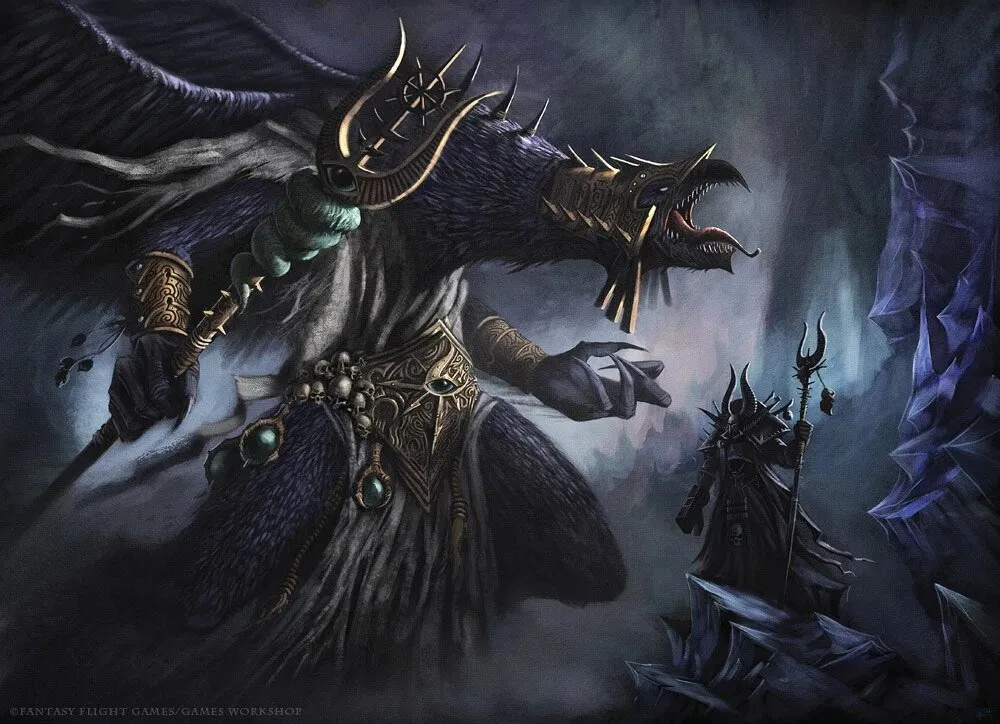
The Journal Tactica sits inside the Prospero Burns – The Judgement of Valdor book that ships alongside the Custodes Support Battle Group. Mechanically the Tzeentch list gets a High Command Ascendant Lord, a Herald, Flamers as Support, Screamers as Recon, Horrors as Troops and a Lord of Change as Warlord. Pink Horrors split into two Blue Horrors when they die, via a reaction called Infernal Mitosis, and the little pink lads doubling themselves out of spite is still my favourite bit of nonsense in the whole daemon range. There’s a Fateweaving psychic discipline with a power that phases a ruined building out of the material dimension so you can draw line of sight through it, which I want to see somebody try to adjudicate at an event. There’s also a Solar Auxilia doctrine called the Fateweaver Cohort that turns ordinary lasrifle troopers into disciples of Tzeentch and hands the Psyker trait to anyone with the Command sub-type, and I’d read a whole book about how that unit thinks it got there.
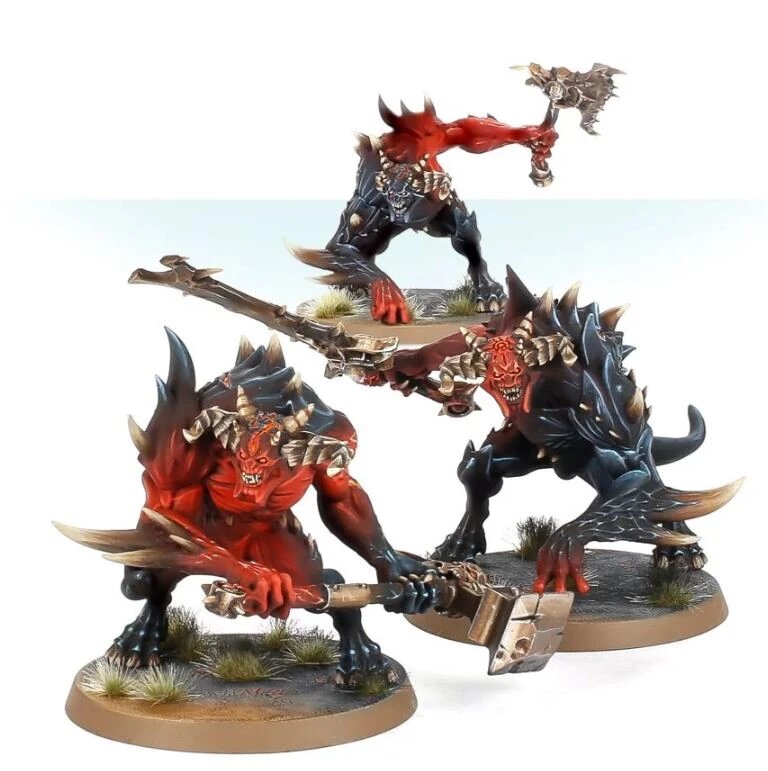
None of that changes what’s on the shelf, though. There are no Heresy-specific Tzeentch daemon kits, so this is the 40K Chaos Daemons range with a different army list stapled to it, same as the Ruinstorm list has always been. I’ve watched three separate people at my local store field Bloodletters as Ruinstorm Lesser Daemons over the past couple of years, and nobody’s ever blinked at it, because the alternative was not fielding daemons. Now those same models can go down as Horrors, with a proper datasheet, a Blue Horror reaction, and a god written on the list sheet in full.
Somebody with better Prosperine white than me is going to paint a Lord of Change to match the Tizca terrain and it’s going to look absurd, in the good way.