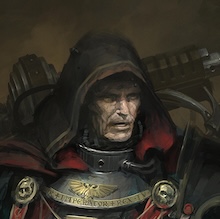
Nekrosor Ammentar makes me wonder what happens when a Necron opens a vault and finds the contents missing. A shard of the Nightbringer, presumably secured by people who understood exactly how dangerous it was. Gone. Somewhere out there, Ammentar has added it to the others, and the next tomb complex on its route has to decide whether to open the door. I’d quite like a story told from inside that second tomb.
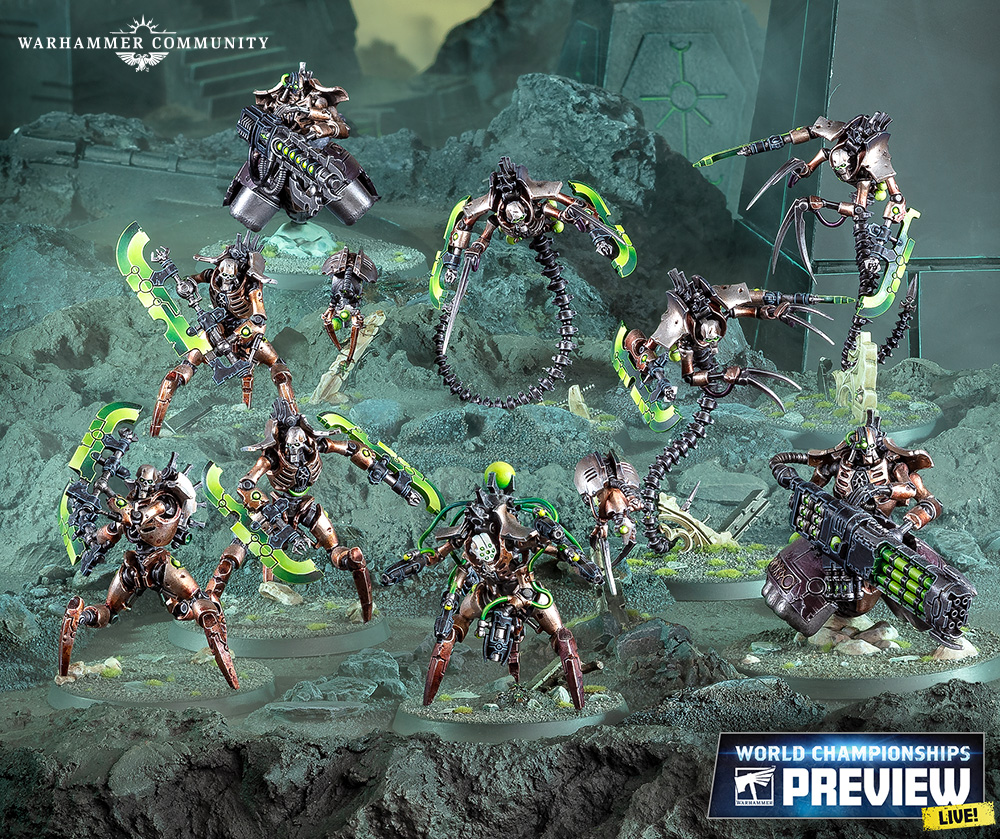
GW’s Christmas Battleforce announcement puts Ammentar and a C’tan Shard of the Nightbringer together in Disciples of the Nekrosor. The box also contains three Ophydian Destroyers, a Canoptek Doomstalker, ten Necron Warriors, and three Scarab Swarms. Pre-orders are still described as coming soon. The pairing returns to the premise of 500 Worlds: Titus, whose original reveal explicitly gave Ammentar multiple Nightbringer shards already.
I like having a Necron character whose ambitions could make another Necron barricade the entrance. There’s plenty of room in the faction for the people threatened by this thing: nobles with territories, Crypteks with work they intend to finish, entire courts already occupied with some exquisitely petty disagreement. You can imagine the interruption halfway through an audience, while an Overlord is still deciding which title the messenger forgot to use.
Nekrosor Ammentar has a very specific collecting problem
The original Ammentar reveal states the project plainly: gather the Nightbringer’s scattered fragments and revive the whole star god. The attack on Ultramar gives that project somewhere to happen, with Titus and the Second Company fighting on the Vespator Front. I find the collection itself more unsettling than another map covered in arrows, mostly because of what Necrons went through to produce those fragments.
White Dwarf #383’s What Is a Necron? describes the rebellion against the C’tan as a ruinously expensive undertaking. Szarekh waited for an opportunity, the Necrons brought extraordinary weapons to bear, and their former masters were broken into fragments secured within tesseract labyrinths. Millions of Necrons died in the fighting, including the other members of the Triarch. The passage places the revolt before the survivors sealed their tomb complexes for the Great Sleep.
There’s a useful smaller example in Shield of Baal: Exterminatus, in the section Nyadra’zatha, the Burning One. The account presents a fragment confined by ancient technology, with a reality-bending creature inside the prison. That’s already an alarming thing to bring along on a campaign. The decision to release the Burning One rests with Anrakyr in that account.
Ammentar wants the Nightbringer whole again, not merely another captive shard to deploy. That’s the ambition I keep having to pause over. Each additional fragment could mean another search, another defended site, another set of Necrons with an excellent reason to interfere. For a narrative campaign I’d be interested in the recovery attempts themselves, including a failed one where the custodian escapes with the prize. A recurring antagonist can get quite a lot done while still leaving several vaults unopened.
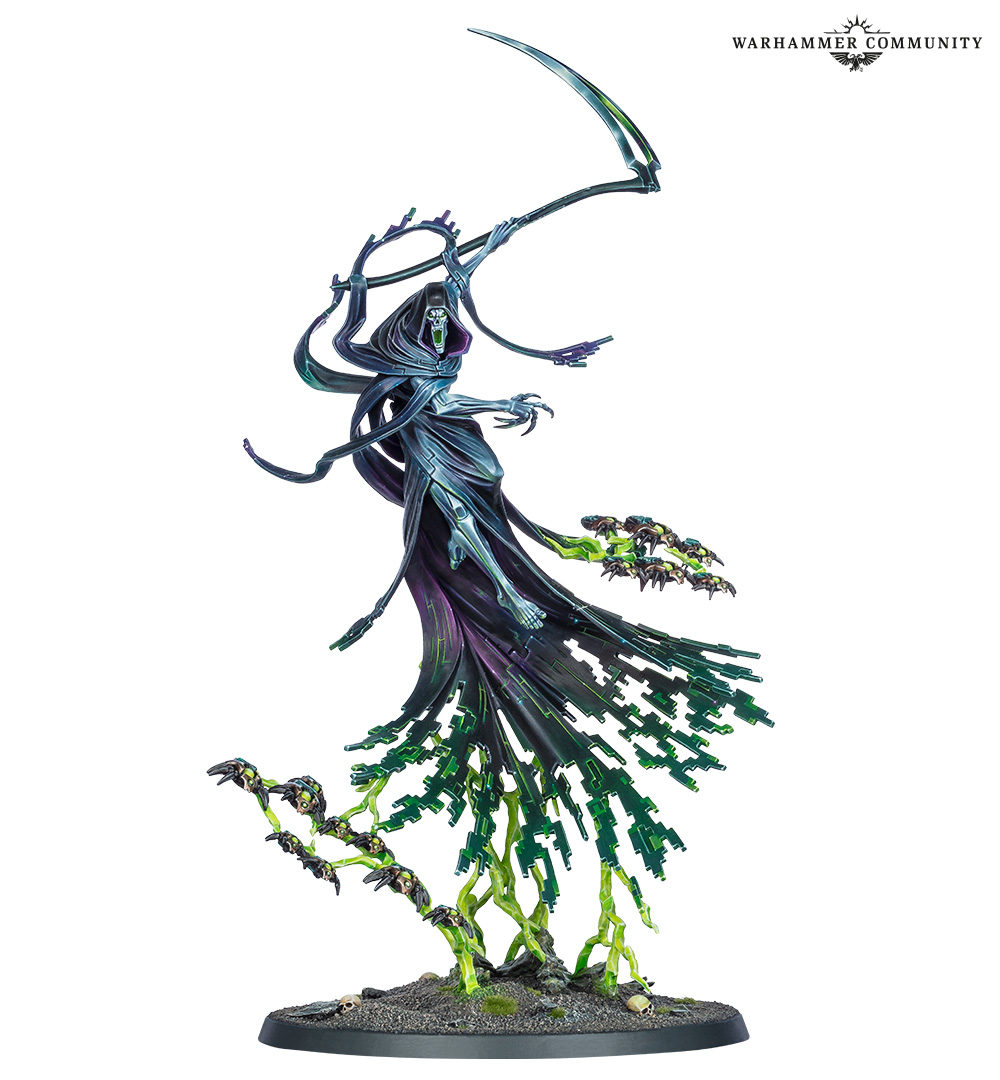
The Nightbringer’s own miniature reveal identifies it as Aza’gorod, called Kaelis Ra by the Aeldari, and places its imprisonment within the Necrons’ revenge for biotransference. White Dwarf #450’s Biotransference gives that grievance its horrible physical setting: the furnaces consume the Necrontyr’s bodies while the C’tan feed on the essences being cast off. Szarekh experiences the spiritual emptiness of his own new body as the process unfolds around him.
You can see why a court would struggle to find a polite response to Ammentar’s enthusiasm. The star gods belong to the catastrophe that made the Necron dynasties what they are. A noble might have survived the furnaces, the rebellion, and the Great Sleep, carrying some version of those events through all of it. Then the visitor announces its plans for Aza’gorod and expects cooperation with the retrieval arrangements.
The official lore introduction describes Ammentar’s fascination as approaching religious devotion. It leaves the cause uncertain, suggesting immense age or an ancient injury. I don’t know how much of that devotion Ammentar could explain during one of its lucid intervals. I’d be wary of supplying a coherent theology on its behalf, especially when the published description allows for a damaged mind finding an object for its fixation.
Actually, I might be making the shard hunt sound too manageable. The scattered fragments give a writer useful intermediate objectives, which I like. They also make it very easy for the promised reunion to sit permanently over the horizon while another campaign ends inconclusively. I’d get impatient if Ammentar spent years collecting exactly enough pieces for the next boxed set. The original reveal’s decision to give it several shards already does help; there’s something tangible for the defenders of Ultramar to deal with.
And yes, I love the horrible floaty scythe lad. The Scarabs peeling away beneath the new model are especially good. I can already picture myself getting gold on one of those green connections, trying to correct it, then correcting the correction. I’d have to paint those Scarabs in batches.
The Crypteks have work for you
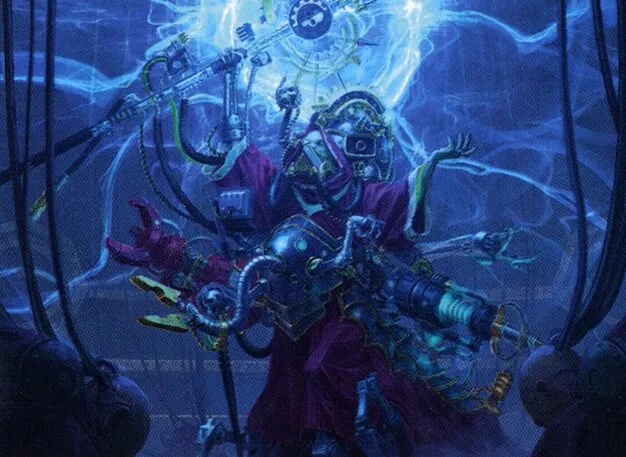
Ammentar’s methods make the approach to a tomb world unpleasant long before a C’tan gets involved. According to the lore introduction, proximity to the Nekrosor corrupts Necron minds across the hierarchy, and its enthralled Crypteks forcibly convert those who resist into Destroyers. A new arrival can therefore bring both the mental affliction and the specialists capable of rebuilding its victims. The Crypteks are already accompanying it when the conversions begin.
An Overlord has practical reasons to worry about the Crypteks. These are the people who understand how the machines work, and a tomb depends on specialist knowledge accumulated over absurd stretches of time. Picture a chamberlain discovering that the technician assigned to inspect a damaged warrior has acquired a new patron. Who else has the access needed to check what was done? I’m extrapolating a scene here, but the published forced conversions give it an uncomfortable starting point.
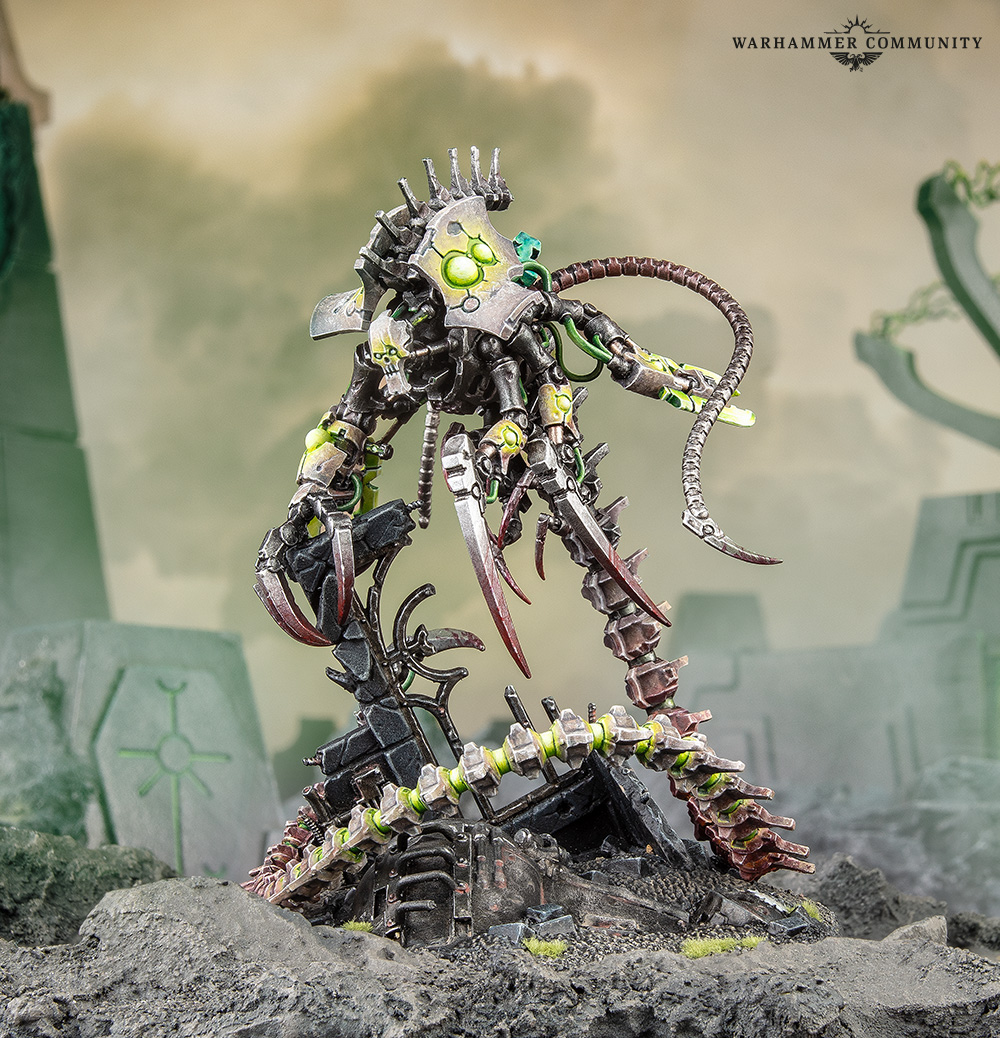
The body has its own place in this. In Imperial Armour Volume Twelve: The Fall of Orpheus, Touched by Madness describes Destroyers as Necrons who have succumbed to violent nihilism and abandoned their humanoid forms. I find that account useful for thinking about the experience of someone subjected to conversion. A Necron’s existing body can be altered around an obsession until the new silhouette has very little of its old shape left.
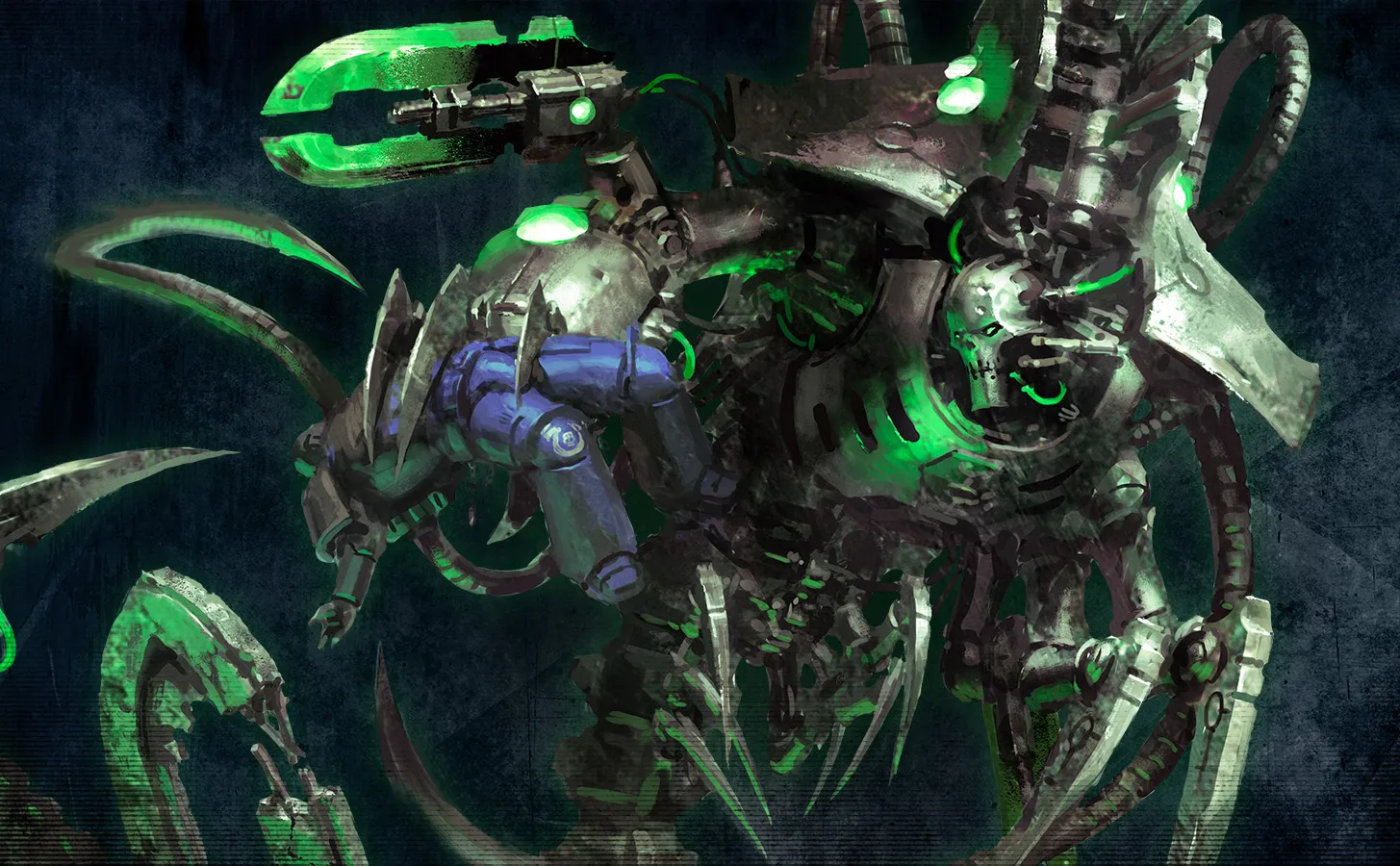
For a Destroyer, the rebuilt form accommodates the fixation on killing. Ammentar has an enormous amount of that work visible on the miniature: projecting blades, extended limbs, a segmented tail, weapons tucked into a body that looks awkward to approach from any direction. The skull sits beneath the raised carapace, where I initially had trouble picking it out. Looking at the model from the front helped me understand the illustration’s arrangement of the head and shoulders.
I had a much less ambitious problem with tiny faces in 2019. I’d decided the eyes on my Rubric Marines needed Moot Green, despite having barely finished the gold trim. Used a brush that was already hooked, got green across three helmets, then tried washing the lot back with blue. Kiran asked why that squad looked seasick. I spent the rest of the evening repairing one helmet and put the other two at the back of the tray. They’re still there; I know which models they are when I pick the unit up.
An enthralled Cryptek might retain every technical skill its court once relied on. That’s an especially nasty possibility for a noble who has depended on a particular specialist through several awakenings and disasters. There’s a relationship there, potentially older than the Imperium, with obligations on either side. What happens to the old relationships when the same hands start performing these conversions?
The recruitment process also makes resistance a question of timing. When do you realise the visitors have affected your own judgement? How do you decide which guards can still be trusted to watch the chamber? Those are questions I’d like fiction to spend time on. An Overlord can order an execution or seal a passage, provided it recognises the danger soon enough to give the order and still has servants able to carry it out.
The first Destroyer is still a suspicion
GW deliberately leaves space around Ammentar’s earliest history. The original reveal says memories of its origin appear to have been forcibly removed, and points towards the Silent King’s authority to make changes on that scale. The later lore introduction treats its status as the first victim of the Destroyer affliction as a suspicion, with confirmation unavailable. Calling it the proven creator of every Destroyer would run ahead of those descriptions.
I’ve written about Szarekh and Necron memory before, and the temptation to blame him for everything gets quite strong once you start looking. I ought to resist it here. The missing memories establish a mystery around Ammentar; we still need the intervening events before assigning a particular motive to whoever removed them. Guilt, containment, and the protection of some surviving secret would each produce rather different stories.
The uncertainty leaves room for encounters between Ammentar and characters who have their own incomplete account of the past. I’d happily read a Cryptek recognising a modification it remembers making, then struggling to remember the recipient. That’s an invented possibility, obviously. The interesting part would be how much evidence the character needs before acting, particularly with its own mind becoming harder to rely on during the investigation.
So, look. I’m being greedy here. I want the poor bastard who has to check the inventory afterwards. Give me that job, that particular awful afternoon. The chamber’s empty. There’s a transfer record somewhere. Who signed it? I’d read the ensuing argument between the surviving staff, even if it took a chapter to find the record.
There are plenty of Necron quarrels available for that story to get tangled in. Imotekh’s dispute with the Silent King already gives dynastic politics an enormous unresolved problem. I’d want Ammentar’s arrival to catch a smaller court halfway through its own business, with grudges and obligations that make an orderly evacuation difficult. Someone has to decide what to take, and there may be a shard in the vaults that ought to stay secured.
One small detail I’d missed until reading GW’s original rules preview is tucked into its footnote: Nekrosor is a title, and virtually no Necrons remember its meaning. Ammentar has a name, a collection, and a title whose translation has mostly gone missing. I’d like to know which court still has a record of that word.