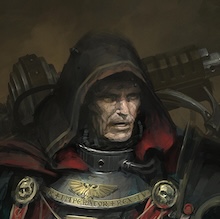
Nathaniel Garro’s ship was stranded, its Navigator dead, its warp engines coming apart. His solution was to eject the engines and detonate them. In Visions of Heresy’s account of the flight of the Eisenstein, he hoped the explosion would attract another ship. The engines were ejected from a ship whose superstructure was already close to collapse.
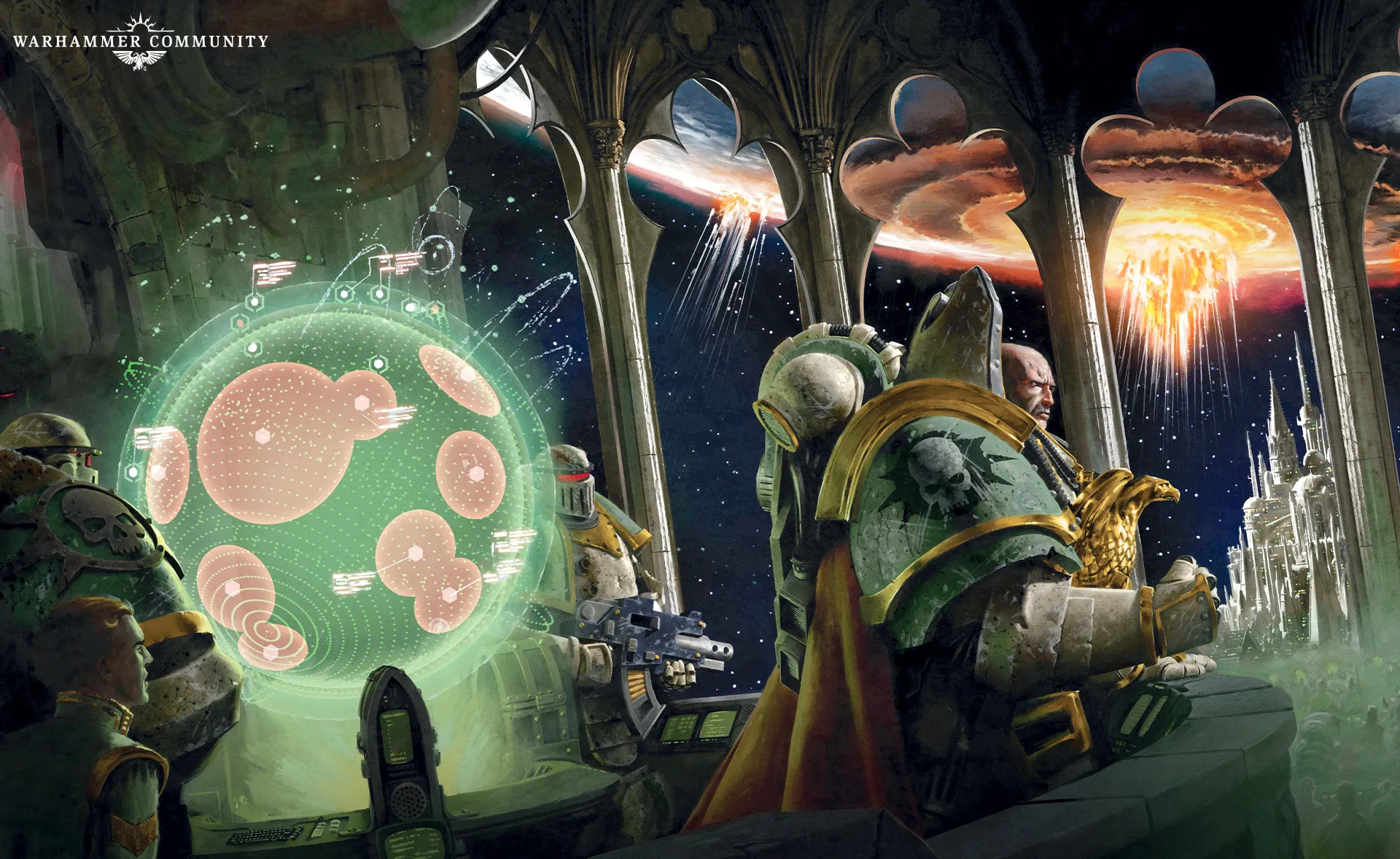
The new cover reveal for The Flight of the Eisenstein, published on 14 October, catches him earlier in the disaster. Garro stands on the bridge with destruction visible through those enormous gothic windows. James Swallow’s novel is the fourth entry in the Horus Heresy Saga selection; the matching Special Edition has faux leather, foil detailing and a metal badge. WarCom says pre-orders are coming soon, with no date announced in that article.
I keep coming back to the part after the escape. Remaining loyal costs Garro the chain of command that once made his decisions straightforward, and the Imperial authorities who receive him have plenty more decisions ready for him. He gets through the blockade, brings his warning, survives the scrutiny. Malcador sends him off to find other Space Marines whose lives have also come apart.
Nathaniel Garro has seventy men and a damaged frigate
Visions of Heresy, in its section on the Isstvan rendezvous, describes the conspiracy as a personnel problem before the killing begins. Horus, Angron and Mortarion discuss whether their warriors can be relied upon to follow the rebellion. Eidolon reports for the absent Fulgrim. Each Legion contains men whose loyalty to the Emperor makes them dangerous to the plot, and the commanders arrange to dispose of those men at Isstvan III.
Knowing that makes the Legion badge uncomfortable to look at. The skull on the shoulder still describes a whole lifetime of service. There’s nothing on it to tell a captain that his primarch has put colleagues on a list of people to murder. Garro has to make sense of events using relationships and habits formed during the same campaigns as the officers carrying out the purge. I find that easier to get my head around when the story stays close to one frightened ship and the people aboard it.
The Visions section titled Flight of the Eisenstein calls Garro a Terran veteran who’d fought alongside the Emperor during the Great Crusade. It gives him seventy fellow loyalists aboard the commandeered vessel. They take repeated hits passing the blockade; their astropaths die and their Navigator is mortally wounded. Reaching open space leaves them with a damaged ship and no way to send the warning ahead.
The loss of the astropaths is an especially nasty detail. There’s no opportunity to transmit the evidence and let the crew concentrate on staying alive. Every delay keeps Terra ignorant. Someone has to carry that information across the distance, in a hull that Horus’s fleet has already been shooting holes through. I normally skim travel in Heresy summaries because the destinations are familiar, and this is where that habit does the book a disservice.
Garro orders a warp jump because the pursuing ships can catch them in realspace. The passage goes badly. Their Navigator can’t chart a safe course through the gathering storms, and Garro orders an emergency return to realspace. After the Navigator dies, the unstable engines leave the vessel at risk of destruction or another uncontrolled plunge into the warp. That’s the situation in which he orders the detonation.
It works because Rogal Dorn’s fleet is nearby, also held up by the warp storms. The Imperial Fists’ Navigators detect the explosion and locate the wreck. Visions has Dorn hear Garro’s account, dispatch much of his fleet towards Isstvan, and escort the survivors towards Terra. The rescue depends on another fleet having difficulties of its own, which gives the whole episode an awkward bit of luck I like. Nobody aboard the Eisenstein could have known who’d see the signal.
The Emperor is unavailable
There’s a short scene in Visions of Heresy called Malcador and Captain Garro. Dorn brings the Death Guard captain before the Regent and asks to see the Emperor about a matter of enormous importance. Malcador tells him the Emperor won’t see them. Garro must give his account to the Sigillite instead.
After all that, an appointment problem. A primarch has personally brought the witness to the Palace and they’re still going through the person who manages access. The scene barely needs dialogue to make me feel tired. The scene ends with Garro recounting Isstvan III to Malcador, with Dorn present.
The next stage is harsher. According to Visions’ Knights Errant section, Garro is held in isolation and subjected to tests and trials before Malcador judges him suitable for service. The source doesn’t give me a timetable for that process. I don’t know how long he has to sit with his warning already delivered, wondering what the people outside his room have decided about him.
I think the testing makes sense. He’s wearing the colours of one of the Legions implicated in a rebellion, carrying information the government urgently needs to establish as true. Letting him walk into sensitive rooms immediately would be reckless. Then I picture the men who followed him onto the frigate, and I start resenting the whole arrangement again. The account leaves the tests undescribed, so I can’t decide how reasonable the precautions were from that passage alone.
Malcador appoints him Agentia Primus. His new task is to travel under the Sigillite’s authority and recruit particular Space Marines into the Knights-Errant. The names and the purpose come from Malcador. The account describes him searching for specific recruits across the galaxy, with Malcador determining who should be approached.
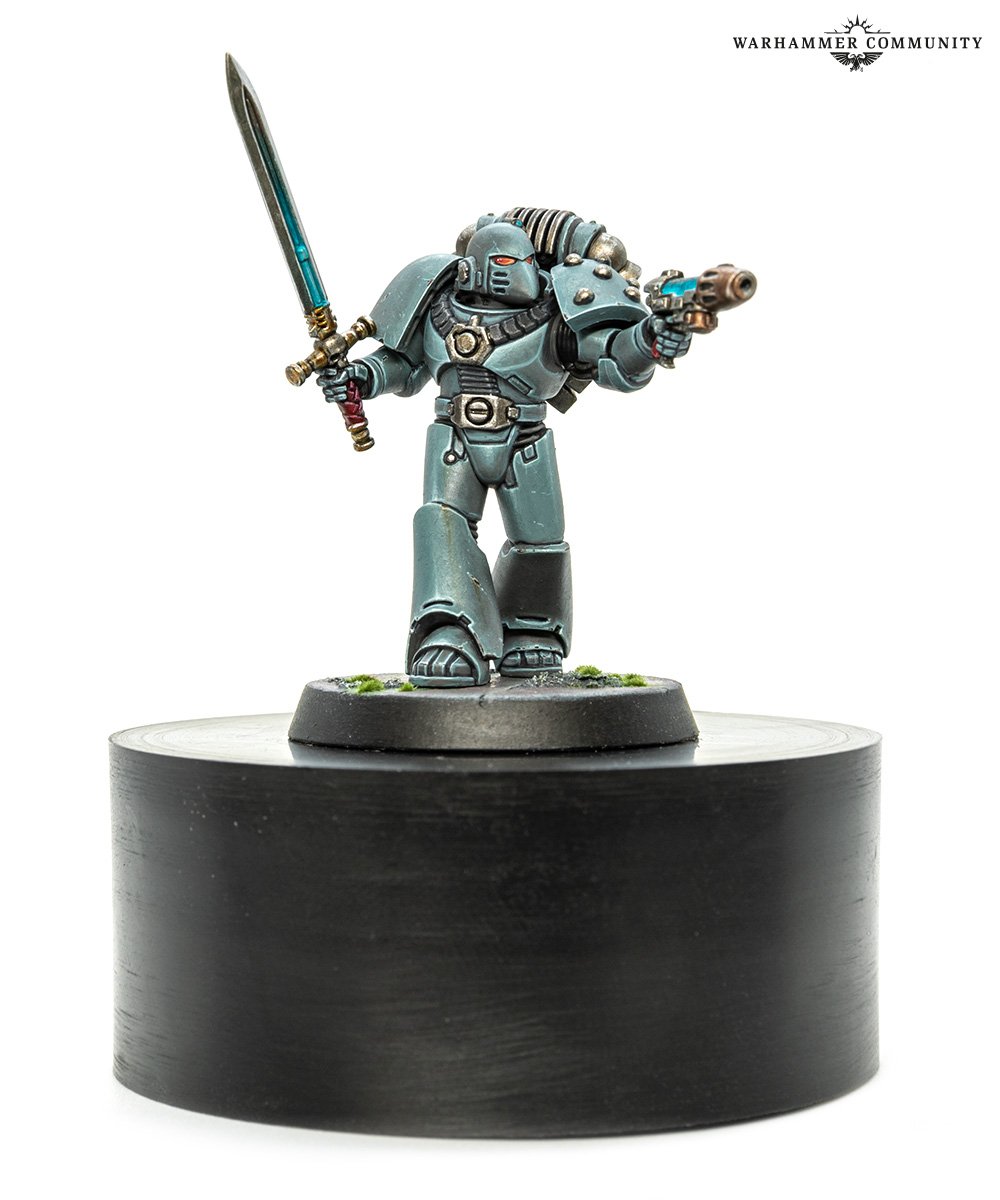
A Knight-Errant conversion from Warhammer Community’s staff Legends of Paint event. Image: Games Workshop.
Recruiting for the Sigillite
The Legacies of the Age of Darkness: Legiones Astartes background adds a useful administrative detail to Garro’s appointment. The initial list of roughly two dozen names came to Malcador through the loyalist Luna Wolf Severian. Garro’s assignment takes him and his growing band across the galaxy, searching for warriors who can be brought into the new organisation. The same entry describes him renouncing his oaths to the traitorous Death Guard before swearing service to Malcador.
That’s a difficult introduction to make at somebody else’s war. Hello. Your command structure may already be compromised. Here’s a man from a Legion currently helping Horus, and he’s got a message from Terra. Yes, that Terra. No, you probably can’t check with your primarch. I can imagine getting through about half the explanation before somebody orders the doors locked.
Visions names Iacton Qruze, Tylos Rubio and Macer Varren among the men called into this work. It says the selection criteria and missions were known only to Malcador, and that the surviving names give an incomplete picture of the organisation. Some recruits were lost to the war. Plenty of the Knights-Errant had served as Librarians or possessed latent psychic ability, which became valuable as the daemon threat grew.
The grey armour suits that precarious arrangement. The Legacies entry describes exceptionally fine equipment beneath the plain heraldry, supplied through Malcador’s household. I like the thought of an observer seeing a rather anonymous Marine and failing to appreciate how much political backing has arrived in the room with him. The source puts the supply of those weapons and armour through the Sigillite’s household.
During 8th edition I used a spare Chaos Sorcerer as a stand-in for almost every human-sized objective character our little narrative games required. Thousand Sons collection, limited budget, one available base. I once announced that my blue-and-gold idiot was a loyalist agent and Kiran asked whether the enormous Tzeentch symbol was part of the disguise. We left him on the table. I still use him when a scenario wants a prisoner, with the familiar still glued to the base.
There’s a temptation to file Garro straight into the Grey Knights’ origin story and move on. Visions describes a separate selection within the Knights-Errant: Malcador chooses eight champions to present to the Emperor. Recruitment into the larger organisation and selection for that group are different stages. Garro’s job already has consequences before anyone gets as far as Titan, because he has to find men, persuade them, and bring them through a galaxy in open revolt.
I prefer leaving some room around that work. We know Garviel Loken through an enormous amount of fiction, so it’s easy for a familiar name to swallow the less documented people around him. Visions explicitly allows for many more Knights-Errant than its named examples. I don’t know how many of the missing men had even reached their first assignment; the account gives no totals.
Garro’s faith becomes another obligation
His private beliefs make his position worse. The Legacies background says Garro has listened to the Lectitio Divinitatus and developed a secret faith in the Emperor’s protection. He keeps it from even his closest brothers. That gives him something painfully intimate to conceal while he’s serving the administrator whose apparatus enforced the Imperial Truth.
I’m wary of treating every early Imperial believer as somebody who’s already worked out how the setting ends. Garro has survived extraordinary things, encountered people who interpret them religiously, and begun to believe. The source describes the seed of faith. I’d like more time with the hesitation in that description, especially the business of hiding it from the men he’s serving alongside.
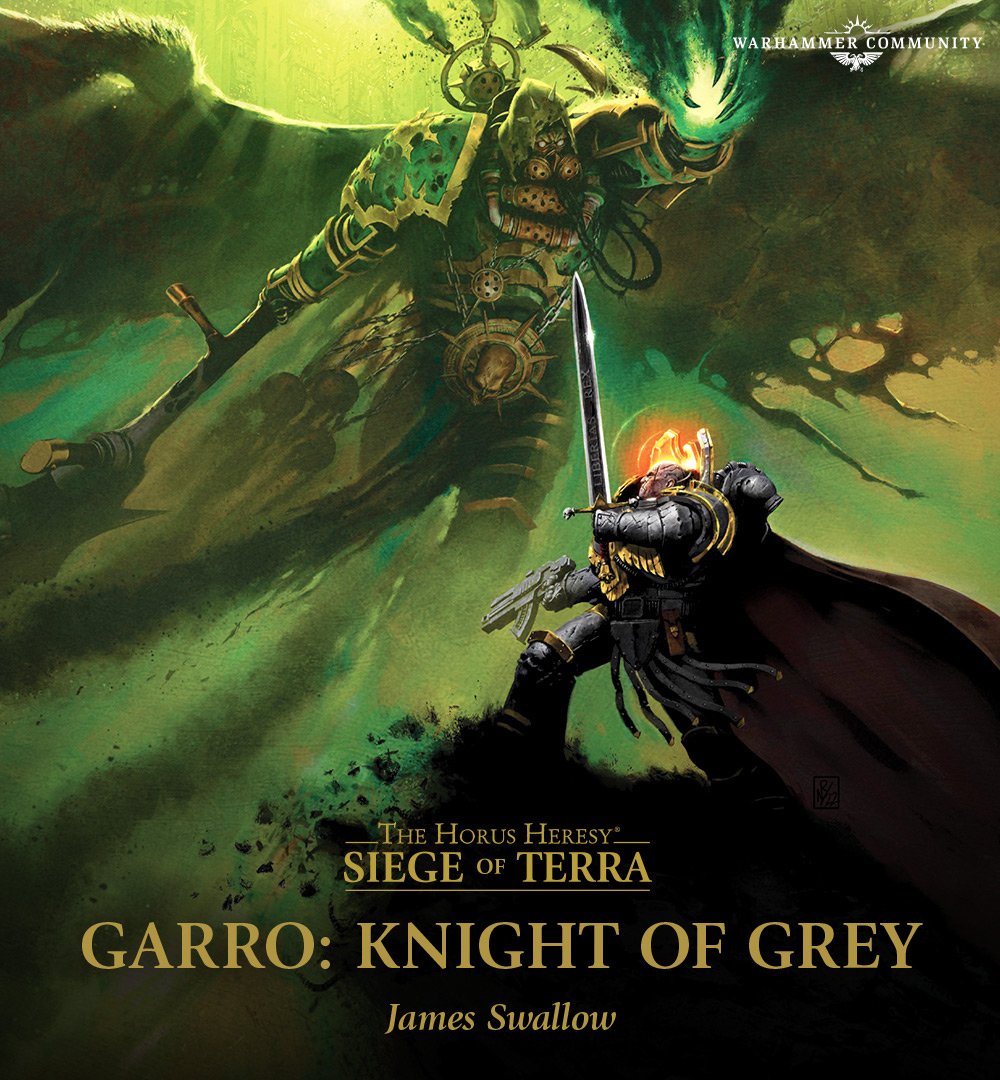
Garro: Knight of Grey cover artwork, reproduced in Warhammer Community’s original announcement. Image: Games Workshop.
James Swallow takes those obligations into Garro: Knight of Grey. The original announcement and its published blurb place him in the besieged Imperial Palace, trying to protect Euphrati Keeler, the emerging Imperial saint. Mortarion arrives as his enemy. The blurb identifies Keeler as the first saint of the Imperial Church and places her protection at the centre of his final confrontation with Mortarion.
Even the cover makes me wince a bit. Mortarion fills the upper part of the image, wings spread, with Garro standing below him holding his sword in both hands. I’ve spent enough time looking at my Thousand Sons across from Kiran’s Death Guard to have a healthy dislike of that scythe. The illustration gives Garro very little space beneath it.
If you’re following the new Saga editions, The Flight of the Eisenstein is where to start with him. For his later service, Swallow’s Garro collects the Knight-Errant material, and Knight of Grey takes him into the Siege. I’d keep the latter until you’ve spent some time with the earlier missions; its blurb is already fairly generous about who he meets in the Palace.