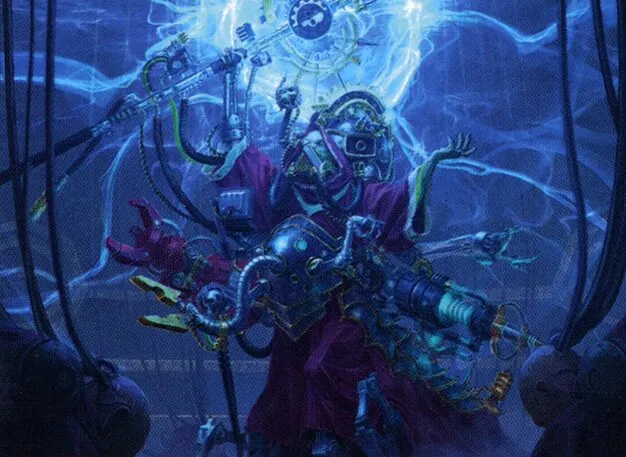
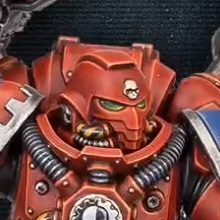
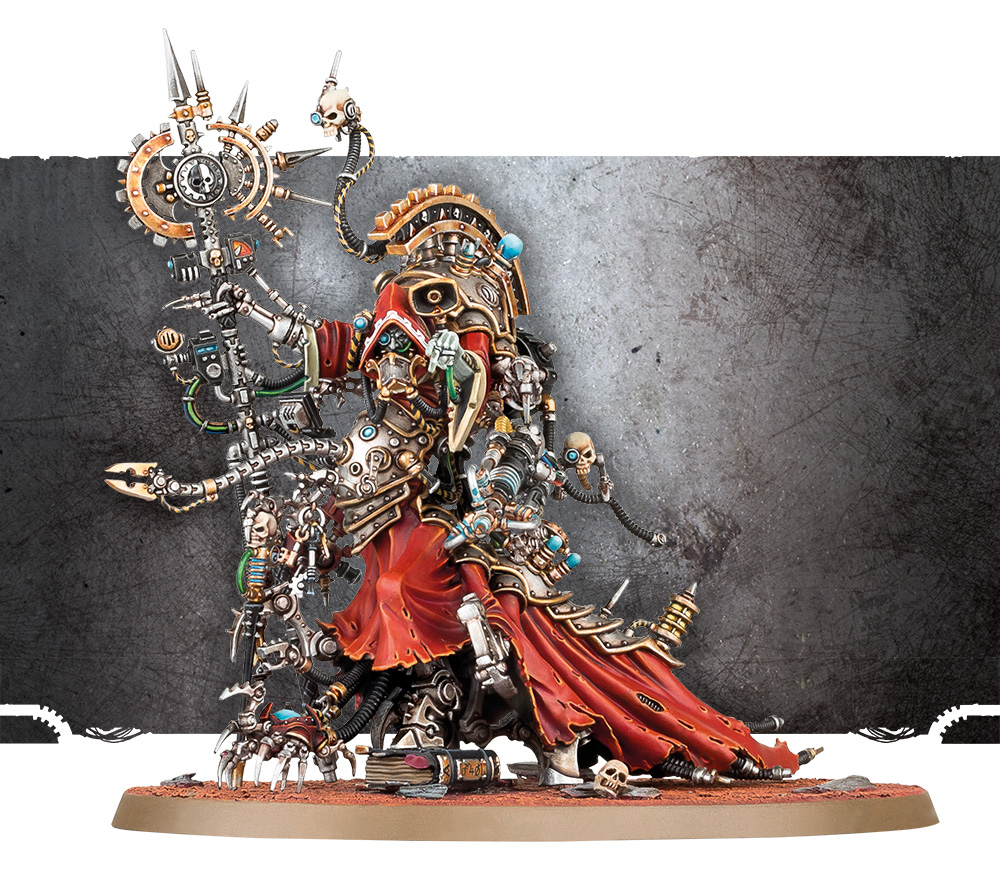
Belisarius Cawl has a repair servo-skull wired into his tertiary consciousness. That’s in White Dwarf #414’s original model feature, Belisarius Cawl – Tech-Priest of Mars. His solar atomiser runs through a separate warmode consciousness. I spent an embarrassing amount of time looking at that miniature before noticing the magazine had assigned different bits of his equipment to different parts of his mind.
The feature came out in January 2017, when Cawl arrived with Gathering Storm. Sculptor Steve describes a body assembled over millennia, with mismatched limbs reflecting changing preferences. The annotations go further into the machinery. Even the little skull doing repairs has a particular mental department to report to, and the gun’s department has its own name.
I’m interested in how he keeps enough of a person together to carry on making decisions. His work on the Primaris Space Marines required him to manage an immense project across changes to his own mind. Guilliman has entrusted him with work that will outlast most of the people supervising it, while Cawl keeps borrowing other people’s minds and setting aside his own memories.
GW’s own profile of notable Tech-Priests says he has upgraded himself with dozens of personality engrams. The published background gives us plenty of reasons to take that description seriously. Counting how many complete people are still in there requires a definition of person that I don’t think the setting has agreed on.
Belisarius Cawl inherited a very ambitious passenger
Ezekiel Sedayne helped make the original Space Marines. By the time his story intersects with Cawl’s, he’s an elderly geneticist facing the end of what rejuvenation can do for him. Cawl possesses the soul-merging knowledge Sedayne wants, learned through his connection to the Heresy-era magos Hester Aspertia Sigma-Sigma. Sedayne intends to use that knowledge to continue living inside Cawl.
The coercion is particularly unpleasant. In the events of Guy Haley’s Belisarius Cawl: The Great Work, summarised in the Warhammer 40,000 Wiki’s account of his history, Sedayne has Cawl’s friend Friedisch shot. Restoring Friedisch becomes the condition attached to Cawl’s cooperation. There’s a dying scientist arranging a transfer, an injured friend, and a younger man whose agreement has been obtained at gunpoint.
Sedayne expects his personality to dominate their combined mind. Cawl’s survives as the dominant presence instead. Sedayne’s knowledge and memories become part of the resulting being, including expertise with the Emperor’s genetic work. Cawl carries on with information acquired by someone who had been there for the development of the first Astartes.
That last part makes the familiar ten-thousand-year project feel more crowded. When Cawl draws on knowledge from the Emperor’s laboratories, some of the relevant experience belongs to Sedayne. The memories arrive with a history of their own, including the circumstances in which Cawl obtained them. Some recollections of the laboratory come to him through Sedayne.
The book’s encounter with the Emperor makes that uncertainty explicit. Cawl experiences a meeting through Sedayne’s memory, and the Emperor addresses him as Belisarius Cawl. The scene folds the later merger into an earlier conversation. Readers argue about how literally to take the Emperor’s foresight here; I read it as an encounter that Cawl himself has to live with, with all the awkwardness of receiving instructions inside another man’s recollection.
I wouldn’t use it to give him a general permission slip for every experiment since. The conversation concerns his future service and the possibility that he’ll believe he has betrayed the Emperor. Applying that to a particular invention needs another argument, and Cawl has a considerable personal interest in finding reassurance when he goes looking through those memories.
A part of me likes Sedayne’s fate. He tries to steal a life, and the intended victim ends up using his knowledge. There’s a satisfying bit of nastiness in that. Then I think about trying to establish where Sedayne ends inside the merged being, and I lose some enthusiasm for treating the result as straightforward justice. The procedure leaves Cawl walking around with the old man’s memories available to him. I don’t know what degree of disappearance that represents for Sedayne.
The word “soul” makes this harder. Soul-merging is the technology’s name, and 40K has souls that can be observed, stolen, and consumed. Translating the procedure into a clean modern account of downloaded files would settle questions the fiction leaves uncomfortable. The merger transmits identity and experience; I can’t put a precise boundary around Sedayne from that description.
There’s only so much room in the archive
The background also describes Cawl shedding information as he accumulates more. The Wiki’s compilation records his periodic memory dumps and two occasions when his memories were stolen through mind-wiping. His recollection has gaps left by both processes.
He has storage outside the experience he’s actively carrying. His accumulated knowledge fills enormous archives, while parts of his past have become difficult to place or retrieve. According to that background, Cawl has even lost track of how portions of his knowledge were originally obtained. He can have access to an answer without having a dependable account of the journey that produced it.
The Adeptus Mechanicus already asks its priests to trust inherited knowledge whose provenance is often dreadful. Cawl brings the problem inside one individual. Say he retrieves a procedure from storage, recognises it as his work, and finds the expected results. How much of the old reasoning comes back with it? The story gives us room to ask that without requiring a secret malevolent personality to be responsible for every missing entry.
I sympathise with the impulse to clear some space. In 2019 I bought a second Cadian Command Squad because I was certain I’d used all the spare special weapons from the first one. I put the new box in the cupboard with my lovely useless officers, still mostly grey, and found the first squad’s untouched sprue directly underneath it. I’d carefully put it away in a bag labelled “Cadian spares”. Pete was there when I opened the cupboard. He made me read the label aloud.
I still have both sets of officers. Selling one would involve admitting I don’t need two different attempts at the same regimental standard, and I prefer the option of eventually painting both. The newer box still has the receipt inside it.
Cawl’s scale is grotesque, obviously. Ten thousand years is roughly a thousand times as long as I’ve been a father, which exhausts my ability to picture continuous personal experience. He has lived through changes of body, specialised mental alterations, stored recollections being loaded again, and long periods of recuperation. The picture I get is of somebody repeatedly negotiating access to his own past as he needs it.
I’d initially wanted to treat the stored memories as a fairly practical solution. Offload the material, fetch it when needed, get on with the work. Actually, I think I’d want to keep everything, even if that made me slower. An old decision’s context is often the part I need when I discover I’ve made the same mistake again. That’s a preference I can afford over a human lifetime; I have no idea how it would survive several millennia of additional material.
Cawl’s confidence makes it easy to forget this. He arrives, explains what everyone else has misunderstood, and proceeds with the next experiment. An observer can enjoy that performance while wondering how thoroughly today’s Cawl has inspected the decisions made by a version of himself whose memories are currently in storage.
The Cawl Inferior gets to answer
The Cawl Inferior extends the arrangement beyond his body. In Dark Imperium, Guilliman deals with a construct installed aboard Macragge’s Honour which can converse in Cawl’s manner. Its explanation relies on responses prepared in advance, probable situations calculated by its maker, and updates transmitted by astropath. Organic brains form part of the mechanism. The account of its workings is bound up with its insistence that the arrangement complies with Imperial restrictions on machine intelligence.
Guilliman is suspicious. Quite reasonably. The machine is capable of presenting an account of itself that protects its continued existence, and the person who designed it is away doing other things. The primarch has to decide how much authority to give an answer supplied in Cawl’s voice through equipment whose operating principles he’s unable to independently verify in that conversation.
So, Cawl. Which Cawl are we asking? The one scuttling about on the ship, fine. He can answer. He’s busy? All right, we’ve got the other thing down there. Yes, the room full of heads. Apparently it knows what he’d say. I’d want him there to explain which bits of the last conversation he’d been updated about.
The Men of Iron give the Imperium a terrible historical reason to fear autonomous machines. Cawl’s use of organic components sits within a culture that permits an immense amount of computation when suitable human tissue and sanctioned terminology are involved. From Guilliman’s position, determining what this particular device can do takes more than listening to its own description. The construct’s explanation specifically points to its use of organic servitor brains.
I find the mundane problem of representation almost as troubling. Suppose the device is operating exactly as Cawl describes. It still has to answer a question using an earlier model of his likely response. Guilliman’s question may concern something Cawl has reconsidered, or something that depends on information his physical self has just recovered. Astropathic updates can adjust the system. There’s still a period in which the reply has to come from the material already provided.
With a Tech-Priest whose own active memories change, a proxy’s fidelity is a complicated promise. Which state of the original is it meant to preserve? The creator can keep altering himself while the delegate continues carrying out its instructions. Guilliman receives the reply while Cawl is elsewhere, potentially working from a different set of retrieved memories.
The name also bothers me a little. Inferior according to whom? That’s my reaction to Cawl’s choice of name. He made it, supplied its repertoire, and gave it a place in Guilliman’s working life. I’d be interested in how often the primarch has wanted to end a conversation and wait until the Archmagos could attend in person.
Dark Imperium gives its operator a name, Guidus Losenti. The account describes Losenti’s discomfort around the apparatus. He’s the master astropath who receives the codes used to activate the device.