The Imperium has eleven Space Marine Chapters it can’t account for. They vanished in the same campaign, in the late 34th millennium, and the Imperium censored its own records before anyone could write down what killed them. There’s a stelae in the Imperial Palace praising the only Chapter to come back, the Novamarines, for “by their mortal sacrifice and unmatched valour” unmaking “that which cannot die.” The inscription doesn’t name what they unmade. Whatever it was, eleven other Chapters didn’t survive meeting it, and the survivors had it deliberately scrubbed out of their own Chapter chronicles.
The campaign was called the Pale Wasting. It came out of a region of space northeast of Segmentum Ultima called the Ghoul Stars.
This is the lore most blogs miss. Even the wikis have it as a footnote inside the Death Spectres’ Chapter article, like the campaign that birthed an entire Chapter is incidental to the Chapter itself. The Ghoul Stars are 40K’s most quietly horrifying corner of space, and the Imperium has spent the last six millennia pretending not to notice.
What’s actually out there in the Ghoul Stars
The Ghoul Stars sit at the extreme northeast of the galaxy, just past the Eastern Fringe, in a sliver of Wilderness Space that lies almost entirely beyond the light of the Astronomican. Imperial Navigators struggle to sense the beacon at all when they enter the region, and most of them refuse to make the trip. The few records the Imperium has describe a place where dying suns light dead worlds, and where most of the things still moving on those worlds shouldn’t, by any reasonable definition, be alive at all. Records list a handful of human worlds in the region during the early Imperium. The rest are Dead Worlds now.
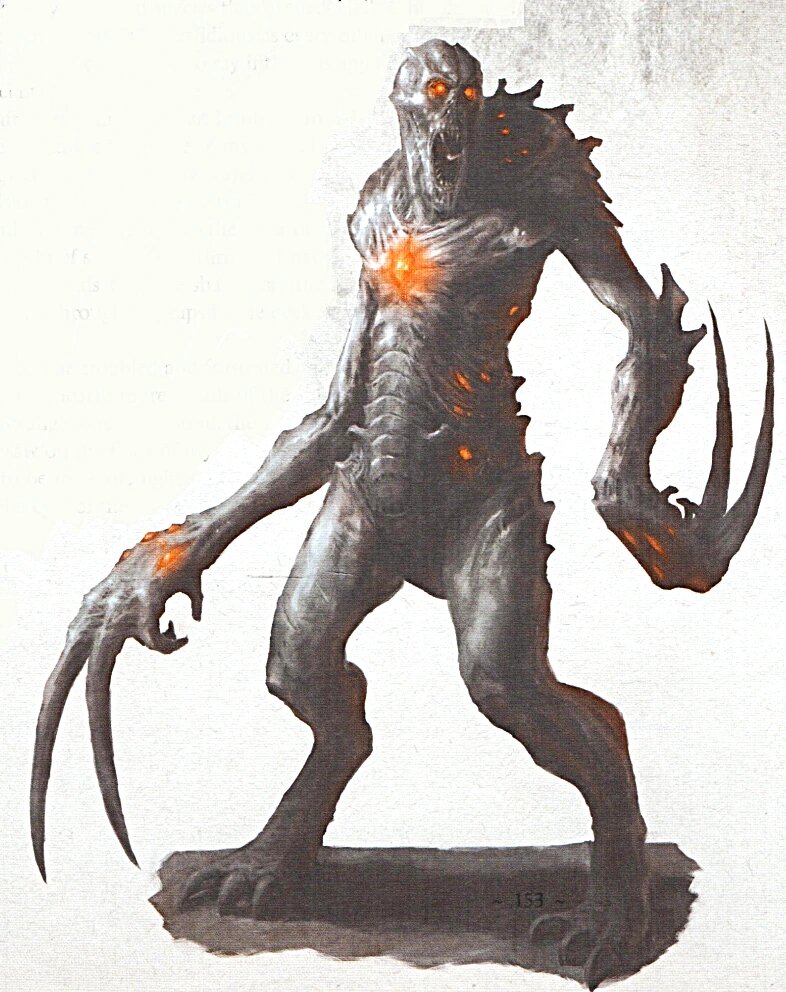
The Cythor Fiends are the most documented residents: a humanoid xenos species with glassy reflective skin and crystal-based technology nobody has reverse-engineered. Past them, in the lore margins, you get the Togoran Bloodreeks (one sentence of lore, then nothing, ever) and various unnamed bat-like horrors the Lexicanum just calls “creatures so alien as to be seemingly born out of the legendary nightmares of Mankind.” Whatever the “Star-spawned plague” or “nightmare engines” of the Pale Wasting actually were is anyone’s guess; the censors left those phrases in the records by accident, and they’re contradictory enough that nobody really knows what they were meant to describe. And then there’s the Bone Kingdom of Drazak, which is where the lore goes from “obscure” to “what the hell were the writers smoking.”
The Bone Kingdom
Drazak is a Necron Tomb World where the entire population is Flayed Ones. Broken Necrons walking around in pelts of human skin, who have lost almost everything that made them sentient. They fight each other over scraps of meat. They can’t carry on a conversation. Other Necrons consider the Flayed Ones a disease state, and the Drazak population is essentially the entire Necron diaspora’s quarantine zone.
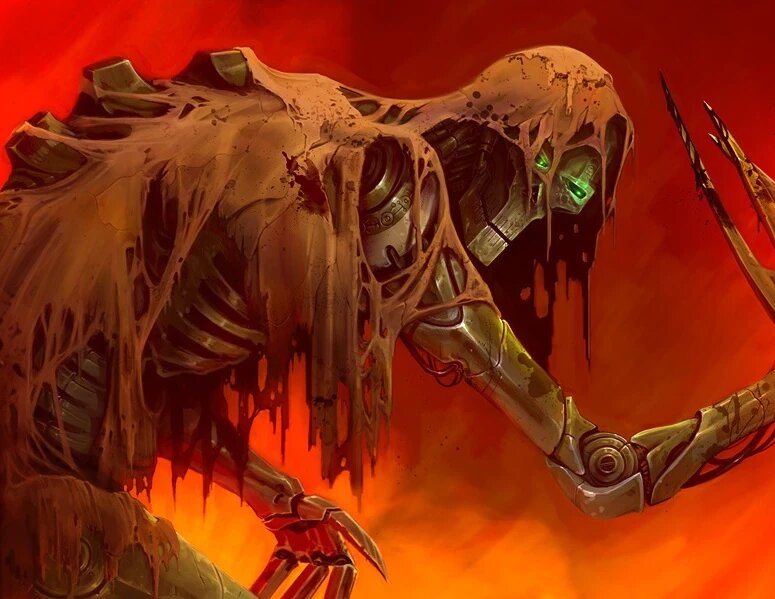
One Necron on Drazak isn’t a Flayed One. His name is Valgûl, the Fallen Lord. He sits on a throne built of splintered bone and tanned skin, and he rules the place. He has one good eye. As far as the lore can tell, he’s somehow immune to the Flayer Curse, and he stays on Drazak anyway. Nobody knows why.
The thing that makes Drazak unforgettable is how he keeps order. Every few months, when the Flayed Ones have run out of things to scrap over, Valgûl declares a “Time of Bounty.” The Necron fleets of Drazak go out to nearby worlds to raid. They’re after gore. They bring back tithes of meat and congealing blood for the Flayed Ones to fight over until the next raid. It’s the Necron equivalent of feeding a kennel. The 5th edition Necron Codex describes the raids as reaving for “tithes of gore and congealing blood,” and the lore hasn’t been updated since.
That is one planet, in a region the Imperium can’t even chart properly without losing Navigators.
I went down a Lexicanum hole on this last summer because Kiran asked me, in passing, what I knew about the weird humanoid xeno that shows up in one of the Blackstone Fortress expansions. He’d been getting back into Cursed City and was curious. I started on the Cythor Fiends page, hopped to the Bone Kingdom, hopped to the Pale Wasting, hopped to the Death Spectres, and three hours later I was on a sub-page about a Cemetery World called Occludus and a glass throne that turns its occupant into a statue, and there was a kitchen full of cold tea I’d forgotten about. Never did answer his question. The Ghoul Stars do this to you. There’s no central article, no one source. It’s a constellation of footnotes and short-story crumbs, and you trip from one to the next.
The Cythor Fiends and the gas giant nobody could break
The Cythor Fiends are not, technically, alive. The Death Spectres, who knew them best, have said as much in Codex commentary. Their bodies are humanoid only as a kind of “intended, grotesque mockery” of the Human form, with elongated faces and skin that reflects light like polished glass. Their gaze paralyses. And in the Era Indomitus, Rogue Trader Janus Draik watched one perform a piece of technology that should not exist. A small silver disc, when activated, caused the Fiend’s body to collapse into a shower of crystal shards. The shards then reformed into a different mobile crystal that travelled independently and shredded a pack of Ur-Ghuls, throats cut, in solar seconds.
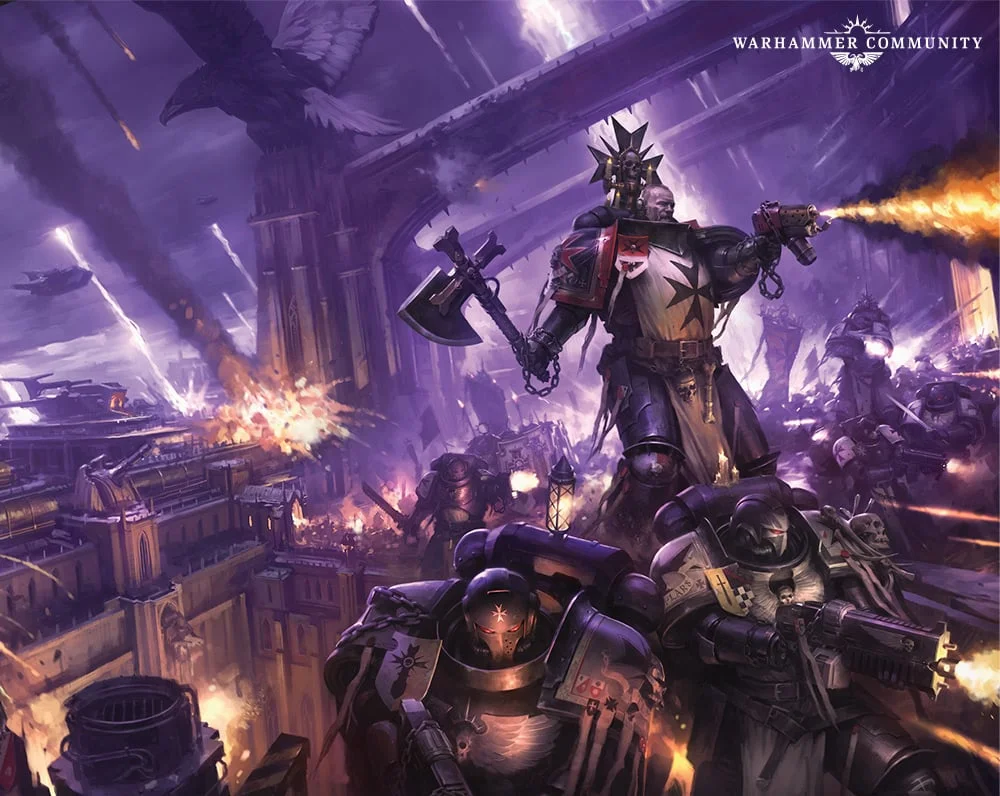
Their homeworld, before the Black Templars came, was a gas giant the Imperium designated 9836-18 Grave Core. Helbrecht said it looked like Neptune. The Cythors had built crystal fortress-cities on platforms suspended in its toxic, freezing atmosphere. When the Black Templars finally reached it, eight years into the Ghoul Stars Crusade, every Cythor was already gone. The fortress-cities were still standing and the platforms were still in the sky, completely undefended, and there was nobody home.
The Templars tried to Exterminatus the planet. They couldn’t. Grave Core was, for reasons that have never been explained, resistant to the Imperium’s most apocalyptic weapon. Helbrecht ordered his armada to ignite the atmosphere with sustained naval bombardment instead. That took an unnaturally long time, like the planet itself was deciding how much damage to allow. None of the Templar after-action reports mention this in plain language; you have to read between the lines of the campaign log.
Death Spectres Captain Naroosh, who was there, told Helbrecht the effort was wasted anyway. The Death Spectres had assaulted Grave Core themselves before the Crusade was even launched. They’d found it empty too. The Cythors always came back. Naroosh’s exact phrasing isn’t preserved, but his Chapter had run the same operation twice already.
What Helbrecht walked away from
In 990.M41, freshly raised to High Marshal of the Black Templars, Helbrecht decided his first major Crusade as Chapter leader would be an attack on the Ghoul Stars — a region from which no Imperial expedition had ever returned. He spent eight years grinding outwards through the Cythor systems. The official record says the xenos population was “all but destroyed.” Then he reached Grave Core.
Found it empty. Tried Exterminatus. Failed. Tried fire. Took too long. And before any Inquisitor could properly investigate why an entire xenos species had vanished, or why a planet was apparently incapable of being damaged, the astropathic call from Armageddon arrived. Ghazghkull was at the gates. The Third War for Armageddon had started.
Helbrecht turned around. He coordinated three full Black Templars Crusades into the Third War and led them personally. Whatever was happening at Grave Core got logged, filed, and ignored. The Inquisition didn’t send a follow-up team to investigate how a planet had beaten Exterminatus, no second Crusade was launched, and the file just sat there.
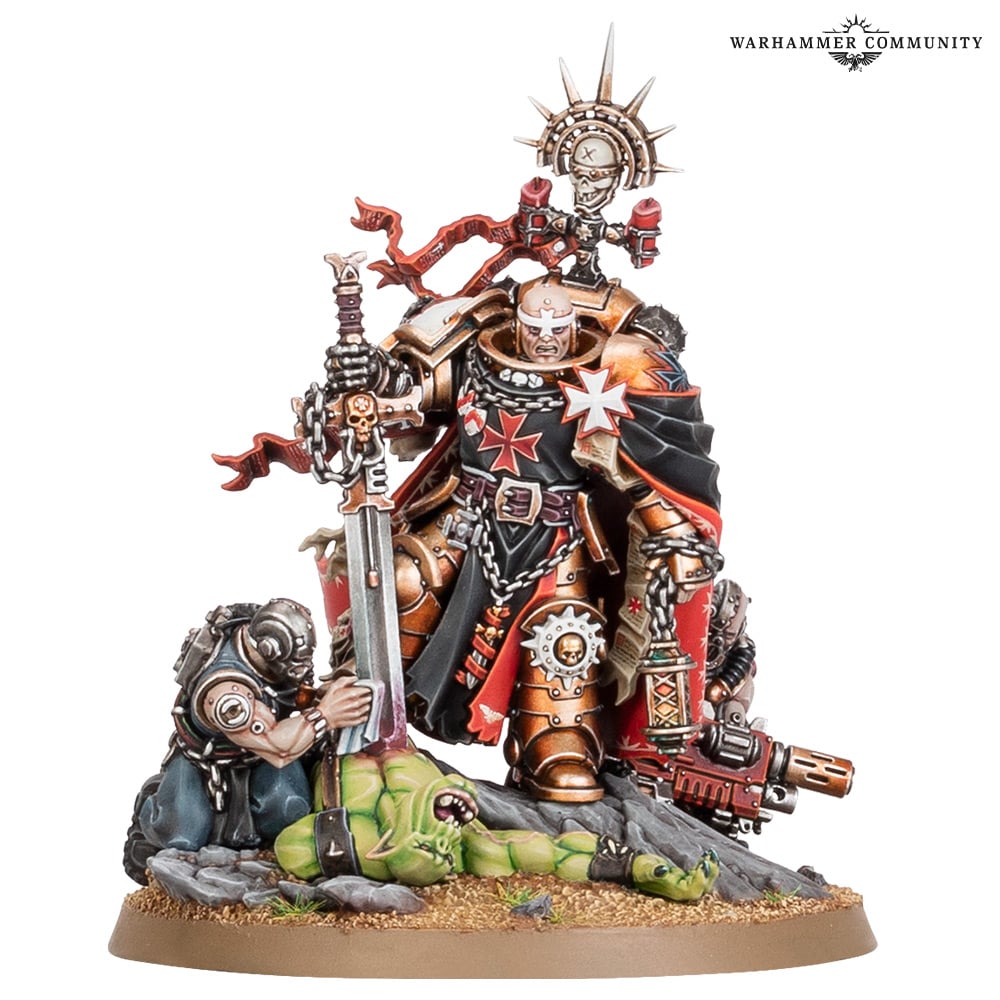
That’s twenty-eight years ago in lore-time, which is roughly twice as long as I’ve been collecting Tyranids, and as far as anyone can tell from anything published since, the Imperium has never gone back. Nobody has explained where the Cythor Fiends went. They’ve shown up since — once on the Seventh Blackstone Fortress, once on a Daemon World on the edge of the Eye of Terror — but their homeworld is presumably still out there in the Ghoul Stars, the platforms presumably still intact, and Naroosh’s flat little remark about how they always come back is presumably still correct.
Imagine being the Inquisitor whose desk that file landed on. Actually, I don’t even know if it landed on a desk. There’s a real chance the entire Crusade got buried in Astra Militarum-tier paperwork, or rolled up into the broader Armageddon narrative, or just genuinely forgotten because the Imperium has more imminent problems than gas-giant xenos who keep teleporting away. The most likely explanation is plain bureaucratic neglect: the file got buried with all the other files, an entire xenos species’ homeworld lost in archive sprawl. There’s nothing in the published canon that contradicts that reading.
The Death Spectres’ job
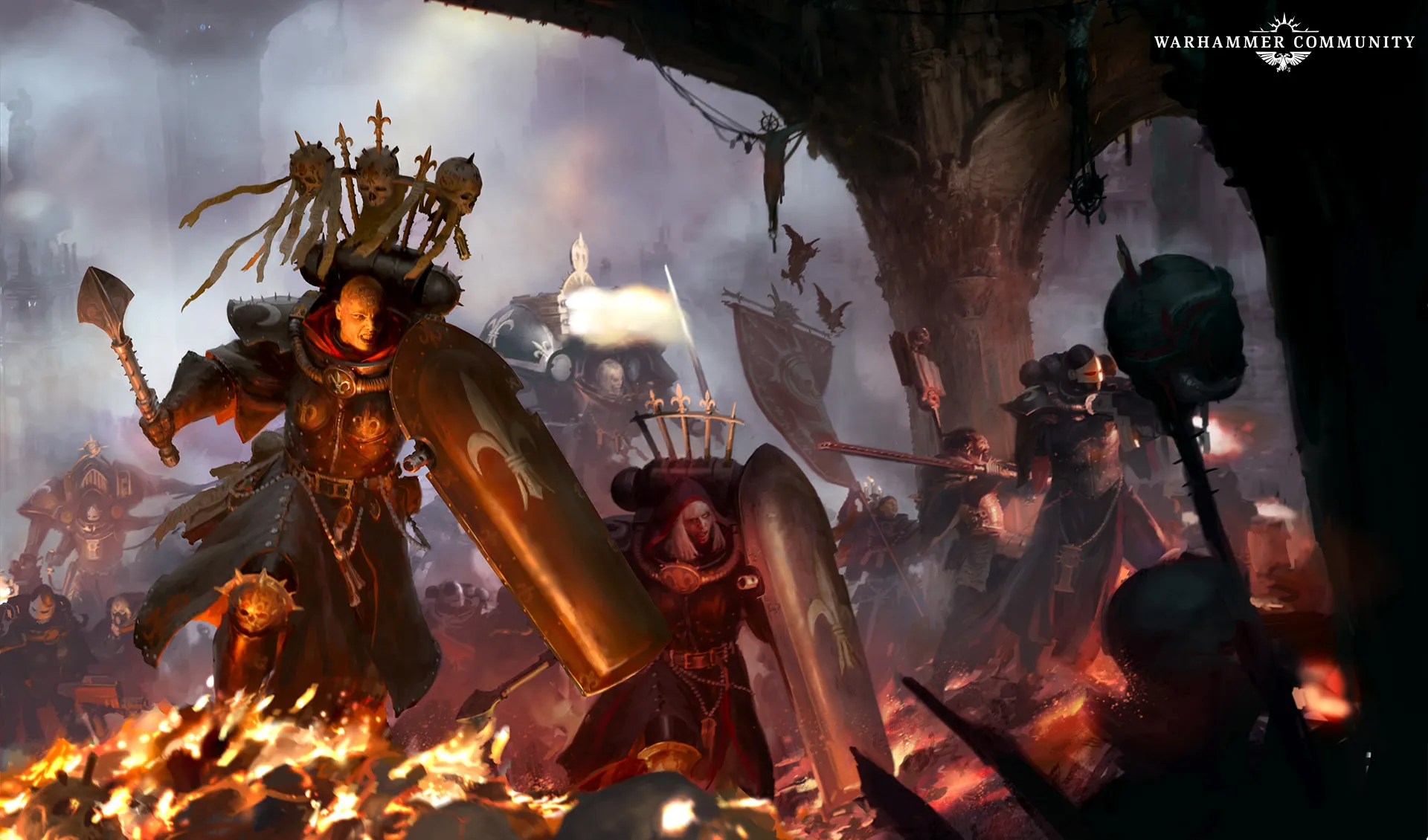
There is, technically, a Chapter still on the watch. The Death Spectres were created in the 13th Founding (the so-called “Dark Founding,” the only Founding the Adeptus Terra didn’t keep gene-seed records for) explicitly to contain the Ghoul Stars after the Pale Wasting. They are albinos with red eyes. They wear black, white, and bone. They recruit, in a piece of fluff that has aged complicatedly, from a controlled breeding world established near their fortress-monastery. The fortress-monastery itself sits on a Cemetery World called Occludus. And underneath it sits the Shariax, a glass throne that grants their Chapter Master vaguely-defined psychic power in exchange for slowly turning him to stone.
That is the Imperium’s actual permanent solution to the Ghoul Stars. A successor Chapter to the Raven Guard, a Chapter the High Lords of Terra don’t keep records on, run by a Megir who is petrifying alive in a basement underneath the Chapter’s home, watching the frontier where eleven other Chapters got unmade. The Megir’s title rotates to the strongest psyker available, and the previous Megir literally turns to stone in his throne while still nominally alive.
I love these guys, by the way. Like, properly. My favourite awful albino watchmen. There’s no good reason. They have no recent model release. They don’t show up in main 40K media. The only book in my house that mentions them by name is a second-hand Imperial Armour Volume Nine I picked up at a games shop in Bradford a few years back, fiver, the cover was creased. Kiran reckons I just like the colour scheme. The colour scheme is sick, in fairness. What I love about them is the lore commits to the implication. The Chapter is on the door of the Ghoul Stars and accepts the door is permanent. The Megirs petrify in their basement. The Astartes recruit albino sons from a quiet little controlled colony. Six millennia of this, and counting. The 9th edition codex doesn’t update them. The 10th edition codex doesn’t update them. They’re a fixed feature of the lore that nobody at GW has ever had the heart to cut, and probably never will.
Why the Ghoul Stars matter again now
The reason I’m thinking about the Ghoul Stars at all this week is that the current 11th Edition launch is centred on Armageddon, with Yarrick’s return, Ghazghkull’s grand plan, the Astra Militarum motor pool, the new Detachments. And when you go back and read the Ghoul Stars Crusade, the war that arguably defines this edition’s narrative is the same war that pulled Helbrecht out of his investigation of the Cythor Fiends. The Third War saved Armageddon, and it also interrupted the only serious Imperial attempt to figure out what was living at the edge of the galaxy. That interruption is still in effect. There has not, as far as I can find, been a single Black Library short story or codex sidebar that revisits Grave Core since the 4th Edition Black Templars codex.
Goes nicely with the Iron Warriors at Agripinaa or the Surface of Armageddon piece this site ran a couple of weeks ago, in the sense that the Third War’s pull is gravitational. Everything in the Imperium gets dragged into it, including investigations that are eight years deep into hostile space.
I haven’t seen GW touch the Ghoul Stars in any new release since the 5th Edition Necron Codex. There’s nothing on Drazak in the 9th Edition Necron book. Janus Draik gets one Cythor sighting on a Blackstone Fortress and the Liber Xenologis gives the species two pages, and that’s about the last decade of canon. Whether 11th Edition’s renewed Armageddon focus eventually cycles back to the unfinished Crusade is anyone’s guess. Probably not. The Cythors will stay where they are, doing whatever they do, while the galaxy gets on with its more immediate apocalypses.
There’s a thought experiment my old gaming group used to run, which was “what would the Imperium look like if it actually had to deal with everything it knows about.” The Ghoul Stars are the cleanest answer to that. Nothing about the situation gets resolved. The Bone Kingdom doesn’t get razed. Drazak doesn’t get razed. The Cythors don’t get explained. The Death Spectres die slowly on their throne and nobody publishes anything new about them. Six new Detachments come out for Armageddon. Two new Astra Militarum vehicles. Nothing for the Ghoul Stars.
So we don’t finish. The Imperium has bigger fires. Helbrecht is busy on Armageddon. Whatever’s at Grave Core is presumably still doing whatever it does, and nobody’s going to find out for a while yet.