The feet bother me most on Obliterators. There’s exposed flesh bulging over the armour, toes disappearing into metal, cables going into places I’d prefer cables stayed out of. I keep looking at the places where a boot ought to come off. Spending the rest of your existence with your footwear becoming part of you seems especially unpleasant when you look down at the miniature from above.
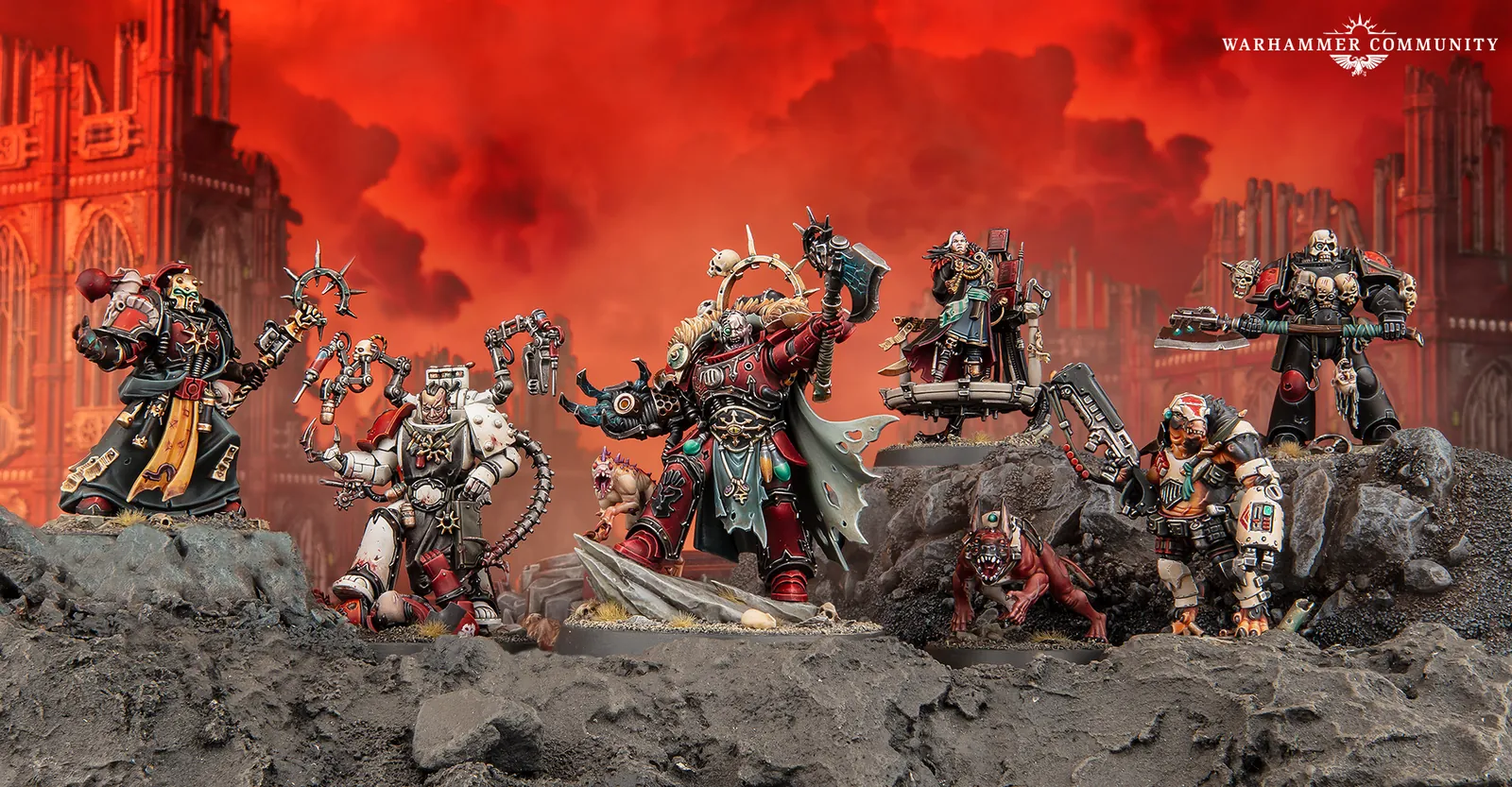
GW’s 19 October Battleforce announcement puts two Obliterators and three Mutilators in the Chaos Space Marines Cult of Destruction box, alongside a Warpsmith, Defiler, Venomcrawler, and five Havocs. That’s a useful excuse to look at the creatures themselves. We’ve covered the Defiler and its imprisoned daemon already; the infantry standing beside it have a different set of problems involving their own bodies.
I like the pairing because it gives Chaos an especially unpleasant command arrangement: warriors consumed by a private obsession still have to be persuaded to fight somebody else’s campaign. Vigilus Ablaze supplies a fairly detailed example of how that arrangement works, including what happened when one of the creatures challenged Abaddon. There’s also the question of who noticed the infection developing in the first place, when the symptoms could easily pass for diligence in the armoury.
Mutilators start by looking after their weapons
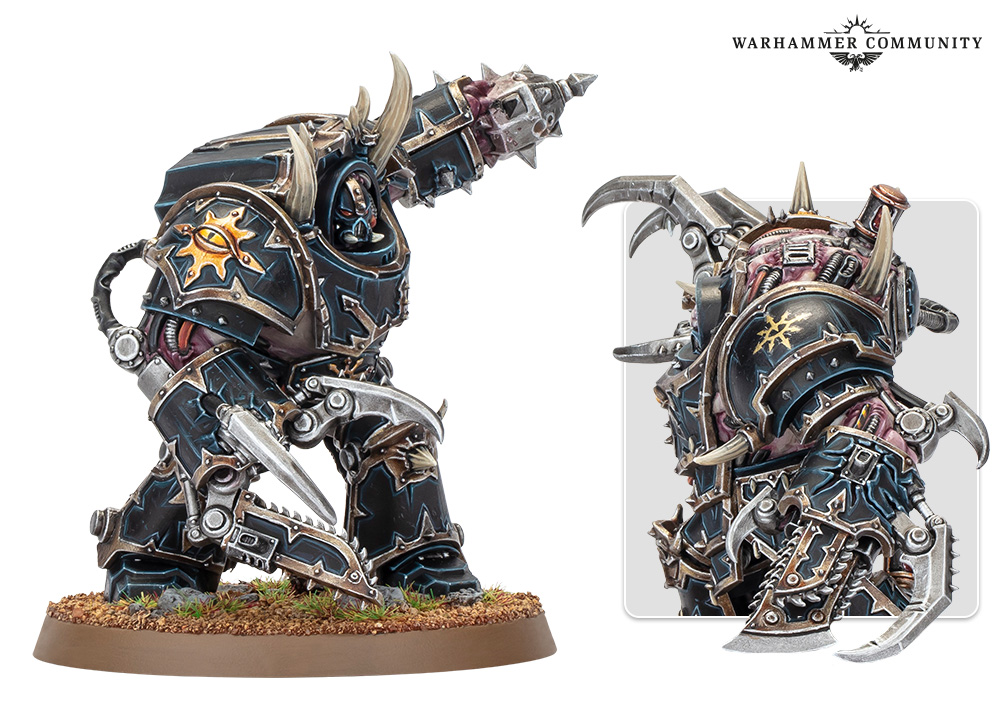
WarCom’s background for the Mutilator refresh describes the initial symptoms as compulsive weapon cleaning and sharpening, or an unwillingness to be separated from a favourite blade. A warrior already obsessed with butchery falls victim to a technovirus gestating in the Warp. His body enlarges, his mind deteriorates, and flesh and armour begin growing together. The same article describes the eventual absorption of daemon weapons, whose killing forms can then emerge from the Mutilator’s body.
Imagine being the person responsible for noticing that progression. Your squadmate spends longer than usual sharpening his sword. He gets aggressive when anyone asks to borrow it. Fine. You’re in a warband where people nail trophies to their own shoulders and occasionally hear instructions from the walls. How many evenings of sharpening does it take before somebody has a quiet word with the Warpsmith? By the time his gauntlet starts joining to the hilt, he’s probably been assigned to several boarding actions.
That gradual progression leaves time for a soldier to accommodate each change. He wants his weapon close, and now it’s closer. His hand starts changing around it, which presumably makes his grip excellent. I’m imagining the rationalisations here; WarCom gives the symptoms without following an individual sufferer through them. A short story told across that interval would have plenty to work with, even if most of it happened between deployments in an armoury.
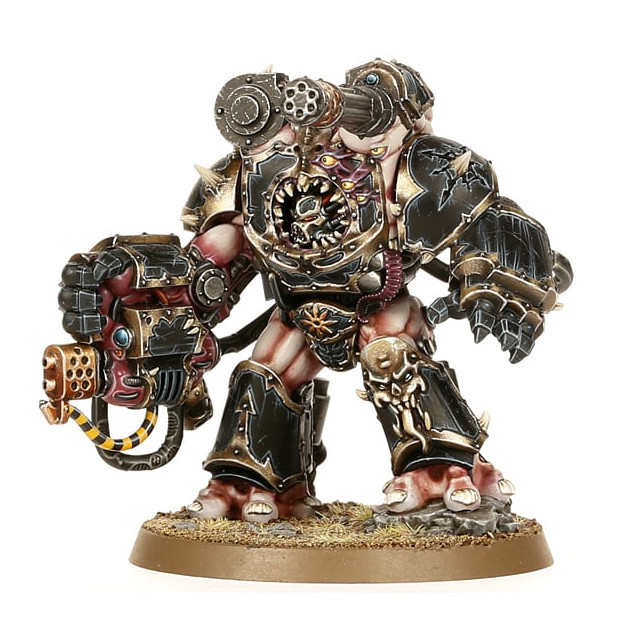
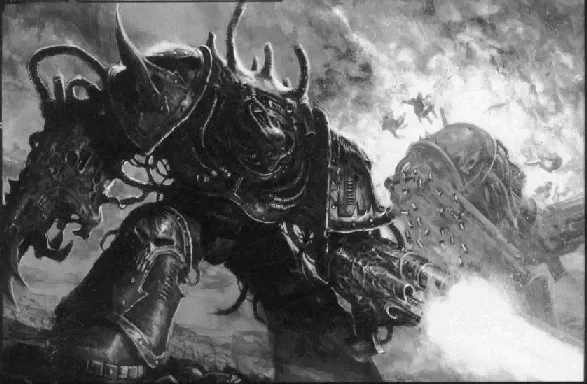
Obliterators bring that process to ranged weapons. The 2023 Chaos Space Marines faction focus describes their fleshmetal guns sprouting from their bodies, with different forms suited to different targets. Its rules belong to an older edition; I’m interested in the physical description. Look at the miniature’s arm and you can pick out recognisable barrels packed together inside a swollen limb, with skin pushed up against the metal housings.
The older codex background has accumulated several explanations for the contagion and its origins. The Obliterator reference entry, citing the fourth- and sixth-edition Chaos codexes, preserves the Dark Mechanicum connection and describes absorbed weapons being reproduced from the host. I wouldn’t use that to identify a single inventor or a laboratory where every strain began. The official Mutilator article already uses the plural, technoviruses, and leaves plenty of room for the Warp to produce related horrors by different routes.
I don’t know how much sensation the transformed warrior retains. The descriptions I’ve checked tell us about bodily growth and mental decline, which leaves a lot unanswered about the experience inside the armour. Does changing a weapon hurt? Can he feel the barrel getting hot? Can he still recognise a hand that used to be there? The sculpt gives you little patches of skin to paint, and then you start worrying about them while waiting for the wash to dry.
The Iron Warriors keep finding uses for them
The 2026 Mutilator feature explicitly calls deliberate infection of Iron Warriors recruits a rumour. That qualification deserves to survive the trip from announcement to article. GW places Obliterators and Mutilators frequently in the Legion’s ranks, then floats a particularly ugly explanation for their availability. It gives us a suspicion about recruitment practices, with enough uncertainty for a warband’s own veterans to argue about what’s being done down in the holds.
The same feature says Warsmiths such as Kravek Morne use Mutilators as assault troops and spend their lives freely in grinding melees. This fits the Legion’s appetite for organising grotesque resources into usable formations. The Iron Warriors’ military structure gives a commander somewhere to put creatures whose relationship with their weapons has become an advanced medical emergency. You can almost picture the requisition officer updating the unit strength after another recruit becomes too large for his assigned berth.
I was about to call that entirely cynical, and then I remembered how willingly I’d put these horrible lads into a collection. There’s a real attraction to becoming stronger and harder to kill, especially if you’ve spent centuries fighting people who want you dead. A warrior might actively welcome the changes. I still think the recruiting officer gets the better end of the arrangement, although we don’t have that recruit’s account of it. I’d want to hear what he thought while he was still able to describe the changes clearly.
In 2019 I bought the Chaos half of Shadowspear from a mate at my local store because I wanted the Obliterators. I’d decided a small Black Legion project would be a sensible break from painting Thousand Sons trim. Sensible. I put the bag behind the Thousand Sons boxes and found it again while looking for spare bases months later, with the seller’s masking-tape price label still stuck to the plastic. Kiran asked whether storing a second army behind the first counted as starting it. The bag eventually went into a larger box with some unused Tzaangor arms.
The Warpsmith in the Battleforce makes me want to build a little entourage around him. Different stages of damage across the unit, perhaps, and one surviving bit of ordinary equipment carried along long after it’s useful. I keep thinking of a holstered pistol on a creature that can grow guns. You could justify keeping it as a memento, or simply because some remote bit of the warrior’s old drill still insists his equipment should be present. That’s a conversion idea; I haven’t found a source describing an Obliterator doing it.
Obliterators and Mutilators at Hyperia
Vigilus Ablaze, in “The Cults of Destruction,” names a group called the Belis Corona Warbeasts. They’re huge cyborg warriors, each driven by a particular kind of killing, and they’re famously difficult to manage. One Mutilator, the King of Swords, defied Abaddon. Drach’nyen cut him in half with a single blow. The account says the surviving Warbeasts subsequently recognised the Black Legion’s master as their leader.
I’d have liked another page about that confrontation. How does the challenge begin? Does the King of Swords speak clearly? Does he just raise a blade when an order arrives? The published passage moves quickly through his death because it’s setting up the Warbeasts’ deployment. Abaddon has established sufficient fear to direct the survivors towards the fortress networks of Hyperia, and we pick them up advancing across consecrated ground, their footsteps leaving steaming discoloured marks in the stone.
Their attack has a straightforward rhythm. Obliterators fire into the defences surrounding the Ring of Nothingness, breaking apart the fortified walls and bringing the garrisons down with them. The Sisters of Battle counterattack, and their Exorcist tanks manage to kill some of the attackers. When the Sisters close to bring their shorter-ranged weapons into play, the Mutilators charge out beside the Obliterators. The defenders repeatedly give ground under those assaults.
It’s a satisfying bit of combined arms for creatures that seem so thoroughly absorbed in their own appetites. The gun specialists draw the defenders into responding; the blade specialists punish them for closing. You can see why a commander would keep accepting the risk of having the Warbeasts aboard his ship. The breach opens, the defenders are displaced, and an army that might have stalled outside the fortifications can continue its advance through the damaged perimeter.
Also, yes, I’d be tempted. Big lads with guns. More big lads with knives. Put them together, point at the wall, hope they keep moving that way. Then somebody asks who’s meant to go and fetch them afterwards. Hang on. I was imagining being the commander on the other end of the vox, somewhere several decks away from the embarkation ramp.
The King of Swords incident leaves a complication for the next officer who tries to give them an order. The Warbeasts have learned to fear Abaddon personally. A warlord borrowing them for a lesser campaign has to make his own authority convincing, and I’d be cautious about assuming that Abaddon’s example automatically does the work for him. Vigilus Ablaze describes this particular cult’s submission; it doesn’t promise every Chaos officer an obedient unit of fleshmetal siege infantry.
The Sisters eventually deal with the Warbeasts by drawing the cult onto Phanatos Bridge. They place their explosives, collapse the causeway, and send a dozen of the creatures into the darkness below. After all those paragraphs of guns emerging from bodies and blades changing shape, I appreciate the attention somebody paid to the bridge supports. I’d enjoy a mission built around that withdrawal, with the demolition team still trying to get clear of the span when the Mutilators reached it.
Images: Games Workshop artwork and miniatures; Obliterator images via the Warhammer 40,000 reference wiki, Mutilator image from Warhammer Community.