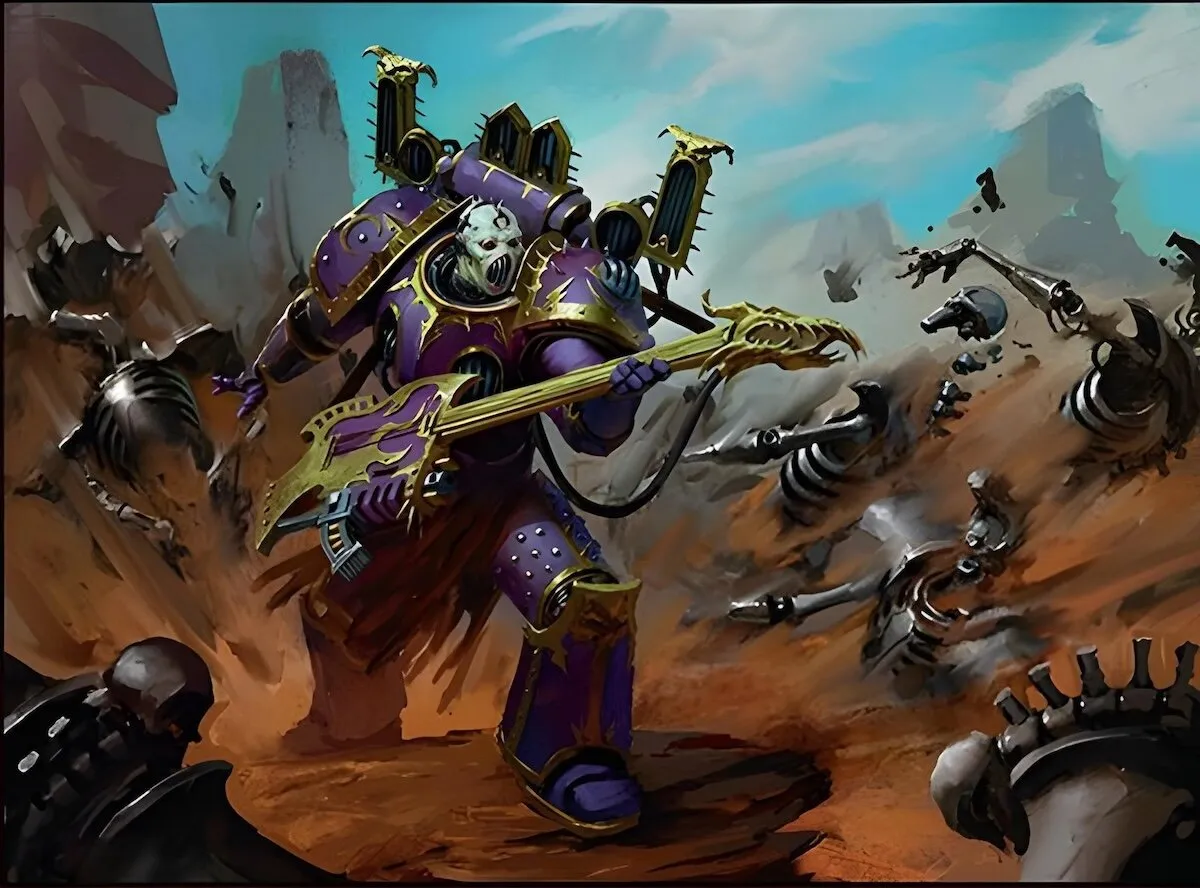
Noise Marines are weaponized musicians. Chaos Space Marines who serve Slaanesh by turning sound itself into a killing tool. Their sonic blasters can rupture organs and crumble walls. Their doom sirens project frequencies that liquefy brain tissue. They march into battle cranking amplified warp-noise so loud it causes physical damage to anyone nearby.
They’re also one of the most metal concepts in a setting that already includes chainsaw swords and flame-throwing tanks. I love them unreservedly.
There’s something deeply funny about a universe full of grimdark misery that also contains Space Marines who went evil because they liked music too much. But the deeper you get into the lore, the less funny it becomes, because the Noise Marines’ descent from the Emperor’s Children is genuinely one of the most disturbing fall-from-grace stories in 40K. These were the Emperor’s proudest sons. The legion that bore his own name on their armor. And now they’re shrieking maniacs who literally cannot feel anything unless it’s turned up past eleven.
How They Happened
Noise Marines emerged during the Horus Heresy, specifically during the Siege of Terra, when the Emperor’s Children abandoned the actual siege to terrorize Terra’s civilian population. By this point, Fulgrim’s Legion had fully embraced Slaanesh, and their pursuit of sensation had gone well past any reasonable limit.
The story before that point is worth understanding, because the Emperor’s Children didn’t fall overnight. Before the Heresy, they were the most aesthetically perfectionist of all the Legions. Their Primarch Fulgrim was obsessed with excellence in all things. Art, combat, diplomacy, they wanted to be the best at everything. And they were, for a while. But when Fulgrim picked up the Laer blade on Laeran, a daemon weapon posing as a trophy, the Legion’s pursuit of perfection became a pursuit of sensation. The distinction matters. Perfection has a ceiling. Sensation doesn’t.
By the time of the Heresy, the Emperor’s Children were already experimenting with stimulants and sensory modification. The Kakophoni, an early iteration of what would become the Noise Marines, were a specialist formation led by Marius Vairosean. They discovered that warp-touched sonic weapons could produce sounds that transcended normal hearing, sounds that triggered neurological responses in both the wielder and the victim. The pleasure of firing these weapons was as much a part of the experience as the killing. That’s the key thing about Slaanesh corruption. The weapon isn’t just a tool. It’s the point.
Normal sensory input wasn’t enough anymore. Combat, drugs, art, music, everything had been pushed so far that diminishing returns set in. So they started augmenting. Warp-tainted modifications to their hearing and vocal systems. Weapons that channeled sound into lethal frequencies. Armor that incorporated speakers and amplifiers as integral combat systems. Some had their nerve endings rewired so completely that silence became physically painful. Others had their eardrums replaced with warp-resonant membranes capable of perceiving sounds that would drive a normal human insane.
The result was Astartes whose entire combat doctrine revolves around sensation through sound. Their weapons don’t fire bullets. They fire concentrated sonic energy. A Noise Marine with a blastmaster can level a building with sustained acoustic bombardment. A squad of them playing their “instruments” in concert is a literal weapons system.
How the Weapons Actually Work
The sonic weaponry of Noise Marines isn’t just “loud guns.” The technology, if you can call warp-corrupted hardware technology, operates on principles that blend acoustics with psychic resonance. A sonic blaster generates a focused beam of sound at frequencies and amplitudes that tear apart matter at the molecular level. Flesh ruptures. Ceramite cracks. The air between the weapon and the target literally vibrates so violently that it becomes visible, a shimmering cone of distortion.
The blastmaster is the heavy weapon variant. It can operate in two modes: a sustained bass frequency that shakes structures apart over time, or a single concentrated blast that hits like a demolition charge. The sustained mode is what you use against fortifications. The single shot is what you use against that one guy you really don’t like.
Then there’s the doom siren, which is built directly into the Marine’s helmet and vocal system. It projects a cone of psychosonic energy from the Marine’s own modified throat. The sound it produces isn’t really a sound in the conventional sense. It’s a warp-frequency vibration that targets the nervous system directly. Victims don’t just hear it. They feel it in every nerve ending simultaneously. Most die from sensory overload before the physical damage even registers.
The thing that makes all of this worse is that Noise Marines can hear every detail of what their weapons do. Their augmented senses let them perceive the exact frequency at which a ribcage resonates before shattering. They can hear blood boiling inside a body. And they enjoy it. Every kill is a new note in a symphony they’re constantly composing.
The Culture of Excess
Noise Marines don’t just fight with sound. They live inside it. Between battles, they compose what they consider music, though calling it that is generous. It’s more like structured auditory torture. They hold performances in the Eye of Terror where the “audience” is usually prisoners of war strapped to resonance chairs that amplify the vibrations through their bones. Survivors of these concerts (there aren’t many) describe the experience as having every emotion forced through them simultaneously at maximum intensity.
The obsession goes deeper than entertainment. Noise Marines have developed entire philosophical frameworks around sound. They believe that the universe has a fundamental frequency, a vibration at the base of reality, and that Slaanesh is the only being capable of hearing it in full. Their mission, such as it is, is to recreate that frequency. Every battle is a rehearsal. Every scream of a dying enemy is a note they’re trying to perfect. It’s completely insane, and it’s also weirdly internally consistent, which makes it even more disturbing.
Different warbands have different approaches to this obsession. The Flawless Host, a successor warband to the Emperor’s Children, pursue sonic perfection through relentless repetition. They’ll attack the same target dozens of times trying to recreate a specific acoustic effect from a previous kill. The Harmonious, a smaller warband, are known for integrating captured psykers into their “compositions,” using the psychic screams as a kind of lead instrument over the baseline sonic weapons. And the Screamers of Tzeentch have occasionally come into conflict with Noise Marine warbands over what amounts to a territorial dispute about who gets to make the most annoying sounds in the warp. I’m not making that up.
The Aesthetic
GW leans hard into the rock-and-roll aesthetic, and it works. The models feature amplifier-studded armor, guitar-shaped sonic weapons, and faces twisted into permanent screams of ecstasy. The color schemes (typically bright pinks, purples, and blacks with gold trim) are deliberately garish. That garishness is the point. Subtlety is something the Emperor’s Children abandoned about ten thousand years ago.
The fan community has taken this and run with it. Noise Marine conversions using actual guitar parts, drum kits, and musical instruments are a whole subgenre of 40K hobby content. There’s a famous conversion of a Noise Marine wielding a keytar. It’s magnificent.
Painting Noise Marines
If you’re picking up Noise Marines for your collection, you’re in for a treat and a headache. The classic Emperor’s Children scheme is pink and black with gold trim, which sounds simple until you actually try to paint pink over a dark primer. My advice: start with a white or light grey undercoat and build up the pink in thin layers. Screamer Pink from GW as a base, then layer up through Pink Horror to Emperor’s Children pink (yes, they named a paint after the legion). Edge highlight with Fulgrim Pink or mix in some white.
The real fun is in the details. Those amplifiers and speaker grilles on the armor look incredible when you pick them out in metallic gold or brass, then wash them with a dark shade to give them depth. The skin, if your Noise Marines have exposed flesh, should look wrong. Pale with a slightly purple or bruised tint works well. These aren’t healthy individuals. They haven’t been healthy for millennia.
For the sonic weapons themselves, I like doing the barrels and emitters in a bright contrasting color, maybe a toxic green or electric blue, to suggest the energy they’re channeling. Some painters do object source lighting (OSL) effects from the weapon barrels, which looks spectacular when done well. It’s not easy, but nothing about painting a Slaanesh army is easy. You’re painting an army of flamboyant chaos rockstars. Commit to it.
The community conversion scene around Noise Marines is also worth mentioning, because it’s genuinely one of the most creative corners of the hobby. People build Noise Marines carrying actual guitar bodies as blastmasters, with greenstuff cables running from amplifier stacks on their backpacks. There’s a famous conversion of an entire Noise Marine band, complete with a drummer using skulls as a kit. The Slaanesh aesthetic gives you license to be as over-the-top as you want, and the community absolutely takes that license and runs with it.
The Emperor’s Children Codex and What It Means
With the Emperor’s Children getting their own dedicated codex, Noise Marines are finally stepping out of the generic Chaos Space Marines roster and into the spotlight they deserve. The codex leans hard into the sensory overload theme, giving the faction mechanics that reward aggressive, mid-range play and punish opponents for clustering their units together. Noise Marines in the new rules aren’t just a troop choice you slot into a list. They’re the backbone of an army designed around sonic saturation, where overlapping fields of sonic fire create zones that are genuinely dangerous to move through or hold objectives in.
What excites me most is how the codex handles the relationship between pleasure and pain mechanically. The Emperor’s Children rules reward you for taking casualties in ways that would cripple other armies, turning dead models into combat buffs for the survivors. It captures something essential about Slaanesh worship: loss isn’t a setback, it’s a stimulus. Your army gets more dangerous as it gets hurt, which forces your opponent into an uncomfortable calculation. Do they focus fire on a unit and risk powering up its neighbors, or do they spread damage thin and let everything keep shooting? There’s no clean answer, and that kind of decision pressure is exactly what the Emperor’s Children should feel like on the table. The new Lucius the Eternal model is also spectacular, capturing that damaged-beauty-turned-monster aesthetic that defines the Legion’s fall. I’ve already started stripping my old Noise Marines to repaint them for the new codex, which is the highest compliment I can pay any GW release.
On the Tabletop
On the tabletop, Noise Marines shoot twice (they can fire their sonic weapons even when they die, getting a final shot off as their death rattle). It’s a fun rule that captures the “they never stop” aspect of their lore. In a competitive setting, that extra shooting phase when models are removed can genuinely swing a game. Your opponent has to factor in that killing your units isn’t free because every dead Noise Marine gets a parting shot.
They’re best used as a midrange shooting unit that can hold objectives while putting out consistent damage. They’re not the toughest infantry in the Chaos codex, but they don’t need to be. Their job is to sit on a point and make the area around them deeply unpleasant for anything that gets close. Pair them with a Chaos Lord or Dark Apostle for reroll support and they become extremely efficient.
If you’re building an Emperor’s Children army, Noise Marines are the signature unit. If you’re building any Slaanesh-aligned force, they’re an auto-include for flavor alone. And if you’ve ever wanted to field an army whose primary weapon is weaponized dubstep, this is your moment. I’ve been running a squad of ten with two blastmasters in my casual games and the look on my opponent’s face when I explain the “shoots on death” rule for the first time never gets old.